Print-on-Demand Taxes for US Etsy Sellers (2026 Guide)
Print-on-demand taxes for US Etsy sellers: the $20,000 1099-K rule, Schedule C and self-employment tax, sales tax on provider bills, deductions and 2026 dates.
By the POD Made Easy team · September 24, 2026 · 13 min read

Print-on-demand taxes come down to one rule: your profit is taxable income, whether you sell $300 or $30,000 a year and whether or not Etsy sends you a tax form. As a US seller you report it on Schedule C, pay self-employment tax once your net earnings reach $400, and let Etsy handle the sales tax on your orders.
The POD-specific parts are where new sellers get caught out. The 1099-K threshold changed again in 2025, your provider may charge you sales tax on production costs, and your Etsy deposits don’t match your taxable profit. This guide walks through each one, with a worked example, the remaining 2026 dates and a monthly routine that keeps it manageable.
Key takeaways
- All POD profit is taxable income, with or without a Form 1099-K. Sole proprietors report it on Schedule C.
- Etsy issues a 1099-K when you pass $20,000 and 200 transactions in a year (a threshold restored by a 2025 law), or a lower threshold in some states.
- Self-employment tax is 15.3% of 92.35% of your net profit, and applies once net earnings reach $400.
- Etsy collects and remits sales tax on US orders, but Printify can still charge you sales tax on production costs unless you file a resale certificate.
- Expect to owe $1,000 or more? Pay quarterly estimates. The last 2026 payment is due January 15, 2027.
Do you have to pay taxes on Etsy sales?
Yes, on your profit. The IRS is explicit that if you receive payments for selling goods, you report all of the income, whatever the amount and whether or not you get a form. What changes with the size of your shop is how that income is treated and which forms you fill in. (If you haven’t opened your shop yet, our guide to starting print-on-demand on Etsy covers the setup.)
The first question is whether your shop is a business or a hobby. The IRS looks at factors such as whether you run the activity in a businesslike way, keep accurate books, put in time and effort to make it profitable, and change your methods to improve profitability. A POD shop you’re actively trying to grow, with a pricing plan and records, usually looks like a business.
| Business | Hobby | |
|---|---|---|
| Where the income goes | Schedule C (profit or loss from business) | Schedule 1, as other income |
| Fees, software, ads and other expenses | Deductible against your sales | Generally not deductible under current federal rules |
| Losses | Can generally reduce your other income | Can’t reduce your other income |
| Self-employment tax | Due once net earnings reach $400 | Not due |
Simplified from IRS guidance. Whether an activity is a business depends on your facts, so ask a tax professional if you’re unsure.
Form 1099-K: the $20,000 threshold (and state exceptions)
A Form 1099-K reports the gross payments you received through a payment platform, and for Etsy sellers it has been a moving target. The American Rescue Plan Act of 2021 would have lowered the reporting threshold to $600, the IRS delayed that change more than once, and then the One, Big, Beautiful Bill, signed in July 2025, retroactively restored the old rule. At the time of writing, Etsy has to send you a 1099-K when your payments in a calendar year exceed $20,000 and you have more than 200 transactions.
Some states set lower thresholds of their own. Etsy issues a 1099-K if you meet either the federal threshold or the threshold for the state your shop is based in:
| Where your shop is based | Threshold for an Etsy 1099-K |
|---|---|
| Any state (federal rule) | Over $20,000 in gross payments and over 200 transactions |
| Arkansas | $2,500 |
| District of Columbia, Maryland, Massachusetts, Vermont, Virginia | $600 |
| Illinois | $1,000 and 4 transactions |
| New Jersey | $1,000 |
Federal rule from the IRS; state thresholds from Etsy’s 1099-K help article at the time of writing. State rules change, so check the current list.
Three things to know about the form itself:
- It shows gross sales, not profit. Etsy’s total includes shipping and doesn’t subtract fees or refunds, so it will be far higher than what you actually earned. Sales tax that Etsy collected and remitted isn’t included.
- No form doesn’t mean no tax. Below the threshold you still report every dollar of income. The form is an information report, not a bill.
- Etsy needs your taxpayer ID early. Once you pass $500 in sales in a calendar year, Etsy requires a valid SSN, ITIN or EIN on file and suspends shops that don’t add one. Forms appear under Shop Manager → Finances → Legal and tax information by the end of January.
To check the number, download your Etsy Payments sales CSV and total the “Gross” column, as Etsy’s 1099-K guide explains. If the form looks wrong, contact the filer (Etsy) for a correction; the IRS’s page on understanding your Form 1099-K explains the rules in more detail.
How POD income is taxed: Schedule C and self-employment tax
As a sole proprietor, including a single-member LLC, which the IRS treats the same way by default, you report your shop on Schedule C. It works like a simple profit-and-loss statement: gross receipts, minus the cost of the goods you sold, minus your other business expenses, equals net profit. That profit is taxed in two ways:
- Income tax at your normal federal rate (and your state’s, where there is one), because it’s added to the rest of your income.
- Self-employment tax of 15.3% (12.4% for Social Security plus 2.9% for Medicare) on 92.35% of your net profit, worked out on Schedule SE. It applies once your net self-employment earnings reach $400, and you can deduct half of it when working out your adjusted gross income.
One recent change helps small sellers: the qualified business income (QBI) deduction has been made permanent, and from 2026 you may be able to claim a minimum deduction of $400 if you have at least $1,000 of qualified business income from an active business. Tax software or a preparer will work out whether you qualify.
A worked example: one year of side-hustle sales
Here’s an illustrative year for a seller with a day job: 300 t-shirts sold at $24.99 with free shipping, using the same per-sale costs as our Etsy fees breakdown. These are example numbers, not a forecast; for what shops realistically earn, see how much you can make with print-on-demand.
| Line | Amount |
|---|---|
| Gross sales (300 × $24.99) | $7,497 |
| Etsy fees (listing, 6.5% transaction, processing) | −$846 |
| Provider product and shipping (300 × $13.55) | −$4,065 |
| Sales tax your provider charged on production (about 6% of $8.80 each) | −$158 |
| Samples, software and Etsy Ads | −$570 |
| Net profit (Schedule C) | $1,858 |
| Self-employment tax (15.3% × 92.35% of profit) | ≈ $263 |
| Federal income tax at a 12% rate, after deducting half the SE tax | ≈ $207 |
| Total federal tax, before any QBI deduction or credits | ≈ $470 |
Illustrative example only. Your costs, tax bracket, state tax and deductions will differ. Sales tax that Etsy collects from buyers isn’t income and doesn’t appear here.
Notice that this seller wouldn’t get a federal 1099-K at all, because $7,497 is under the threshold (a shop based in a state like Massachusetts, with its $600 threshold, would). Yet they still owe around $470 in federal tax, plus state tax where it applies. If their day job puts them in the 22% bracket, the income tax line rises to about $380.
Etsy fee & profit calculatorSee your profit per sale after Etsy fees and your provider’s costs, the number your tax is based on. (It doesn’t calculate income or sales tax.)Sales tax: what Etsy handles for you
Under state marketplace facilitator laws, Etsy calculates, collects and remits sales tax on orders shipped to US buyers in every state that has a sales tax, plus DC and Puerto Rico, wherever you’re based. You can’t opt out, Etsy doesn’t charge extra for it, and you don’t need to set anything up in your shop’s sales tax settings for those states.
The sales tax Etsy collects isn’t your income. It shows in your Payment account as sales tax paid by the buyer and remitted, and it isn’t on your 1099-K.
Selling on your own site is different
Etsy’s collection only covers Etsy orders. If you also sell through a Shopify store or another site of your own, sales tax on those orders is generally your responsibility: usually in your home state, and in other states once you pass their economic nexus thresholds, which are often $100,000 a year in sales into the state and higher in some large states. Our Shopify print-on-demand guide covers the setup side, and this is a good point to bring in an accountant.
Even if you only sell on Etsy, check your own state’s rules. Requirements for sellers whose sales all go through marketplaces differ from state to state, and your state’s department of revenue is the place to confirm them.
The POD twist: sales tax on your provider’s bill
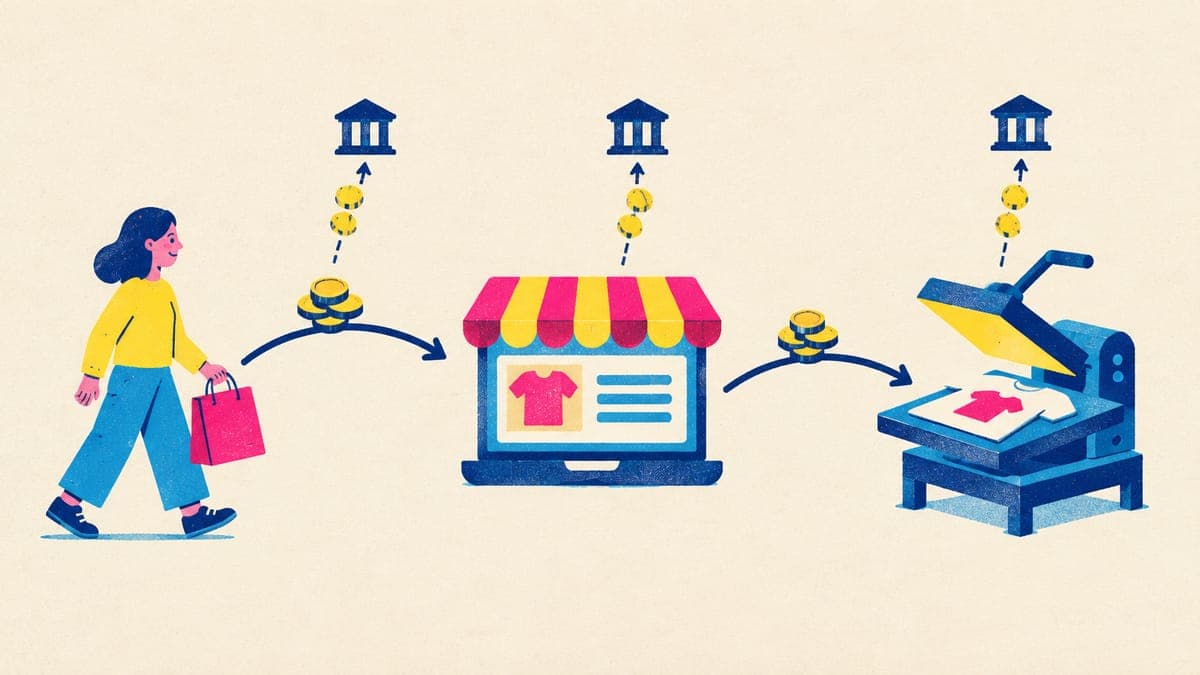
Here’s the part most beginners miss. Your provider sells the product to you, and in most states that sale is taxable too. Printify charges sales tax on the production price (the retail price in California) for orders shipped to the states where it’s registered, which is most of them, unless you’ve given it a valid resale certificate. So on an Etsy order, the buyer pays sales tax to Etsy on the retail price, and you may also pay sales tax to Printify on the production cost.
| Provider | Charges you sales tax on Etsy orders? | How to stop it |
|---|---|---|
| Printify | Yes, in most states, on the production price (retail price in California) | Submit a resale certificate under Wallet → Taxes → USA before you place orders |
| Printful | Not on automatically imported Etsy orders where Etsy collects the tax; yes on manual orders | A resale certificate under Billing → Tax information covers qualifying orders from any platform |
| Gelato | Can apply, depending on the order | Accepts resale certificates and publishes exemption instructions for marketplace sellers |
From each provider’s help center in September 2026. Check your provider’s current tax settings before relying on this.
A resale certificate isn’t free paperwork, though. To use one you generally need a sales tax permit, as Printify’s resale certificate guide explains, and a permit can bring filing obligations of its own. At small volumes, many sellers simply treat the provider’s sales tax as part of the product cost and price it in, which is what Printify itself suggests. Whether registering is worth it depends on your state and your volume, so it’s a good question for an accountant. Our Printify review covers its other costs.
What can POD sellers deduct?
Business expenses that are ordinary and necessary for your shop reduce your taxable profit. For most POD sellers the list looks like this:
| Cost | How it’s usually treated | Notes |
|---|---|---|
| Products and shipping from your provider | Cost of goods sold | Include any sales tax the provider charged you |
| Etsy fees (listing, transaction, processing, Offsite Ads) | Business expense | Your monthly Etsy statements list them |
| Etsy Ads and other advertising | Business expense | Keep the monthly invoices |
| Samples and test orders | Business expense | When used for photos and quality checks, not as your own clothes |
| Software and subscriptions | Business expense | Design tools, mockups, fonts and research tools |
| Refunds and reprints | Refunds reduce your sales; reprints add to your costs | Track both so refunded orders aren’t counted as income |
| Home office | Deductible if you qualify | Simplified method: $5 per sq ft, up to 300 sq ft, for space used regularly and exclusively for the business |
| Phone and internet | Business share only | Use a reasonable business-use percentage |
A general guide. How each item is treated depends on your situation, so confirm with your tax software or preparer.
Two habits make this painless: keep your provider’s order invoices, which show exactly what each sale cost you, and download your Etsy statements and CSVs at least once a quarter. If you already price from your costs up, as in our POD pricing guide, you have most of the numbers.
Fewer hours on listings, simpler books
POD Made Easy turns your ideas into print-ready designs, writes your title, 13 tags and description, and creates the product in your own Printify shop at your prices. It’s one flat monthly subscription with no per-sale fees or fulfillment markup, so it’s one line in your expense records.
Start your free trialQuarterly estimated taxes: do you need them?
Nobody withholds tax from your Etsy profit, so the IRS expects you to pay as you go. You generally need to make estimated payments if you expect to owe $1,000 or more when you file. You can usually avoid an underpayment penalty by paying at least 90% of this year’s tax or 100% of last year’s (110% if last year’s adjusted gross income was over $150,000).
| Payment | For income earned | Due date |
|---|---|---|
| 1st | January–March 2026 | April 15, 2026 |
| 2nd | April–May 2026 | June 15, 2026 |
| 3rd | June–August 2026 | September 15, 2026 |
| 4th | September–December 2026 | January 15, 2027 |
From IRS Form 1040-ES (2026). You can skip the January payment if you file your 2026 return by February 1, 2027 and pay the full balance with it.
If your shop runs alongside a day job, as in our 5-hour-a-week side hustle plan, there’s a simpler route: raise the federal withholding on your W-4 at work to cover the shop’s tax. The IRS treats withholding as paid evenly through the year, so it can replace quarterly payments, and it’s one less set of dates to remember.
A 20-minute monthly tax routine
- Download your Etsy monthly statement and sales CSV, and save them in a folder for the year.
- Export your provider’s invoices for the month, from Printify, Printful, Gelato or whoever you use.
- Log your other costs: ads, samples, software and anything else bought for the shop.
- Work out the month’s profit and move a share of it to a separate savings account for tax. Ask your preparer what percentage fits your bracket and state.
- Put the next estimated-tax date in your calendar if you pay quarterly.
A separate bank account (or at least a separate card) for the shop makes every step faster. Keep your records for at least three years after you file, and longer in some cases: six years, for example, if you leave out income worth more than 25% of the gross income shown on your return.
When to talk to a tax professional
Tax software handles a simple Schedule C well. Bring in a CPA or enrolled agent when:
- your 1099-K doesn’t match your records, or you get forms from more than one platform;
- you’re deciding whether to get a sales tax permit and resale certificate;
- you sell on your own website as well as Etsy;
- you’re thinking about an LLC or S corporation;
- your shop made a loss and you want to deduct it;
- you sell internationally, or you’re not a US citizen or resident.
Do you need an LLC for tax reasons?
Not at first. A single-member LLC is treated as a disregarded entity for federal income tax by default, so you still file Schedule C and pay the same taxes as a sole proprietor. An LLC is mainly about separating business liability from your personal assets, and it comes with state fees and paperwork. Electing S corporation status can reduce self-employment tax once profits are substantial, but it adds payroll and costs: it’s a conversation for your accountant when your shop is well established, not in your first year.
Selling from the UK instead? Our guide to paying tax on Etsy sales in the UK covers HMRC’s rules. And if you ship to buyers in Europe, the EU’s product safety law applies to those sales too: see GPSR for Etsy and POD sellers.
Frequently asked questions
- Do I have to pay taxes on Etsy sales if I made less than $600?
- If you made a profit, yes. The IRS requires you to report all income from selling goods, whatever the amount, and self-employment tax applies once your net earnings reach $400. The $600 figure was a planned 1099-K threshold that never fully took effect.
- Does Etsy report my sales to the IRS?
- Yes, once you pass the federal 1099-K threshold (more than $20,000 in payments and more than 200 transactions in a calendar year) or a lower threshold in some states. Etsy files the form with the IRS and gives you a copy, and it asks for your taxpayer ID once you pass $500 in sales.
- Is the sales tax Etsy collects part of my income?
- No. Etsy collects and remits sales tax on US orders as the marketplace facilitator, so it isn’t your income and it isn’t included on the 1099-K Etsy issues. Don’t add it to your gross receipts.
- Can I deduct what I pay Printify or Printful?
- Yes. What your provider charges for the products and shipping on orders you sold counts toward your cost of goods sold on Schedule C, and any sales tax it charged you is part of that cost. Keep the order invoices as your record.
- What if my Etsy shop lost money this year?
- If it’s a business, a loss on Schedule C can generally reduce your other income, subject to IRS rules. If it’s treated as a hobby, losses can’t offset your other income. Several loss-making years in a row are a good reason to review your setup with a tax professional.
- Do I need a business license to sell on Etsy?
- It depends on your state, county and city. Some require a general business license, and trading under a shop name that isn’t your legal name may need a DBA filing. Check with your city or county clerk and your state’s business office.
Keep reading
More legal & policy guides
Legal & policy
How to Add an Etsy Production Partner (Printify, Printful)
Add an Etsy production partner for Printify, Printful or Gelato: the exact steps and fields, what to write, how to bulk-assign listings and what if you skip it.
Sep 24, 2026 · 9 min read

Legal & policy
Do You Pay Tax on Etsy Sales in the UK? HMRC Rules (2026)
Do you pay tax on Etsy sales in the UK? The £1,000 trading allowance, Self Assessment dates, what Etsy reports to HMRC, VAT at £90,000 and the records to keep.
Sep 24, 2026 · 13 min read

Legal & policy
GPSR for Etsy and POD Sellers: What the EU Rules Require
GPSR for Etsy print-on-demand sellers: who it covers, EU responsible person options, what each listing must show, and how Printify, Printful and Gelato help.
Sep 24, 2026 · 13 min read