GPSR for Etsy and POD Sellers: What the EU Rules Require
GPSR for Etsy print-on-demand sellers: who it covers, EU responsible person options, what each listing must show, and how Printify, Printful and Gelato help.
By the POD Made Easy team · September 24, 2026 · 13 min read

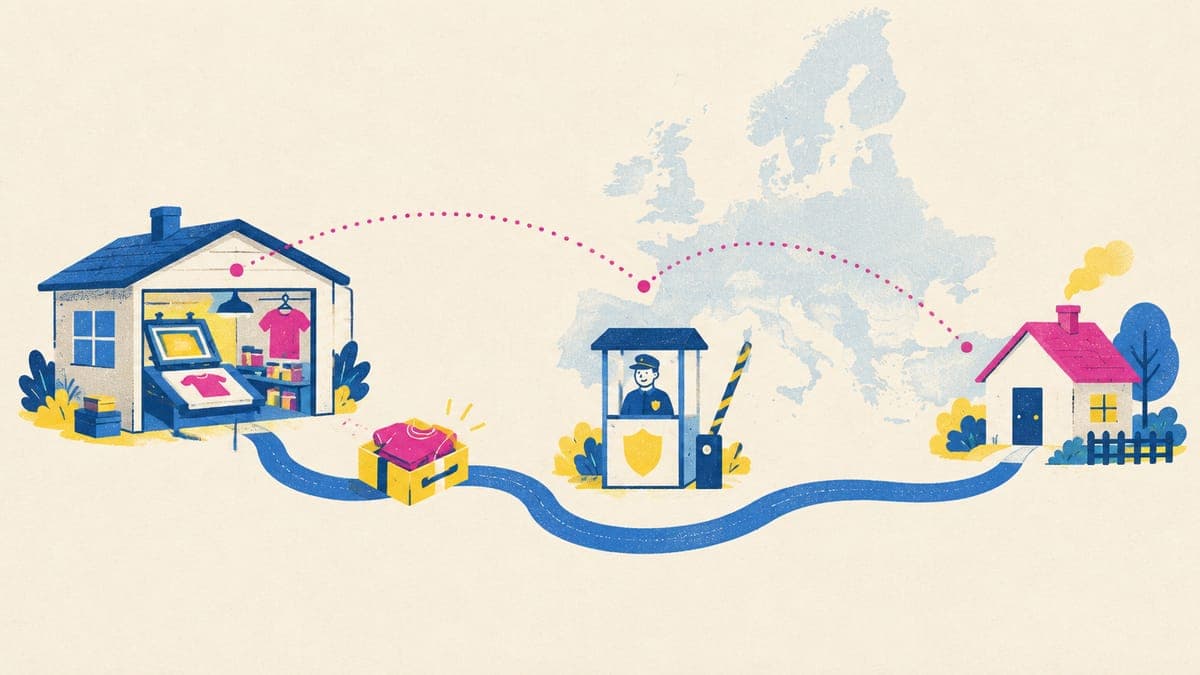
If you sell print-on-demand products to buyers in the EU or Northern Ireland, the EU’s General Product Safety Regulation (GPSR) applies to those sales, wherever your shop is based. Since 13 December 2024, each listing must show who the manufacturer is, an EU-based responsible person if you’re outside the EU, what the product is and any safety information. On Etsy, that means adding an economic operator and filling in the product safety details on your listings, or opting out of selling to those countries.
The good news for POD sellers is that the big providers now supply most of the product information, and two of them will act as your EU contact. This guide explains what GPSR asks of a small Etsy shop in plain English, how Etsy, Printify, Printful and Gelato handle it at the time of writing, and a step-by-step setup you can work through in an evening.
Key takeaways
- GPSR covers consumer products sold to buyers in the EU and Northern Ireland; Etsy also applies it to Iceland, Liechtenstein and Norway.
- A POD seller who sells under their own shop name is usually the “manufacturer” under GPSR, even though a partner prints the item.
- Sellers outside the EU need an EU-based responsible person. Printful and Gelato let you name their EU entities; with Printify you supply your own.
- Every listing sold into the EU must show manufacturer and responsible-person contact details, product identification and any warnings.
- On Etsy you add an economic operator and product safety info, or opt out of selling physical items to GPSR countries.
- Great Britain isn’t covered by GPSR; it still uses the UK’s 2005 product safety rules.
What is GPSR?
The General Product Safety Regulation, Regulation (EU) 2023/988, is the EU’s baseline safety law for non-food consumer products. It replaced the 2001 General Product Safety Directive and has applied since 13 December 2024. The core rule is the same as before (products must be safe), but it adds specific duties for online sales and traceability: authorities and buyers must be able to see who is responsible for a product and how to contact them.
T-shirts, hoodies, mugs, posters, stickers, phone cases and tote bags are all consumer products, so a typical POD catalog is in scope. Products with their own EU safety laws, such as toys, have extra requirements on top.
Does GPSR apply to your shop?
GPSR follows the buyer, not the seller. If a product can be delivered to a consumer in an EU country or Northern Ireland, the rules apply to that sale. Etsy applies its GPSR requirements to sales into the EU, Iceland, Liechtenstein, Norway and Northern Ireland.
| Your situation | Does GPSR apply? |
|---|---|
| US seller who ships to EU buyers | Yes, to your EU sales. You need an EU-based responsible person |
| UK seller in Great Britain who ships to EU or Northern Ireland buyers | Yes. A Great Britain address doesn’t meet the EU-based requirement |
| Seller based in the EU | Yes. As a manufacturer established in the EU, your own details usually cover the responsible-person role |
| Seller who doesn’t sell to the EU or Northern Ireland | No, as long as those countries are excluded |
| Occasional private seller | Etsy’s requirements focus on “traders”. If you sell regularly to make a profit, it’s safest to assume you’re one |
Simplified. Etsy says it can’t advise whether you count as a trader; if you’re unsure, ask a legal adviser.
On Etsy you also declare whether you’re a trader or a private individual in your shop’s seller details, which is the first step in the setup below.
Who counts as the manufacturer for print-on-demand?
You do, in most cases. Under Article 13, anyone who places a product on the market under their own name or trademark is treated as its manufacturer, even if someone else physically makes it. Your provider prints the shirt, but it’s sold under your shop’s name, and Printify, Printful and Gelato all tell sellers to enter their own details as the manufacturer.
The manufacturer’s duties (Article 9) include making sure the product is safe, carrying out an internal risk analysis and keeping technical documentation for 10 years, making the product identifiable (a type, batch or other identifier), putting the manufacturer’s name and contact details on the product, its packaging or an accompanying document, and providing instructions and safety information in a language consumers understand. A POD seller leans on the provider for most of this: the product data, care instructions and safety details come from the provider’s catalog. The responsibility stays with you, though.
A practical starting point for simple items like tees and mugs is a short file per product type: the provider’s product specification and safety data, the blank’s brand and model, the care instructions and a note on foreseeable risks (for example, “no small parts; not made for children”). If an authority ever asks, you have an answer ready.
The EU responsible person: your options
Under Article 16, a product covered by GPSR can’t be placed on the EU market unless an economic operator established in the EU is responsible for it. That person keeps documentation available to authorities, cooperates with them and regularly checks things like the product’s identification and labeling. Their name and contact details must appear on the product, its packaging, the parcel or an accompanying document, and in your listing.
Under EU market surveillance law, the role can be filled by a manufacturer based in the EU, an importer, an authorized representative with a written mandate, or an EU fulfillment service provider for the products it handles. For a POD seller outside the EU, that translates into four realistic options:
| Option | How it works | Worth knowing |
|---|---|---|
| Your provider’s EU entity | Printful and Gelato publish EU company details that sellers outside the EU can name as their responsible person | Only for products that provider makes; Printify asks you to supply your own |
| A paid authorized-representative service | A compliance company acts as your responsible person under a written mandate | Etsy has partnered with Cert-Rep and International Associates; fees vary |
| Your own EU business | If you have a business established in the EU, you use your own details | Rarely practical for a side hustle |
| Stop selling to the EU and Northern Ireland | Opt out on Etsy and exclude those countries from shipping | Simplest, but you lose those buyers |
Based on Regulation (EU) 2023/988, Regulation (EU) 2019/1020 and the published guidance of Etsy and each provider as of September 2026.
The provider route is the easiest if it fits your setup. At the time of writing, Printful’s guidance names Sinden Ventures Limited in Limassol, Cyprus, and Gelato’s names Gelato Estonia OÜ in Tallinn, for sellers who haven’t appointed their own. Printify supplies the product safety text but asks you to provide the responsible person: your own business in the EU or Northern Ireland, or a partner you appoint.
If you use more than one provider, make sure each listing shows the responsible person that actually applies to the product it sells.
What every listing must show
For online sales, Article 19 lists what the offer itself has to show “clearly and visibly”. Here’s what that means for a POD listing, and where each item goes on Etsy:
| GPSR requirement | What to enter for a POD product | Where it goes on Etsy |
|---|---|---|
| Manufacturer’s name, postal address and email | Your legal or trading name, a postal address and an email address | Manufacturers field in the listing form |
| Responsible person’s name, postal address and email (if the manufacturer isn’t in the EU) | Your provider’s EU entity, your authorized representative or your own EU business | Economic operator (Settings → Partners you work with) |
| Information that identifies the product, including a picture and its type | Clear photos, the product type and the blank’s brand and model | Photos, plus the Product safety info field or description |
| Warnings and safety information, in a language consumers understand | Care instructions and any warnings from your provider’s product data | Product safety info field |
Article 19 of Regulation (EU) 2023/988, mapped to Etsy’s listing tools as of September 2026.
Warnings must be in a language consumers can easily understand, as decided by each EU country. For most apparel and paper products that’s simply care information, but if a product carries real warnings, English alone may not be enough everywhere.
How to set up GPSR on Etsy, step by step
- Set your seller status. In Shop Manager, open Sales channels and select the pencil icon next to your shop. In the Seller details section, choose Edit, select Trader or Private individual, and save.
- Add your economic operator. Go to Settings → Partners you work with → Add economic operator, enter the name, address and contact details, and save. You can’t do this in the Etsy Seller app yet. Etsy’s form asks for a phone number even though GPSR doesn’t require one; use the number that belongs to the contact details you’re entering.
- Update your listings. Fill in the Manufacturers field and the Product safety info field. Bulk edit only listings that share the same product model, because the details differ from one product to another.
- Or opt out. If you’d rather not sell to GPSR countries, go to Settings → Options and, under “Choose how you sell to GPSR states”, exclude your physical items. Buyers in the EEA and Northern Ireland then can’t buy them from your shop.
This is separate from the production partner setting, which every POD listing needs regardless of where you sell. Etsy’s own GPSR help article has the current menu names if they’ve moved.
How Printify, Printful and Gelato handle GPSR
| Printify | Printful | Gelato | |
|---|---|---|---|
| Product safety information | Supplied: tick the GPSR box when publishing, or bulk-add it to up to 24 products at a time | Supplied in its catalog and GPSR product lists to copy into listings | Supplied as a compliance list covering every product category |
| EU responsible person | You provide your own (your EU business or an appointed partner) in Store settings | Sellers outside the EU can name Sinden Ventures Limited (Cyprus) | Sellers outside the EU can name Gelato Estonia OÜ (Estonia) |
| What you still do on Etsy | Fill in Etsy’s own GPSR fields too; description text alone may not pass Etsy’s checks | Add an EU economic operator and update each listing | Add an economic operator and update listing descriptions |
From each provider’s help center in September 2026. Providers update their guidance, so check it before you rely on it.
Printify’s point is worth repeating: marketplaces like Etsy have their own GPSR fields and checks, so information that only sits in your product description may not be enough. Fill in Etsy’s fields either way. Printify also notes that its name doesn’t appear on your listings; the details buyers see are the ones you enter. Gelato, meanwhile, states that its products don’t have any safety or hazard warnings.
If you’re still choosing a provider, EU coverage is one more factor to weigh in Printify vs Printful vs Gelato. Our Gelato review covers its local production network, and the Printful review covers its own facilities.
Keep the rest of each listing quick
GPSR adds details to every EU listing. POD Made Easy handles the design and copy side: print-ready files at the exact print size, spell-checked text, and a title, 13 tags and description with Etsy’s AI-disclosure and production-partner wording, created as a product in your own Printify shop.
Start your free trialWarranty, accidents and packaging: the other EU duties
- The two-year legal guarantee. Under EU consumer law (the Sale of Goods Directive, 2019/771), buyers are entitled to a repair, replacement or refund for goods that are faulty or not as described for at least two years. That duty sits with you as the seller. Providers usually only accept claims within a short window (Printify and Gelato both work to 30 days after delivery), so decide in advance how you’ll handle later claims. Our guide to POD returns and misprints has message templates.
- Accidents. If a product causes a serious accident, the manufacturer must report it to the authorities through the EU’s Safety Business Gateway (Article 20). That’s unlikely with a t-shirt, but know the duty exists and pass anything serious to your provider straight away.
- Packaging registration. Some countries have separate packaging rules. In Germany, marketplaces have had to check sellers’ packaging registration (the LUCID register) since July 2022. Gelato says sellers can use its LUCID number for orders it produces, packs and ships; with other providers, check what they cover.
- Penalties. Each EU country sets its own penalties for breaking GPSR, and marketplaces can hide or remove non-compliant listings for EU buyers.
UK sellers: Northern Ireland vs Great Britain
For UK shops, the answer depends on where the buyer is. The EU regulation has applied in Northern Ireland since 13 December 2024, so sales there need the same GPSR details as EU sales. In Great Britain, the UK’s General Product Safety Regulations 2005 still apply instead, as GOV.UK’s Northern Ireland guidance explains.
Change is coming there too. The Product Regulation and Metrology Act 2025, which received Royal Assent on 22 July 2025, lets the government update UK product safety rules, and its 2026 consultations (which closed on 23 June 2026) included oversight of online marketplaces. Watch for new UK requirements for online sellers.
A UK seller shipping to the EU needs an EU-based responsible person, just like a US seller. For the rest of the UK picture, see our guides to print-on-demand in the UK and paying tax on Etsy sales in the UK.
Should you keep selling to the EU?
For most POD shops, yes, if the setup is manageable. A quick guide:
| If… | Consider |
|---|---|
| Your provider offers an EU responsible person | Using its details and keeping EU sales open; it’s mostly a one-time setup |
| You use Printify and EU orders are a meaningful share of sales | A paid authorized-representative service, or moving EU-heavy products to a provider that offers one |
| You sell children’s products or anything with real safety risks | Getting compliance advice before you sell into the EU |
| EU orders are rare and you want zero extra admin | Opting out on Etsy until your shop is bigger |
A starting point, not a rule. Check how many of your orders actually go to the EU in your Etsy stats first.
Whatever you decide, build it into your routine: new listings should either include the GPSR details or sit behind your opt-out, never somewhere in between. And EU sales are still income at home, so they belong in your tax records too (see our guides for US print-on-demand taxes and UK sellers above).
Frequently asked questions
- What happens if I don’t add GPSR information on Etsy?
- Marketplaces can block your products or hide your listings from buyers in the EU and Northern Ireland, and EU countries can penalize traders who break the rules, with penalties set by each country. Adding the details, or opting out of selling to those countries, avoids both.
- Can Printify act as my EU responsible person?
- Not at the time of writing. Printify supplies the product safety information, but its help center asks you to provide the responsible person yourself: your own business in the EU or Northern Ireland, or a partner established in the EU that you appoint. Printful and Gelato do offer EU entities you can name.
- Does GPSR apply to digital downloads on Etsy?
- Etsy’s guidance says its GPSR requirements can cover digital as well as physical products, and its opt-out setting lets you choose separately for physical and digital items. Printed POD products are physical, so they’re the priority for most POD shops.
- Does the responsible person’s address have to be on the product itself?
- Not necessarily. GPSR allows the responsible person’s name and contact details to go on the product, its packaging, the parcel or an accompanying document, and for online sales they must also appear in the listing. Ask your provider how its labels and packing slips handle this.
- Is GPSR the same as CE marking?
- No. CE marking applies to products covered by specific EU laws, such as toys and electronics. GPSR is the general safety law for consumer products, so a POD t-shirt or mug needs GPSR details but not a CE mark. POD toys would have to meet the toy-specific rules as well.
Keep reading
More legal & policy guides
Legal & policy
How to Add an Etsy Production Partner (Printify, Printful)
Add an Etsy production partner for Printify, Printful or Gelato: the exact steps and fields, what to write, how to bulk-assign listings and what if you skip it.
Sep 24, 2026 · 9 min read

Legal & policy
Print-on-Demand Taxes for US Etsy Sellers (2026 Guide)
Print-on-demand taxes for US Etsy sellers: the $20,000 1099-K rule, Schedule C and self-employment tax, sales tax on provider bills, deductions and 2026 dates.
Sep 24, 2026 · 13 min read

Legal & policy
Do You Pay Tax on Etsy Sales in the UK? HMRC Rules (2026)
Do you pay tax on Etsy sales in the UK? The £1,000 trading allowance, Self Assessment dates, what Etsy reports to HMRC, VAT at £90,000 and the records to keep.
Sep 24, 2026 · 13 min read