Etsy SEO in 2026: The Complete Guide for POD Sellers
Etsy SEO for print-on-demand in 2026: how Etsy search matches and ranks listings, what goes in titles, tags, attributes and photos, plus a one-page checklist.
By the POD Made Easy team · September 24, 2026 · 13 min read
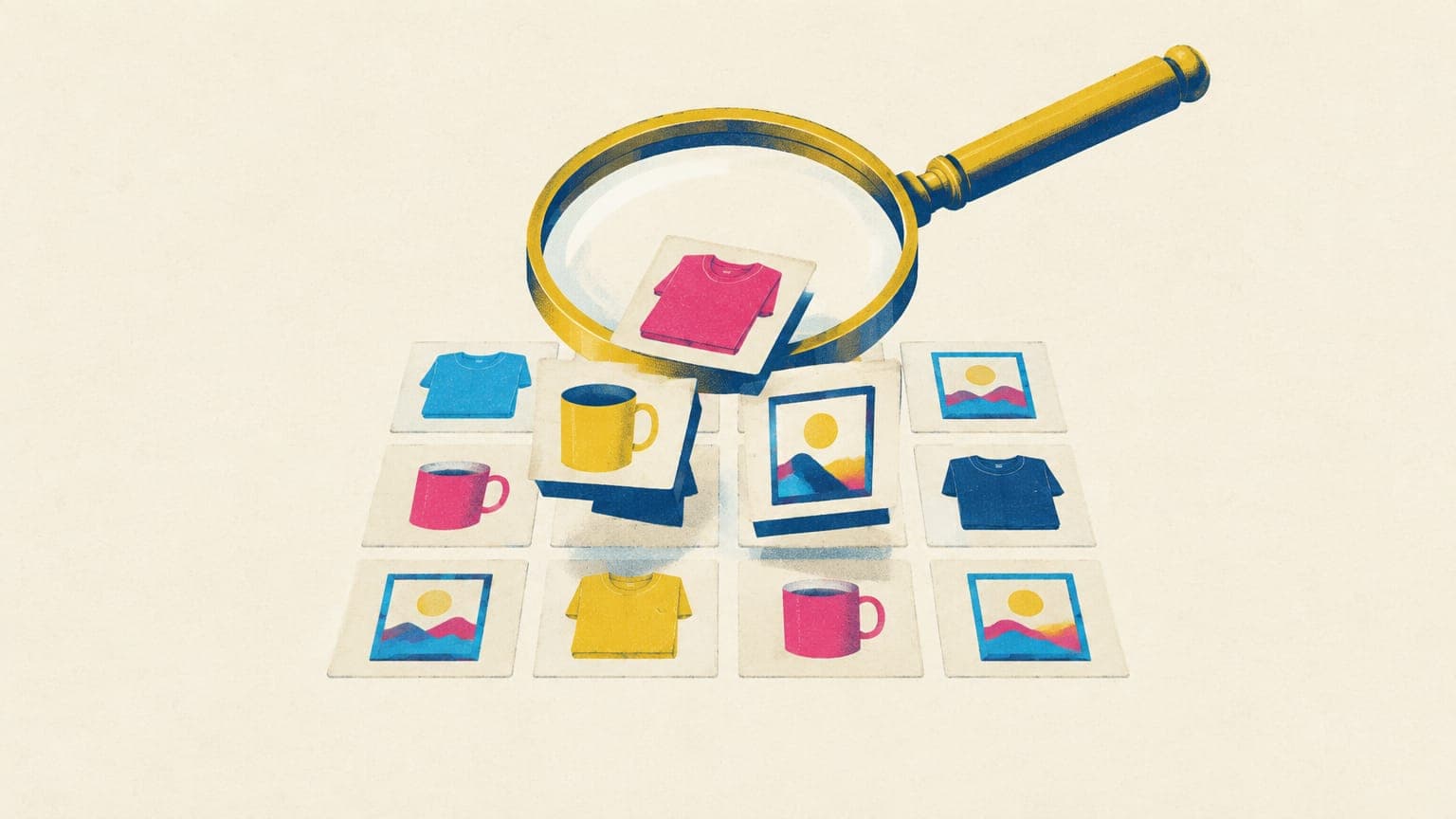
Etsy SEO is the work of getting your listings shown when shoppers search on Etsy. It happens in two steps: Etsy first finds the listings whose words match the search, then ranks them by how likely each one is to sell. So good Etsy SEO means two things: use the phrases buyers actually type (in your title, tags, attributes and description), and build listings that shoppers click and buy (a clear first photo, a fair total price, good reviews).
This is the complete version for print-on-demand (POD) sellers, based on what Etsy has published in its Seller Handbook and Help Center as of September 2026. Each step links to a deeper guide, and the end of the page has a one-page checklist you can work through on your next listing.
Key takeaways
- Etsy search works in two phases: query matching (does your listing contain the words?) and ranking (is it likely to sell?).
- Etsy reads your title, tags, categories, attributes, description, first photo and reviews together, so the title no longer has to carry every keyword.
- Use all 13 tags as multi-word phrases, pick the most specific category and fill in every true attribute: categories and attributes act like extra tags.
- Your first photo, total price, shipping cost and reviews decide whether matched listings earn clicks and sales, and those sales feed back into ranking.
- For US buyers, Etsy favors free shipping or domestic shipping under $6, and a return policy is required for priority placement.
- Renewing listings for a boost, stuffing titles and searching for your own listings to check rank all waste time, by Etsy’s own account.
How Etsy search works (the two-minute version)
Etsy describes its search in two phases:
- Query matching. A shopper types a search, and Etsy gathers every listing that matches it. Etsy says its search now takes a “holistic view” of each listing for this step: title, tags, attributes, description, first photo, reviews and more.
- Ranking. Etsy orders those matches so the items a shopper is most likely to buy come first. The factors it names include relevance, listing engagement (how often views turn into purchases), listing and shop quality, customer service, shipping price, recency and language. Then it personalizes the order for each shopper.
That split explains most of Etsy SEO. Keywords get you into the race; buyers decide where you finish. Perfect tags with a weak first photo match plenty of searches and then sink. A beautiful listing with the wrong words is never considered at all.
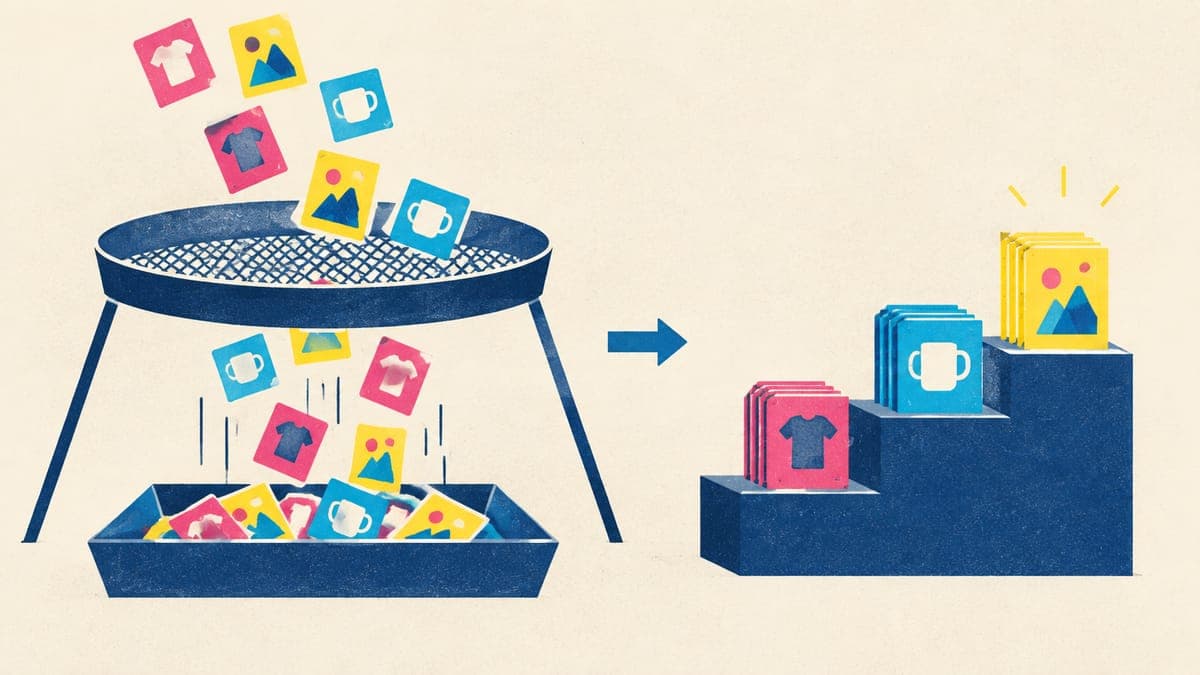
For the detail on each ranking factor, with sources, read how the Etsy algorithm works. The rest of this guide is the to-do list.
13 × 20
Tags per listing, each up to 20 characters including spaces
Source: Etsy Help Center
< 15 words
What Etsy suggests considering for a clear, scannable title (the limit is 140 characters)
Source: Etsy Seller Handbook
$6
US domestic shipping price below which Etsy prioritizes listings in US search
Source: Etsy Help Center
Step 1: Find the phrases buyers actually type
Before you write a title, collect the phrases real shoppers use for your design. For POD that means three layers:
- The core phrase: the identity or theme plus the product, like “retired teacher sweatshirt”.
- Modifiers: style (retro, watercolor), recipient (for grandma), occasion (retirement) and product details (crewneck, 15 oz mug).
- Long-tail combinations: specific phrases that describe exactly what you made. Etsy advises prioritizing these over broad searches, because they tend to convert better.
The best free source is Etsy itself. Marketplace Insights (Shop Manager → Stats → Marketplace Insights) shows how often a keyword was searched on Etsy in the last 30 days and how many listings compete for it, with 15 free lookups a week at the time of writing. Add the search bar’s suggestions and your own Stats, and you’ll have more ideas than listings.
Our step-by-step Etsy keyword research guide walks through a full example. If you’re weighing a paid research tool, read Everbee vs eRank first, and if you’re still deciding what to make, start with what sells on Etsy.
Step 2: Write a short, buyer-first title
Titles can be up to 140 characters, but Etsy’s current guidance is to say what the item is, put the key traits up front, consider fewer than 15 words, and move gift phrases and subjective words (“perfect”) elsewhere.
Two details from Etsy’s Keywords 101 matter for POD sellers:
- Word order doesn’t change ranking. Etsy says where a phrase appears in your title doesn’t affect a listing’s rank. Lead with the product anyway, because shoppers only see the first few words in search results, especially on phones.
- Exact matches can help. Etsy says a listing whose keywords exactly match a search may rank higher because it looks more relevant. Use the phrase buyers type (“retired teacher sweatshirt”), not a clever paraphrase of it.
A POD title that follows both rules: “Retired Teacher Sweatshirt, Retro Book Stack Crewneck” (53 characters). The full formula and before-and-after rewrites are in how to write Etsy titles that rank.
Step 3: Use all 13 tags, and let categories and attributes do free work
Tags carry most of your keyword list: 13 of them, up to 20 characters each, as multi-word phrases with no repeats. Etsy matches plurals by root word and redirects common misspellings, so skip tags for either.
Categories and attributes are the part many POD sellers skip, and they’re free keywords. Etsy says both act like tags:
- Pick the most specific category. A listing in a subcategory also appears in every category above it, so being specific costs you nothing.
- Fill in every attribute that’s true, such as colors, occasion, holiday and pattern. Etsy’s advice is to add the relevant options even when they’re less precise than your own words: add “pink” as a color even if you’d call it dusty rose.
- Don’t spend tags repeating them. If your category is sweatshirts, a tag that only says “sweatshirt” is wasted. Use the word inside a longer phrase instead, like “teacher sweatshirt”.
A POD wrinkle: if your provider publishes the listing, check the category and attributes it set and fill in the gaps. Make title and description edits in the provider app; with Printify, editing them on Etsy can break the sync. For a tag formula and example sets, see how to choose all 13 Etsy tags.
Etsy title & tag checkerPaste a title and tags to catch tags over 20 characters, duplicates, single words and empty slots before you publish.Step 4: Make the first photo earn the click
Your first photo plays a part in both phases: Etsy search reads it when matching, and shoppers judge it in results, which drives the engagement ranking rewards. Etsy’s search visibility page lists what a listing needs “for a chance to receive priority placement”:
- At least one listing image, with a high-resolution primary photo. Etsy recommends at least 2,000 pixels wide and tall, and says a first photo under 635 pixels can show up lower in search.
- A single image of the finished product as the primary photo: no collages or stitched-together images.
- A clear, well-lit primary photo.
For POD, that means a clean mockup with the design readable at thumbnail size, in the color your title names, framed horizontally or square so Etsy’s crops don’t cut it off. Use the rest of your slots (up to 20 photos and 2 short videos) for a lifestyle shot, a close-up, color options and a size chart. Don’t upload transparent PNGs as photos (Etsy shows the transparent parts as black), and add alt text, up to 250 characters per photo. Our guides to Etsy mockups that sell and Etsy image sizes cover the full photo plan.
Step 5: Write the description for buyers (Etsy reads it too)
Old advice said Etsy search ignored descriptions. Etsy’s Seller Handbook now says search considers keywords and phrases in your description when ranking, and recommends working relevant keywords into the first few sentences naturally, without copying your title or pasting a keyword list.
The description also turns clicks into sales, and for AI-assisted designs it’s where Etsy requires your AI disclosure. A good POD description:
- Opens with one or two plain sentences that say what it is and who it’s for, using your main phrase once.
- Lists what a buyer needs in short lines: fit and sizing, fabric or material, print method, care.
- Explains any personalization clearly, with limits.
- Includes your AI disclosure (if you used AI) and, ideally, a line about your production partner.
Use our Etsy description template with copy-paste examples. If you draft with AI, start from these ChatGPT prompts for Etsy listings, then check every fact against your provider’s product page.
The listing copy, written within Etsy’s limits
POD Made Easy writes a buyer-first title under 140 characters, 13 tags within Etsy’s 20-character limit and a description with Etsy’s AI-disclosure and production-partner wording, then creates the product in your Printify shop, ready to publish to Etsy.
Start your free trialStep 6: Shipping price, return policy and a complete shop
Three ranking factors have nothing to do with words, and you can fix them in an afternoon:
- Shipping price (US). Etsy says shipping price and method are ranking factors: free shipping, a US free shipping guarantee or domestic shipping under $6 may help a listing rank with US shoppers. Many POD sellers build most of the shipping cost into the item price for this reason. Our guide to Etsy shipping profiles for POD shows the math.
- A return policy. Etsy lists a return policy as a requirement for priority placement, “even if it’s ‘No returns’”, and says shop policies have a positive effect on search placement.
- A complete shop. Etsy says an incomplete shop, such as one without a logo, can hurt your listings’ visibility. Add a shop icon, an About section and a shop title (the tagline under your shop name).
Step 7: Reviews and customer service count toward rank
Etsy says shops that consistently meet its customer service standards are prioritized in search, and that it looks at your average review rating, message response rate and case rate from the past three months. The minimums at the time of writing:
| Standard | Etsy’s minimum | What it means for POD |
|---|---|---|
| Message response | Reply to 80% of first messages in a thread within 24–48 hours | Check messages daily, even though you never touch the product |
| On-time shipping | At least 80% of orders ship on time | Set processing times from your provider’s real production time, plus a Q4 buffer |
| Reviews | Under 40 reviews: no more than 4 rated 3 stars or lower. 40 or more: under 10% | Order samples of best sellers and check every file; misprints become reviews |
| Cases | Under 300 orders: no more than 3 cases refunded from your Payment account. 300 or more: under 1% | Reply fast and fix problems with your provider before a buyer opens a case |
Etsy’s customer service standards at the time of writing. Star Seller targets are higher, such as 95% of first messages answered within 24 hours and a 4.8+ average rating.
The POD catch: your provider makes and ships the item, but Etsy holds you responsible, so late production is a late shipment and a blurry print is a bad review. For tactics, read how to get more Etsy reviews as a POD seller.
Etsy SEO moves specific to print-on-demand
- One product per listing. The same design on a tee, a mug and a tote is three listings, each leading with its own product, so each matches its own searches.
- Tag personalization. If buyers can add a name, Etsy suggests tag phrases with “personalized” or “custom”. See personalized print-on-demand on Etsy.
- Rotate seasonal phrases on time. As a rule of thumb, add occasion tags six to eight weeks before the date; our POD seasonal calendar has the dates.
- Keep mockups honest. A mockup brighter or bigger than the real print wins the click and loses the review.
- Assign your production partner and disclose AI. Etsy doesn’t list them as ranking factors, but both are requirements for POD listings, and policy problems can cost you the listing. See how to add an Etsy production partner and selling AI designs on Etsy.
- Keep trademarks out of every field. Brand, team and character names in titles or tags can get listings removed, and Etsy counts policy violations in its customer service quality factor. Our trademark guide for POD shows how to check a phrase.
Etsy SEO myths that waste your time
| Myth | What Etsy says |
|---|---|
| Renewing listings every day keeps them on top | New and renewed listings get a small, temporary boost (a few hours to a few days) so Etsy can learn how shoppers react. Etsy says renewing just for that boost isn’t an effective strategy. |
| Keywords at the start of the title rank higher | Etsy says where a phrase appears in the title doesn’t affect ranking. Front-load for shoppers, not for the algorithm. |
| Searching for your listing shows your rank | Results are personalized, so what you see isn’t what buyers see. Etsy recommends checking your Stats instead. |
| Etsy Ads or Etsy Plus boost organic rank | Etsy says neither influences where listings appear in organic search; ads only appear in ad spaces. |
| Star Seller moves you up | Etsy says Star Seller doesn’t directly change the order of results, though the badge can raise conversion. |
| You need plurals and misspellings as tags | Etsy matches root words and redirects common misspellings. |
Based on Etsy’s Seller Handbook and its ranking disclosures at the time of writing.
Your one-page Etsy SEO checklist
| Area | Check before you publish |
|---|---|
| Keywords | A core phrase from real searches (Marketplace Insights, the search bar or your Stats), checked for trademarks |
| Title | Starts with what the item is, includes one or two traits that set the design apart, under about 15 words, no repeated words |
| Tags | All 13 used, each a multi-word phrase of 20 characters or fewer, covering who, occasion, style and synonyms |
| Category and attributes | The most specific category, and every attribute that’s true (colors, occasion, holiday, pattern) |
| Photos | First photo a single, sharp, well-lit product image at 2,000 px or more; the rest show lifestyle, close-up, colors and sizes; alt text added |
| Description | First sentences say what it is and who it’s for; specs match your provider; AI disclosure if you used AI |
| Price and shipping | Profitable at the price shown; US shipping free or under $6 where your margins allow |
| Shop | Return policy set, shop icon and About section filled in, production partner assigned |
| After publishing | Search visibility page shows no issues; review Stats after two to four weeks |
Print this table or keep it next to your listing form.
How to tell whether your Etsy SEO is working
Etsy says changes can take up to a day to show in search, and a new listing up to 48 hours to appear. Then give a change two to four weeks, and compare it with similar listings you didn’t touch. Three numbers in your Stats tell you most of what you need:
- Visits from Etsy search. The Etsy search traffic source counts visits from shoppers searching on Etsy.com. It doesn’t include searches in the Etsy app or ad clicks, so treat it as a trend line.
- Search terms. The phrases that brought shoppers to you. Useful ones missing from your tags are candidates for new tags; ones that don’t describe your item mean you’re matching the wrong searches.
- Views compared with orders, per listing. Few views point to matching (keywords, category, attributes) or a visibility issue. Plenty of views and no orders point to photo, price, shipping or reviews.
For a weekly routine, see Etsy stats explained. If views come but sales don’t, work through these fixes for Etsy views with no sales, and if you’re still waiting on the first order, follow our 30-day plan for your first Etsy sale.
Etsy SEO is a habit, not a trick: research a phrase, build a listing that deserves the click, and let your Stats tell you what to fix next.
Frequently asked questions
- How long does it take for Etsy SEO changes to work?
- Etsy says edits can take up to a day to show in search, and a brand-new listing can take up to 48 hours to appear. Judge a change after two to four weeks of data, and compare it with similar listings you left alone, because seasons and holidays move traffic too.
- What matters more on Etsy, tags or titles?
- Neither on its own. Etsy reads your title, tags, categories, attributes and description together to match searches, and says exact matches may rank higher. Tags give you 13 extra phrases, so they usually carry most of your keyword list while the title stays short and clear.
- Is Etsy SEO different for print-on-demand listings?
- The ranking rules are the same for every seller. What changes is the workflow: edit synced listings in your provider app, set processing times from your provider’s real production time, keep mockups accurate and assign your production partner.
- Do Etsy listings show up on Google?
- Yes. Etsy listing pages can appear in Google results, and the page title comes from your listing title. Etsy also brings shoppers from Google through its own marketing and Offsite Ads, which show up as separate traffic sources in your Stats.
- Do I need a paid tool for Etsy SEO?
- No. Etsy’s free Marketplace Insights tool shows searches and listing counts for 15 keywords a week, and your Stats show the search terms that already bring you visits. Paid tools add estimates and convenience, which can help once you research many niches.
Keep reading
More etsy seo guides
Etsy SEO
How the Etsy Algorithm Works in 2026 (for POD Sellers)
How the Etsy algorithm works in 2026, from query matching to engagement, shipping price and customer service, explained from what Etsy has said publicly.
Sep 24, 2026 · 11 min read

Etsy SEO
Etsy Shipping Profiles for Print-on-Demand: Times and Rates
Set up an Etsy shipping profile for print on demand: processing times that match Printify, real Printify shipping times, free-shipping math and Q4 planning.
Sep 24, 2026 · 11 min read

Etsy SEO
Etsy Keyword Research for POD: Find Buyer Keywords Free
Etsy keyword research for print-on-demand, free: use Marketplace Insights, search suggestions and your Stats to find buyer keywords, then place them well.
Sep 24, 2026 · 11 min read