Can You Sell AI Art on Etsy? Rules and Disclosure (2026)
Yes, you can sell AI art on Etsy, with conditions: what the Creativity Standards require, disclosure wording to copy, and the copyright and trademark risks.
By the POD Made Easy team · September 24, 2026 · 11 min read
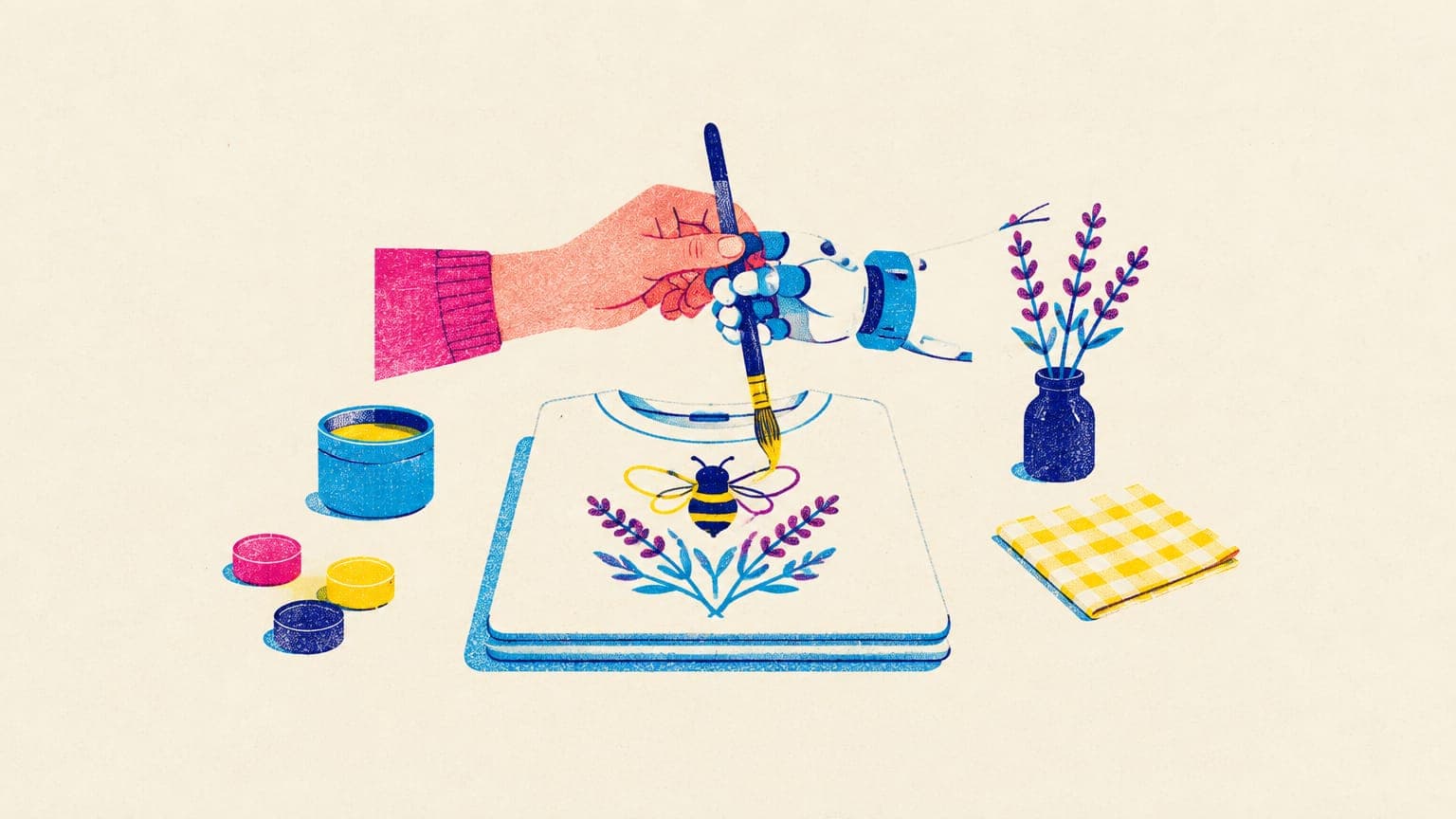
Yes, you can sell AI art and AI-generated designs on Etsy, including on print-on-demand (POD) t-shirts, mugs and posters. Etsy allows items created with AI tools from your own prompts, as long as you say so in the listing. But “allowed” isn’t the same as “risk-free”. How you disclose it, what the AI actually produced and whether anyone can own the result all matter.
That’s good news if you’re not a trained designer and use AI to turn your own ideas into artwork. This guide covers what Etsy’s rules require, sample disclosure wording you can adapt, and the copyright and trademark issues every AI-assisted POD shop should understand before it scales up.
Key takeaways
- Etsy allows designs you create with AI tools from your own original prompts, listed as “designed by” you.
- You must disclose AI use in the listing description, and POD listings must also name a production partner.
- In the US, purely AI-generated images can’t be copyrighted, so you may not be able to stop copycats.
- Trademark, copyright and likeness problems are your responsibility, whichever tool made the image.
- Adding your own creative work and keeping records of your process puts you in a stronger position.
The short answer: yes, with conditions
Etsy’s Creativity Standards sort items by how they were created: made by the seller, designed by the seller (including items a production partner makes), handpicked vintage, or sourced craft supplies. AI-assisted artwork falls under designed by. Etsy’s own examples of designed-by items include artwork generated with AI tools from a seller’s original prompts, alongside things like a logo a seller designed and had printed onto phone cases.
For a POD seller using AI, that translates into three conditions:
- The idea and the prompt are yours. Etsy’s wording is “original prompts”. Writing up your own concept is fine; reusing someone else’s prompt or feeding in their artwork isn’t what Etsy means.
- You disclose AI use in the listing description. Etsy requires it on every listing for an item created with AI.
- You name your production partner. Every POD listing needs one, AI or not, because someone else prints and ships the item.
Etsy also bans selling AI prompts on their own as prompt bundles, because it treats the prompt as part of the creative work rather than a product. That rarely affects POD sellers, but it shows how Etsy thinks about AI: the human input is the part it cares about.
What Etsy’s rules expect from AI sellers
Beyond those three conditions, Etsy’s Creativity Standards and Seller Policy set expectations that matter more with AI than with traditional design:
- Accurate listings. Your photos and mockups must represent the real product. An AI lifestyle photo that shows colors, placement or print quality the actual item won’t have is a misrepresentation, not a creative choice. (Our Etsy mockup checklist covers accurate photos that still sell.)
- Honest wording. Don’t describe AI-generated art as “hand-drawn”, “hand-painted” or an “original watercolor” unless you really made it that way.
- Your own design. Etsy’s standards are built around sellers’ own original designs. Running a best seller’s design through an AI tool to make a lookalike doesn’t meet that bar, and it’s an intellectual property problem too.
- Policies that move. Etsy revised its Creativity Standards in June 2025 and says it will keep reviewing its approach to AI. Re-read the standards every few months rather than relying on a guide from last year.
How to disclose AI use, with sample wording
Etsy requires the disclosure to appear in the listing description, but it doesn’t prescribe exact wording. Aim for something short, plain and honest that a buyer will actually notice. The best disclosures say what the AI did and what you did.
Only claim steps you actually took. If you didn’t edit the image, say you selected and prepared it instead. A few more practical tips:
- Put it where buyers look. Near the top of the description, or in a consistent “About this design” line, is better than burying it under the size chart. Our Etsy description template shows where it fits.
- Keep it brief. One or two sentences is enough, and you don’t need to name the model you used.
- Use the same wording across your shop so nothing gets missed when you publish many listings at once.
- Answer honestly if asked. If a buyer messages to ask how a design was made, tell them. Trust is part of what they’re paying for.
- Check the listing form, too. Etsy’s listing fields change over time. If you see a question about AI or about how the item was made, answer it accurately as well.
Set up your production partner once
Every POD listing needs a production partner, because someone else makes the item. Setting it up takes a few minutes:
- In Shop Manager, go to Settings → Partners you work with (formerly “Production partners”). Etsy renames menus from time to time, so look for “production partners” or “partners you work with”.
- Add your provider, for example Printify, with its location and a sentence about what it does for you, such as printing and shipping your designs.
- Make sure each POD listing is linked to that partner. Provider integrations usually do this automatically when a partner with the matching name already exists on Etsy.
- Check that your shipping profile’s origin and processing times match what your provider actually does.
If the partner doesn’t exist on Etsy, listings published through a provider can end up marked as made by you, which misstates how the item was produced. Fix it once and every future listing benefits (our step-by-step guide to adding an Etsy production partner walks through each field). Here’s the whole checklist in one place:
| What | Where | Status |
|---|---|---|
| AI disclosure | Listing description | Required when an item was created with AI |
| Production partner | Shop Manager settings, linked to each listing | Required for POD |
| Accurate photos and mockups | Listing images | Required for every listing |
| Honest description of how it was made | Title and description | Required: no “hand-drawn” for AI art |
| Trademark and copyright check | Before you publish | Your legal responsibility |
| Records of your process | Your own files | Best practice |
Based on Etsy’s Creativity Standards and Seller Policy at the time of writing.
Copyright: why you may not be able to stop copycats
Here’s the uncomfortable part. In the US, copyright only protects work created by a human author, and the courts have now firmly upheld that rule.
In Thaler v. Perlmutter, computer scientist Stephen Thaler tried to register an image he said his AI system created on its own, listing the machine as the author. The US Copyright Office refused, a federal appeals court agreed in 2025, and in March 2026 the Supreme Court declined to hear his appeal. That leaves the human-authorship requirement firmly in place.
Thaler claimed no human authorship at all, so the case doesn’t settle exactly how much human input an AI-assisted design needs. The Copyright Office’s January 2025 report on AI and copyrightability gives the clearest guidance so far:
- Prompts alone generally aren’t enough. The Office concluded that with current tools, writing a prompt doesn’t give you enough control over the result to make you its author.
- Your own contributions can be protected. Human-made elements in the design, your creative selection and arrangement of material, and meaningful changes you make to the output can qualify.
- The AI-generated parts stay unprotected. Even when a work can be registered, protection covers the human contribution, not the machine-made material.
The Office applied the same thinking in 2023 to a comic book illustrated with Midjourney images: it protected the author’s text and the selection and arrangement of the pages, but not the individual AI-generated images.
What this means for a POD shop
- Copycats are a real risk. If a design is purely prompt-generated, another seller who copies it may face little copyright consequence, because there may be no copyright for you to enforce.
- Be careful with takedown requests. Etsy’s intellectual property reporting is for rights you actually own. Claiming copyright in a purely AI-generated image can backfire. (If you’re on the receiving end of a report, see what to do after an Etsy IP notice.)
- Human work strengthens your position. Your own lettering, hand-drawn elements, substantial edits and the way you combine elements can be protectable even when parts of the design came from AI.
- Keep records. Save your prompts, drafts, edits and dates. If you ever need to show what you contributed, you’ll have the evidence.
- Compete on what’s hard to copy. Speed, niche knowledge, personalization, product quality, strong mockups and a recognizable shop are much harder to clone than a single image.
Rules differ outside the US, and several countries are reviewing how copyright should treat AI output. If you sell mainly in another market, check the guidance there.
Trademark and other IP risk stays with you
AI doesn’t change who’s responsible for what you sell. If a design infringes someone’s trademark, copyright or likeness, “the AI made it” is no defense. Etsy removes listings when rights holders report them, and repeated reports can put your whole shop at risk. AI makes a few traps easier to fall into:
- Lookalike characters and logos. Image models have seen famous characters and brands. A prompt that names one, or describes one closely, can produce something near enough to infringe.
- Trademarked phrases. Plenty of everyday-sounding slogans are registered for clothing and mugs, and an AI tool will happily print one for you.
- Real people. Celebrities’ faces and names are protected by publicity rights in many places. Don’t generate or sell recognizable likenesses.
- Artist styles. A style on its own generally isn’t protected by copyright, but prompting for a living artist’s style can produce outputs close to their actual works, and it’s a quick way to lose buyers’ trust.
- Hidden extras. AI images sometimes include fake signatures, watermarks or garbled logos. Zoom in before you publish.
Before publishing any design with words on it, search the phrase in the USPTO’s free Trademark Search, focusing on the classes that cover your products: Class 25 for clothing, Class 21 for mugs and Class 16 for stickers, posters and other paper goods. If you sell to the UK or EU, check the UK IPO and EUIPO databases as well. Our print-on-demand trademark guide walks through a search step by step.
Check your AI tool’s terms, too
Etsy’s rules sit on top of the terms of whichever tool made the image. Before you sell, check that your tool and your plan allow commercial use. Most major image models let you use their outputs commercially, but terms differ by tool, plan and model, and some prohibit presenting outputs as entirely human-made, which is one more reason to disclose. Keep a copy of the terms that applied when you created each design. Our guide to using AI images commercially compares the main models’ terms.
Best practice: AI designs that sell and stay safe
The shops that do well with AI treat it as a drafting tool, not a vending machine. A workflow that holds up (our AI t-shirt design workflow covers each step in depth):
- Start from a niche and your own concept. Write the idea in your own words: who it’s for, the joke or feeling, and the style.
- Generate drafts, then choose and refine. Pick the strongest draft, fix the details and adjust the composition. Your choices are where the value is.
- Add your own touch. Your own lettering or layout, a hand-drawn element, or a color palette you reuse across a collection.
- Make the file print-ready. The right pixel size for the print area, a clean transparent background and every word spelled correctly. AI image tools still misspell text.
- Screen for IP. Look for logos, characters and faces, and search any phrase in the trademark database.
- List it honestly, with accurate mockups, a clear disclosure and your production partner named.
Try this idea in POD Made Easy
“Linocut-style honeybee on lavender sprigs, two-color print in cream and deep purple” · text: “Plant More Lavender”
Disclosure, spelling and trademark checks built in
POD Made Easy adds Etsy’s AI-disclosure and production-partner wording to every listing, spell-checks design text with a vision model, checks resolution and transparency, and flags famous brand and character names before you publish. A safety net, not legal clearance.
Start your free trialWhat about other marketplaces?
Each marketplace sets its own AI rules. Some ask you to label AI-generated work, some limit how much of it you can upload, and a few restrict it heavily. If your POD provider publishes to several sales channels for you, design your process around the strictest one, and check each platform’s current policy before you expand. Our guides to Merch by Amazon and Redbubble vs Etsy cover those platforms’ rules.
Your AI-on-Etsy checklist
- The concept and prompt are your own, with no brands, characters or real people.
- You’ve refined the output and, ideally, added your own creative elements.
- Any text is spelled correctly, and any phrase has been checked for trademarks.
- The listing description discloses AI use in plain words.
- Your production partner is set up on Etsy and linked to the listing.
- Mockups show the real product accurately, and nothing claims to be hand-made.
- You’ve saved your prompts, drafts and edits.
Frequently asked questions
- Is it legal to sell AI-generated designs?
- Generally yes, as long as the design doesn’t copy someone else’s copyrighted work, trademark or likeness, and your AI tool’s terms allow commercial use. You’re responsible for what you sell, so check both before you publish.
- Do I have to tell buyers I used AI on Etsy?
- Yes. Etsy requires you to disclose in the listing description when an item was created with AI. One or two plain sentences near the top of the description, or in a consistent “About this design” line, works well.
- Can I copyright an AI-generated design?
- Not the purely AI-generated parts, in the US. Copyright requires a human author, and the Supreme Court declined to revisit that in March 2026. Your own contributions, such as hand-drawn elements, your own lettering or a creative arrangement, may be protectable.
- What happens if I don’t disclose AI use?
- Etsy can remove listings that don’t meet its Creativity Standards, and repeated problems can put your shop at risk. Disclosure takes one sentence, so it isn’t worth skipping.
- Can I sell AI designs in the style of a famous artist?
- It’s best avoided. A style on its own generally isn’t protected by copyright, but outputs can end up close to an artist’s actual works, and it erodes buyer trust. Develop your own recognizable style instead.
Keep reading
More legal & policy guides
Legal & policy
Etsy Intellectual Property Infringement: What to Do Next
Got an Etsy intellectual property infringement notice? What it means, your options (retraction or counter notice), a template and how to protect your shop.
Sep 24, 2026 · 12 min read
Legal & policy
How to Add an Etsy Production Partner (Printify, Printful)
Add an Etsy production partner for Printify, Printful or Gelato: the exact steps and fields, what to write, how to bulk-assign listings and what if you skip it.
Sep 24, 2026 · 9 min read
Legal & policy
Do You Pay Tax on Etsy Sales in the UK? HMRC Rules (2026)
Do you pay tax on Etsy sales in the UK? The £1,000 trading allowance, Self Assessment dates, what Etsy reports to HMRC, VAT at £90,000 and the records to keep.
Sep 24, 2026 · 13 min read