Print-on-Demand Trademarks: How to Avoid Infringement
How trademark and copyright work in print-on-demand, how to search the USPTO, UK IPO and EUIPO databases, the traps that get listings pulled and safer ideas.
By the POD Made Easy team · September 24, 2026 · 11 min read
Few things end a print-on-demand side hustle faster than intellectual property (IP) trouble. One report can take a bestselling listing down overnight, and a pattern of reports can put your whole shop at risk. Unlike most POD problems, you can’t fix this one afterward by tweaking a file.
The good news is that the rules follow a clear logic, the main trademark databases are free to search, and original designs are easier to build a shop around anyway. You don’t need a lawyer to screen everyday designs: a five-minute search before you publish catches the most common problems. Here’s how to stay on the right side of the line.
Key takeaways
- Trademarks protect brand names, logos and slogans for specific goods; copyright protects creative works such as art, characters and lyrics.
- A phrase registered for clothing (class 25) isn’t safe on a shirt, even if it sounds generic.
- Search the USPTO’s Trademark Search system, plus the UK IPO and EUIPO if you sell there, before you publish.
- Sports teams, brands, characters, lyrics, celebrities and event names are the classic traps.
- An Etsy IP report removes the listing, and repeated reports can get your shop suspended.
- Original phrases, original art and genuinely public-domain sources are the safe route.
Trademark vs copyright: the short version
POD sellers run into two kinds of IP, and they work differently:
| Trademark | Copyright | |
|---|---|---|
| What it protects | Names, logos, slogans and other signs that identify who sells something | Original creative works: artwork, photos, characters, text and lyrics |
| How it arises | Through use in commerce and, more strongly, through registration for specific goods | Automatically, the moment a work is created |
| Scope | Specific goods and services, in specific countries | The work itself and close copies of it |
| How long it lasts | As long as it’s used and renewed | Usually the creator’s life plus 70 years |
| Typical POD trap | A registered phrase or a team name on a shirt | Copied art, characters, song lyrics or photos |
Simplified. Details vary by country, and company-owned and older works follow different terms.
There’s a third right worth knowing about too: the right of publicity, which in many places lets people control commercial use of their name, face and identity. It’s why celebrity portraits are risky even when you drew the portrait yourself.
Why class 25 matters for shirts
Trademarks are registered for specific categories of goods and services. The US, UK and EU all use the same international system, the Nice Classification, and a handful of its classes matter most for POD:
- Class 25: clothing, footwear and headwear, so t-shirts, hoodies and hats.
- Class 21: household items, including mugs and other drinkware.
- Class 16: paper goods and printed matter, including stickers and posters.
- Class 18: bags, including tote bags.
- Class 9: among many other things, phone cases.
This is why a phrase can be free to use on a poster and off-limits on a shirt. If someone has registered it in class 25, putting it on apparel is exactly what their registration covers. The reverse isn’t a free pass either: famous brands get broader protection that reaches beyond the goods they registered.
You might assume an everyday phrase can’t be a trademark. The USPTO does refuse many widely used slogans because they don’t point to a single seller, but plenty of short phrases, puns and sayings are still registered for clothing. The only way to know is to search.
How to search the USPTO trademark database
The US Patent and Trademark Office retired its old TESS search tool in 2023 and replaced it with a newer system called Trademark Search. It’s free and covers both registered marks and pending applications. A good search takes a few minutes:
- Search the exact phrase. Enter the words on your design, without punctuation.
- Filter to live records. Live marks are registered or pending. Dead ones have been abandoned, canceled or allowed to expire, though the owner may still be using the brand.
- Check the goods. Open each result and read its class and goods list. Class 25 with t-shirts or shirts in the list is a direct conflict for apparel.
- Search variations. Try plurals, alternative spellings, a different word order, numbers versus words (“2” and “two”) and the phrase without its least important word. Confusingly similar marks count, not just identical ones.
- Read the record. The status page (in the USPTO’s TSDR system) shows the owner, the key dates and whether an application is still pending.
- Search the real world too. In the US, a business can gain trademark rights just by using a mark, without registering it. Search Etsy, Amazon and Google for the phrase to see whether someone is clearly using it as a brand.
Once you have results, this rule of thumb turns them into a decision:
| What you find | What it usually means for a shirt |
|---|---|
| No live results for the phrase or close variations | A good sign. Check real-world use, then publish |
| A live registration or application in class 25 | Don’t use it on apparel |
| A live mark only in other classes, such as class 16 | Possibly usable on shirts but not on those products; be very careful with famous brands |
| Only dead records | Usually not a barrier on its own, but check whether the owner still uses the brand |
| The phrase is clearly used as a brand or shop name online | Unregistered rights may exist in the US, so pick another phrase |
A screening shortcut, not legal clearance. When the stakes are high, ask a trademark attorney.
Searching in the UK and EU
Trademarks are territorial: a US registration covers the US, and a UK or EU registration covers those markets. If your shop sells internationally, check the places where your buyers are. (The UK and EU write “trade mark” as two words.)
- UK: the UK Intellectual Property Office’s free “Search for a trade mark” service on GOV.UK. Since Brexit, new EU trade marks don’t cover the UK, so search it separately.
- EU: the EUIPO’s eSearch plus database, for EU trade marks that cover every member state at once.
- Many countries at once: TMview, run by the EUIPO with national and international partner offices, searches trade marks from many registries in one place. WIPO’s Global Brand Database is a useful second check.
Use the same method as in the US: the exact phrase, then variations, live marks only, then the classes and goods.
Common traps that get POD listings removed
- Sports teams and leagues. Team names, nicknames, logos and mascots are protected, and so are the leagues. A city name plus a team’s nickname is still the team.
- Brands and logos, including parodies. Twisting a famous logo into a joke can feel safe. To the brand filing a report, it usually isn’t. Parody can be a legal defense, but it’s decided case by case by courts, not by marketplace support teams.
- Film, TV, game and anime characters. Characters are protected by copyright, and their names often by trademark too. Drawing a character yourself doesn’t make it yours to sell, and neither does changing the colors. (More in can you sell fan art on Etsy.)
- Song lyrics and quotes. Lyrics are copyrighted, and even a short, recognizable line can draw a report. The same goes for memorable lines from films, books and shows that are still under copyright (see song lyrics and movie quotes on shirts).
- Celebrities. Names, faces and likenesses are covered by publicity rights in many places, including on fan tributes and memorial designs.
- Event names. “Super Bowl” and “March Madness” are registered trademarks, and US law gives the US Olympic and Paralympic Committee special rights over words like “Olympic.” That’s why advertisers talk about “the big game.”
- Phrases registered for clothing. Catchphrases, holiday puns, motivational slogans and viral sayings are often filed in class 25, sometimes after the phrase has been popular for years.
- Brand names in tags and titles. Keywords like a brand name plus “style” or “inspired” can trigger a report even when the design itself is original. A “not affiliated” disclaimer doesn’t fix it. Our Etsy tags guide shows how to fill all 13 tags without them.
What happens when Etsy gets an IP report
Etsy runs a notice-and-takedown process: rights owners report listings they believe infringe, and Etsy generally doesn’t decide who’s right in the dispute. In practice, it usually goes like this:
- The rights owner files a report through Etsy’s intellectual property reporting process, naming the listings.
- Etsy removes the listing, typically quickly and without asking for your side first.
- You get a notice, usually including who filed the report and how to contact them.
- You choose a response. You can contact the reporting party and ask them to retract the report. For copyright claims, you can also file a counter notice if you believe the removal was a mistake, and the listing may be restored if the other side doesn’t take legal action. Trademark reports don’t have the same counter-notice route, so a retraction is usually the way back.
- Repeat reports add up. Etsy’s policy is to suspend or terminate the accounts of repeat infringers. It doesn’t publish an exact number of strikes, so treat every report as serious.
The consequences don’t necessarily stop at Etsy. Your print provider’s terms also make you responsible for the rights to what you upload, and serious cases can lead to demand letters or lawsuits. US copyright law, for example, allows statutory damages of up to $150,000 per work for willful infringement, far more than a design is ever likely to earn.
Safer creative patterns that still sell
None of this means your designs have to be bland. These patterns keep the risk low without killing the fun:
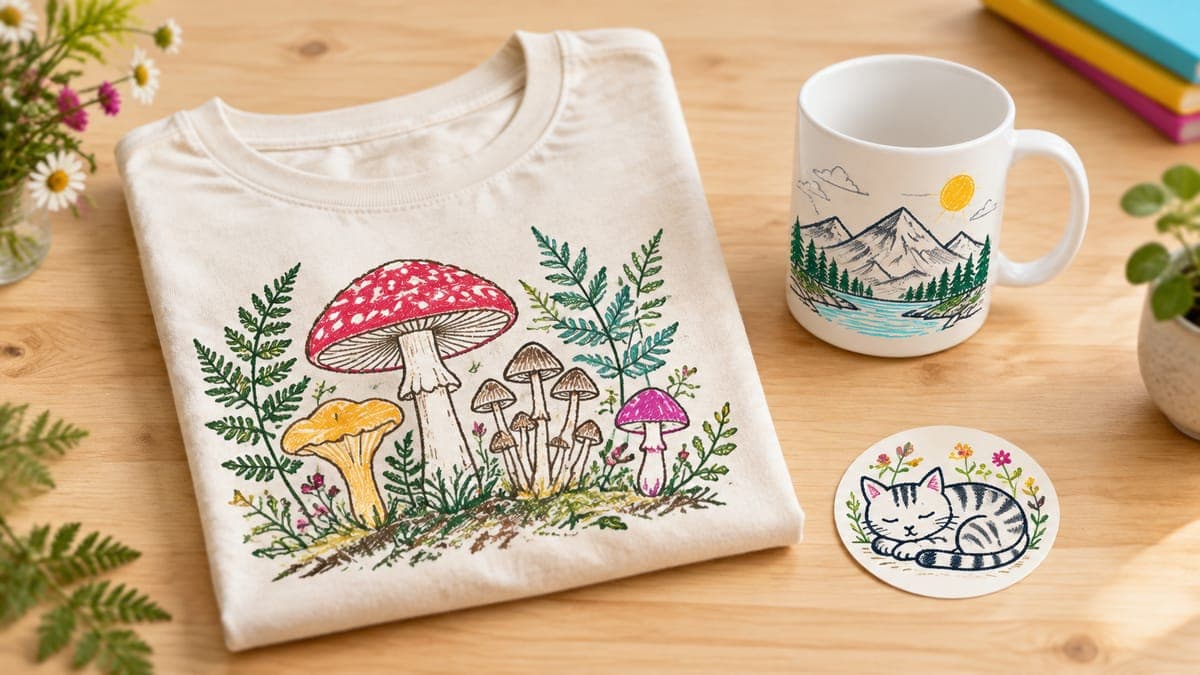
- Write your own phrases. Build them from the buyer’s world: their job, hobby, pet or town. Specific, original wording is both safer and more likely to stand out. Then search it anyway. (Our guide to print-on-demand niches is full of buyer worlds to write from.)
- Describe, don’t reference. “1970s screen-printed travel poster, three colors, halftone shading” is a style anyone can use. A named artist or a copied poster is someone else’s work.
- Lean on original illustration. Designs with no words and an original subject, such as an animal, a plant or an object drawn in a distinctive style, carry the least phrase risk.
- Use the public domain carefully. In the US, works published in 1930 or earlier are generally in the public domain as of 2026, and many museums share open-access images of them. But a modern restoration, translation or new edition can have its own copyright, other countries use different rules, and a public-domain character can still be covered by a current trademark. Our guide to public domain images for POD lists trusted sources.
- License what you don’t make. Fonts, clip art and stock graphics need a license that covers products for sale. Some “commercial use” licenses exclude merchandise or print-on-demand, so read the terms (our list of fonts that are free for commercial use is a safe place to start).
- Keep records. Save your prompts, drafts, source files and dates. If a report ever comes in, evidence of how you made a design helps.
Try this idea in POD Made Easy
“Original vintage field-guide style illustration of forest mushrooms and ferns, muted earth tones, isolated on transparent background”
If you design with AI, the same rules apply to your prompts. Never type a brand, team, character or living artist’s name into an image generator, and look twice at anything that comes back looking familiar, because models occasionally produce lookalikes without being asked. (More on this in can you sell AI art on Etsy.)
A second pair of eyes before you publish
POD Made Easy’s trademark safety check flags famous brand, character and team names in your idea, printed words, title and tags before you publish, and every listing gets Etsy’s AI disclosure. It’s a safety net, not legal clearance: the final trademark search is still yours to run.
Start your free trialA pre-publish IP checklist
- Is every word on the design your own, or searched and clear in the class for your product?
- Did you search the USPTO, plus the UK IPO and EUIPO if you sell there?
- Is there any team, brand, character, celebrity, event or lyric in the design, even indirectly?
- Did you use an artist’s name, or someone else’s artwork, as a reference?
- Are your title, tags and description free of brand names?
- Do you have a commercial license for every font and graphic you didn’t create yourself?
- Have you saved your prompts, drafts and source files?
If any answer makes you hesitate, change the design. Every niche has endless original ideas, and no single design is worth risking your shop for.
Frequently asked questions
- How do I check if a phrase is trademarked?
- Search the USPTO’s free Trademark Search system (it replaced TESS in 2023) for the exact phrase and close variations, filter to live marks and check the goods, especially class 25 for clothing. If you sell in the UK or EU, also search the UK IPO and EUIPO databases.
- Can I use a trademarked phrase if it’s registered for a different product?
- Sometimes, because trademarks cover specific goods and services. But a phrase registered for clothing rules out shirts, famous brands get broader protection, and a marketplace may still remove a listing when it gets a report. When in doubt, choose a different phrase.
- What happens if someone reports my Etsy listing for infringement?
- Etsy removes the listing and notifies you, usually with the reporting party’s contact details. You can ask them to retract the report or, for copyright claims, file a counter notice. Repeated reports can lead to your shop being suspended.
- Is fan art allowed if I drew it myself?
- Drawing it yourself doesn’t make it yours to sell. Characters, logos and names are usually protected by copyright or trademark, so fan art can be removed on a report even if every line is original. Original characters or properly licensed designs are the safe route.
- Does a “not affiliated” disclaimer protect me?
- Generally, no. A disclaimer doesn’t make unauthorized use of someone’s trademark or artwork legal, and it won’t stop a rights owner from reporting the listing.
Keep reading
More legal & policy guides
Legal & policy
Etsy Intellectual Property Infringement: What to Do Next
Got an Etsy intellectual property infringement notice? What it means, your options (retraction or counter notice), a template and how to protect your shop.
Sep 24, 2026 · 12 min read
Legal & policy
How to Add an Etsy Production Partner (Printify, Printful)
Add an Etsy production partner for Printify, Printful or Gelato: the exact steps and fields, what to write, how to bulk-assign listings and what if you skip it.
Sep 24, 2026 · 9 min read
Legal & policy
Print-on-Demand Taxes for US Etsy Sellers (2026 Guide)
Print-on-demand taxes for US Etsy sellers: the $20,000 1099-K rule, Schedule C and self-employment tax, sales tax on provider bills, deductions and 2026 dates.
Sep 24, 2026 · 13 min read