Public Domain Images for Print-on-Demand: Sources and Rules
Public domain images for print-on-demand in 2026: the 1930 cutoff, trusted free sources, license traps and how to turn vintage art into your own design.
By the POD Made Easy team · September 24, 2026 · 12 min read
Yes, you can use public domain images for print-on-demand products and sell them, because nobody owns the copyright anymore. In the US, as of 2026, anything published in 1930 or earlier is in the public domain, and institutions like the Smithsonian, The Met and the Rijksmuseum share huge collections of high-resolution images labeled free for any use, including commercial use.
The catches are what trip sellers up. Plenty of “free” images aren’t public domain, the rules change at the border, trademarks and real people can still be protected inside an old image, and on Etsy an untouched scan isn’t your design. This guide covers the 2026 rules, the sources worth trusting and what their labels mean, and how to turn old artwork into print-ready designs that are genuinely yours.
Key takeaways
- In the US, works published in 1930 or earlier are public domain as of January 1, 2026, and another year joins every January.
- US public domain isn’t worldwide: the UK and EU generally protect works until 70 years after the creator’s death.
- Use sources that label rights clearly (CC0, public domain, “no known copyright restrictions”) and save a record of the label.
- “Free” stock sites aren’t public domain. Unsplash and Pexels, for example, restrict selling unaltered images on products.
- Logos, real people and modern restorations can still be protected inside a public-domain image.
- On Etsy, transform the image into your own design (crop, recolor, compose, add lettering) rather than printing a raw scan.
What counts as public domain in 2026?
A work is in the public domain when its copyright has expired, was never secured or was given up by its owner. Three dates do most of the work:
1930
US works published in 1930 or earlier are public domain in 2026
Source: Cornell University Library chart, Jan 2026
1955
UK and EU: creators who died in 1955 or earlier are out of copyright in 2026
Source: Duke Law, Public Domain Day 2026
Jan 1
Each New Year’s Day, another year of US works joins the public domain
Source: US copyright law, 95-year term
The full picture is a little more involved. This summary follows Cornell University Library’s copyright term chart, updated January 1, 2026:
| Type of work | US status in 2026 | What to watch |
|---|---|---|
| Published in the US in 1930 or earlier | Public domain | Works published in 1931 join on January 1, 2027 |
| Published 1931 to 1963 | Protected for 95 years if the copyright was renewed; public domain if it wasn’t | Renewal checks take real research, so skip these unless you’re sure |
| Published 1964 to 1977 | Generally protected for 95 years from publication | A few published without a copyright notice are free, but that’s hard to prove |
| Created 1978 or later | Protected for the creator’s life plus 70 years | Assume it’s protected |
| Unpublished works (private photos, letters, unpublished art) | Public domain if the creator died before 1956 | Unknown creators make this hard to confirm |
| Works of the US federal government | Public domain in the US | Logos, third-party material and people in the images are exceptions |
| Anything dedicated with CC0 | Free: the owner waived their rights | Only as reliable as the source that applied the label |
Simplified from US copyright law. Works first published outside the US follow extra rules.
Two details catch people out. First, “published” has a specific legal meaning. A painting that was only exhibited may not count as published, which is why the status of older artworks is harder to pin down than books or films. Second, the rest of the world uses a different clock. The UK and EU generally protect works until 70 years after the creator’s death, with their own rules for foreign works. A novel by a British author who died in 1965, for example, can be public domain in the US in 2026 and still protected in the UK until the end of 2035. If you sell internationally, check the creator’s death date too. (For modern works, the US Copyright Office’s duration FAQ explains the life plus 70 years rule.) The same dates apply to songs, covered in our guide to lyrics on shirts.
Public domain vs “free”: read the label
Most mistakes happen here. “Free to download” and “public domain” aren’t the same thing, and only some labels let you print an image on products you sell:
| Label you see | What it means | OK on POD products? |
|---|---|---|
| Public domain or Public Domain Mark | No known copyright | Yes, after the checks below |
| CC0 | The owner waived all rights | Yes |
| “No known copyright restrictions” | The institution found none but can’t promise | Usually; read the item’s notes |
| CC BY | Free if you credit the creator | Yes, with the credit the license requires (for example, in your listing) |
| CC BY-NC (any “NC”) | Non-commercial use only | No |
| CC BY-ND | No changes allowed | Rarely useful: you can’t adapt it into your own design |
| Unsplash, Pexels and similar free stock sites | Their own licenses, not public domain | Not as-is: Unsplash bars selling images without significant modification, and Pexels bars selling unaltered copies on physical products |
| “Royalty-free” or “commercial use” stock | A license with conditions | Only if it explicitly covers merchandise or print-on-demand |
| Found on Google Images or Pinterest | No license at all | No |
License terms at the time of writing. Read the current terms on each site before you use an image.
Keep a record of the label as you found it: the page URL, a dated screenshot of the rights statement and the file you downloaded. Labels change, and a screenshot is your proof of what you relied on.
Where to find public domain images (and what to look for)
These sources hold millions of free images between them, and each tells you, item by item, what you can do with it. Look for the label before you download:
| Source | Best for | Look for |
|---|---|---|
| Smithsonian Open Access | Natural history, design, air and space, American art | Items marked CC0 (millions of images) |
| The Met Open Access | Paintings, prints, textiles and decorative arts | The Open Access (public domain) marking on each object page |
| Rijksmuseum | Dutch and world art, prints and drawings | Public Domain or CC0 items are free for commercial use; CC BY items need a credit; some remain copyrighted |
| NYPL Digital Collections | Maps, prints, photos, menus and ephemera | Items marked public domain (no known US copyright restrictions) |
| Library of Congress | Photos, posters, maps and prints | Its Free to Use and Reuse sets, and the Rights & Access notes on every other item |
| Biodiversity Heritage Library | Birds, insects, botanicals and other natural-history plates | Each item’s rights statement: most older books are public domain, but not everything is |
| NASA | Space and Earth imagery | Generally not copyrighted in the US, but its insignia and logos are protected, you can’t imply endorsement, and identifiable people need permission |
Checked September 2026. Institutions update their labels, so confirm on the item page every time.
The Smithsonian’s Open Access program is a good first stop because everything in it is CC0. NASA is popular for space designs, but read NASA’s media usage guidelines first: the images are generally free, while the logos and any suggestion of endorsement are not.
Wherever you download, grab the largest file offered, note the creator and original date, and prefer the holding institution’s own page over a repost. Wallpaper sites, Pinterest boards and some upload sites label images “public domain” when they aren’t.
Five ways a public-domain image can still get you in trouble
- New layers on old work. Restorations, colorizations, illustrations added to a later edition and modern captions or translations can carry their own copyright. In the US, a straightforward photo of a flat, old artwork generally doesn’t create a new copyright, but a photo of a sculpture or a creatively lit object can, and other countries have their own rules. Use sources that label the digital file itself as free.
- Trademarks inside the image. Old ads, labels and packaging often show brands that still exist and still own their logos. Public-domain characters can also carry current trademarks on merchandise (our fan art guide explains this version trap).
- Real people. A public-domain photo of a person doesn’t clear their likeness for use on products. NASA’s own guidelines warn that commercial use of identifiable people can infringe privacy or publicity rights. Avoid recognizable people, especially famous ones.
- Borders. US public domain isn’t worldwide. Check the creator’s death date if you sell to the UK or EU.
- False labels. A “public domain” tag on a repost proves nothing. Trace the image back to the original institution or publication.
Words on your finished design need the usual trademark screening too. Our trademark guide shows how to search, and if a rights owner ever reports a listing, our guide to an Etsy IP infringement notice covers what to do next.
Etsy’s rules: make it your design
Copyright isn’t the only rule on Etsy. Its Creativity Standards classify print-on-demand items as “designed by” the seller, and they’re built around your own original design. A raw museum scan printed on a mug is hard to present as your design, and listings that don’t meet the Creativity Standards can be removed even when they don’t infringe anyone’s copyright. (Our guide to selling AI designs on Etsy explains how the Creativity Standards work.)
So transform the source into something new, and describe it honestly. A line like this works well:
Only claim what you actually did. Don’t call it hand-drawn, and if you used AI anywhere in the process, disclose that too.
How to turn a public-domain image into your own design
- Start with the buyer, not the archive. Pick a niche first (birders, gardeners, anglers, map lovers), then search the archives for material that speaks to them.
- Choose art that prints well. Engravings, woodcuts, lithographs and botanical plates have clean lines that survive enlargement. Faded photographs rarely do.
- Crop to a hero detail. One bird, one flower or one map district makes a stronger design than a whole page.
- Clean and isolate it. Remove stains and paper texture, then cut the subject out onto a transparent background with crisp edges. Our guide to transparent PNGs for t-shirts explains why soft edges print as halos.
- Recolor and restyle. A limited palette of two or three colors looks modern and prints predictably.
- Compose something new. Combine elements, add a border or badge layout, or arrange a repeat pattern.
- Add your own lettering. A short niche phrase you wrote (and searched) turns an old image into a product for a specific buyer.
- Log it. Save the source URL, the rights label, the date and what you changed.
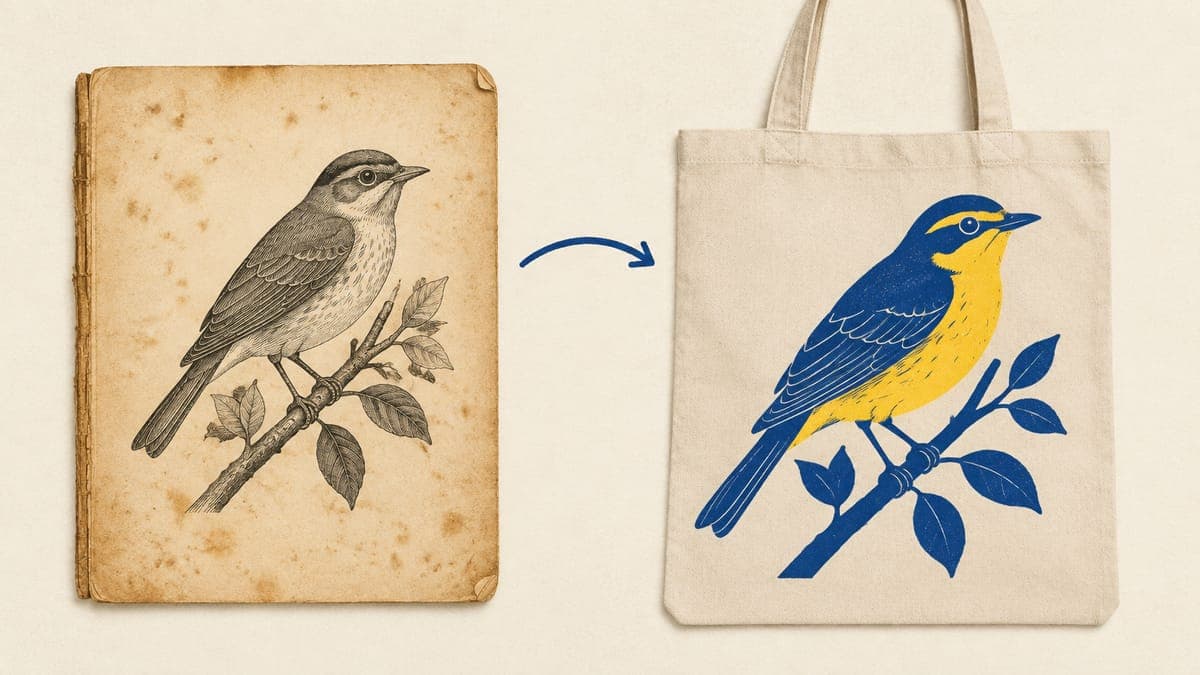
The vintage look, without the rights research
Prefer to skip the archives? POD Made Easy creates original artwork from your own prompt, in whatever vintage look you describe, from engraving to botanical plate, and delivers it at the exact print-area size with a clean transparent background and a resolution check.
Start your free trialMake old scans print-ready
Old art has quirks that show up on fabric and paper:
- Resolution. A full-front tee needs about 4500 × 5400 pixels, and an 18 × 24 inch poster needs 5400 × 7200 at 300 DPI (around 150 DPI is acceptable for big posters). Museum downloads can be large, but a cropped detail may not be, so check before you design.
- Vectorize line art. Engravings and woodcuts trace cleanly into vectors that scale to any size (see how to vectorize an image for print).
- Upscale carefully. Painterly images need AI upscaling, which can invent detail, so check fine lines at 100% zoom (see how to upscale an image for print).
- Printed dots and old paper. Scans of printed pages can show halftone dots that turn into moiré patterns when resized, and yellowed paper tints everything. Soften the dots with a descreen filter and neutralize the background color before you cut the subject out.
- Aspect ratios for wall art. Old plates rarely match standard frame sizes. Crop to a common ratio such as 2:3, 3:4 or 4:5 before you size the file for each poster you sell.
Is public domain art too saturated to sell?
For the most famous images, yes. Countless listings sell the same well-known paintings as plain prints, and they compete on price. Public-domain material works when you pair it with a specific buyer and real design work:
| Niche | Public-domain material | Design angle |
|---|---|---|
| Birdwatchers | 19th-century bird plates | One species, recolored, with a birding phrase you wrote |
| Gardeners | Old seed catalogs and botanical plates | An heirloom vegetable collage for a kitchen-garden tote |
| Anglers | Antique fish illustrations | A species chart for one region’s waters |
| Map lovers | Old city and county maps | A hometown map crop with your own lettering |
| Science teachers | Anatomical, astronomical and insect plates | A moth or beetle specimen grid for the classroom |
| Dog lovers | Victorian breed engravings | A single breed portrait in a modern palette |
Example angles, not sales data. Check demand with your own Etsy research before you design.
Old maps are public domain when they’re old enough, but modern map data and recent map designs aren’t, so stick to the original historic sheets. For more ways to find buyers the big sellers ignore, see low-competition Etsy niches. If prints are your main product, our wall art guide covers providers and pricing.
There’s also a middle path: an original illustration drawn in a vintage style gives you the same look with no source to document, because a style on its own generally isn’t protected by copyright.
Try this idea in POD Made Easy
“Original 19th-century natural history engraving style illustration of a barn owl among oak leaves, two-color print in cream and deep forest green, transparent background”
A quick checklist before you publish
- The work was published in 1930 or earlier, or carries a CC0 or public domain label from the institution that holds it.
- If you sell to the UK or EU, the creator died in 1955 or earlier, or you’ve confirmed the work is free there.
- You downloaded it from the original institution, not a repost, and saved the rights label.
- No logos, brand names, recognizable people or modern characters appear in it.
- You worked from the original, not a modern restoration or edition.
- You transformed it into your own design and described it honestly.
- The file is at the exact print size, with a clean transparent background where the product needs one.
Frequently asked questions
- Can I sell prints of famous old paintings?
- Often, yes, if the painting is in the public domain and your source labels the image free to use. But famous paintings are heavily listed and Etsy expects your own design, so crop, restyle or combine them rather than selling a plain copy.
- Do I need to credit public domain images?
- Not legally for true public domain or CC0 images, though many museums ask for a credit as a courtesy. CC BY images are different: the license requires attribution, so add the credit to your listing.
- Is everything on Wikimedia Commons public domain?
- No. Wikimedia Commons hosts files under many licenses, including ones that require credit or share-alike terms, and some uploads are mislabeled. Check each file’s license and, where you can, confirm it with the institution that holds the original.
- Are NASA images free to use on t-shirts?
- NASA imagery is generally not copyrighted in the US, so many space photos can be used. But the NASA insignia and logotype are protected, you can’t imply NASA endorses your product, and identifiable people in images need permission for commercial use.
- When does the next batch of works enter the public domain?
- Every January 1 in the US. On January 1, 2027, works published in 1931 join the public domain, alongside anything that was already free for other reasons, such as an unrenewed copyright.
- Can I copyright a design that uses public domain art?
- Only your own additions: new artwork, lettering, arrangement and meaningful edits. The public-domain parts stay free for everyone, so another seller can use the same source image in their own way.
Keep reading
More legal & policy guides
Legal & policy
Can You Put Song Lyrics or Movie Quotes on Shirts You Sell?
Can you put song lyrics on shirts you sell? Usually only with a license. What’s protected, how much you can quote, public-domain songs and safer ideas.
Sep 24, 2026 · 10 min read
Legal & policy
Can You Sell Fan Art on Etsy? The Honest Answer for POD
Can you sell fan art on Etsy? Usually not without a license. Why fan art gets removed, the myths behind it, the legal routes and original designs that sell.
Sep 24, 2026 · 12 min read
Legal & policy
Can You Use AI Images Commercially? Rights and Model Terms
Usually yes, but owning an AI image isn’t the same as copyright. What OpenAI, Midjourney, Google, Recraft and FLUX terms allow, US and UK law, and a checklist.
Sep 24, 2026 · 12 min read