Can You Use AI Images Commercially? Rights and Model Terms
Usually yes, but owning an AI image isn’t the same as copyright. What OpenAI, Midjourney, Google, Recraft and FLUX terms allow, US and UK law, and a checklist.
By the POD Made Easy team · September 24, 2026 · 12 min read
Yes. In most cases you can use AI images commercially, including on the print-on-demand (POD) t-shirts, mugs and posters you sell. The major image generators either give you the output in their terms or say they won’t claim it, as long as you follow their rules and, with some tools, you’re on the right plan.
What you can’t count on is exclusive ownership. “You own the output” in a tool’s terms is a promise between you and that company. It isn’t copyright, and in the US a purely AI-generated image has none, so it won’t stop another seller copying your design. This guide covers what each big tool’s terms allow at the time of writing, how US and UK law treat AI images, and the risks that actually get POD listings pulled.
Key takeaways
- The main AI image tools let you use outputs commercially, but check your plan: Recraft’s free tier bars commercial use, and Midjourney requires Pro or Mega for companies with over $1 million in revenue.
- “You own the output” is a contract promise, not copyright. OpenAI, for example, assigns you its rights in the output “if any”.
- In the US, purely AI-generated images can’t be copyrighted. Your own lettering, drawing, edits and arrangement can be.
- The UK still protects “computer-generated works”, but in March 2026 the government proposed removing that protection.
- Trademarks, characters, living artists’ styles and real people are the real commercial risks, and they’re yours whichever tool you use.
- On Etsy, AI designs are allowed as “designed by” you, with AI use disclosed in the listing description.
The short answer: yes, if three things are true
You can build a shop on AI designs with reasonable confidence when all three of these hold:
- Your tool and plan allow commercial use. Most do, but free tiers, business-size limits and the terms of the app you used can change the answer.
- The image doesn’t borrow protected material. No brand logos, characters, trademarked phrases, real people or near-copies of another artist’s work. A tool’s permission covers the tool’s rights, not anyone else’s.
- You follow the marketplace’s rules. Etsy, for example, requires you to disclose AI use in the listing description.
The rest of this guide takes each one in turn, starting with the terms themselves.
What the main AI image tools’ terms say
Here’s how the terms of the most-used image models compare for someone selling physical products. We read the current versions in September 2026; always check the version that applies to your account.
| Tool | Who owns what you make | Selling it on products | Watch out for |
|---|---|---|---|
| OpenAI (ChatGPT images, GPT Image) | You own the output; OpenAI assigns you its rights in it, “if any” | Allowed | Output may not be unique: other users can get similar results |
| Midjourney | You own your images “to the fullest extent possible under applicable law”, even after you cancel | Allowed; companies with over $1M a year in revenue need a Pro or Mega plan | Images are public and remixable by default unless you use Stealth mode (Pro and Mega) |
| Google (Gemini, Nano Banana) | Google won’t claim ownership of content you generate | Allowed | Google may generate the same or similar content for others; the Gemini API is 18+ only |
| Recraft | Paid plans: you own outputs and Recraft assigns you any copyright it has. Free tier: Recraft owns them | Paid plans only; the free tier is for personal use | You can’t use outputs to train AI models |
| Black Forest Labs (FLUX) | BFL claims no ownership of your inputs or outputs | Allowed under BFL’s terms; apps that offer FLUX add their own | Don’t present output as entirely human-made or strip AI labels and metadata |
Summarized from each company’s terms as of September 2026: OpenAI Terms of Use (effective 1 January 2026), Midjourney Terms of Service, Google Terms of Service and Gemini API Additional Terms, Recraft Terms of Service (updated 11 August 2026) and Black Forest Labs Terms of Service. Plans and terms change.
Three patterns stand out:
- Nobody promises exclusivity. OpenAI, Google and Black Forest Labs all say that other users may receive the same or similar output.
- The plan matters. What counts is the plan you were on when you made the design, not the plan you’re on today. A Recraft image made on the free tier stays Recraft’s.
- The risk sits with you. Midjourney’s terms, and OpenAI’s Terms of Use for business users, have you cover the company’s costs if a third party makes a claim over your use. Don’t assume the AI company will defend a design you sell.
Using a model inside another app
Many design apps, ours included, run on models from these companies. In that case two sets of terms apply: the app’s and, usually, the model provider’s. If you generate FLUX or Gemini images inside another product, read that product’s commercial-use terms too. It takes five minutes, and it’s worth saving a PDF of the terms on the day you create a design you plan to sell.
Owning an AI image vs owning the copyright
This is the distinction that trips up most sellers. When a tool says you “own” an output, it’s promising that it won’t claim the image and that it hands you whatever rights it has. OpenAI’s wording is candid about the limit: it assigns you its rights in the output “if any”. If the law doesn’t give an AI image copyright in the first place, there’s nothing to hand over.
| “You own the output” gives you… | It doesn’t give you… |
|---|---|
| Permission from the tool to use, edit and sell the image | Copyright you can enforce against copycats (in the US, purely AI images have none) |
| A promise that the tool won’t claim the image later | Exclusivity: someone else can generate a near-identical image |
| Rights that, under Midjourney’s terms for example, survive canceling your plan | Protection if the image copies someone else’s trademark, character or artwork |
Simplified. How much protection you have depends on the law where you sell and on your own contribution to the design.
For a POD shop, that means two things. You can sell AI-made designs without worrying about the tool, but you can’t rely on the law to protect a design that’s purely prompt-generated. Your protection comes from what you add yourself, and from the things that are hard to copy: speed, niche knowledge, product quality and a recognizable shop.
Are AI-generated images copyrighted in the US?
Not when they’re purely machine-made. US copyright requires a human author, and the Supreme Court declined to hear Thaler v. Perlmutter on 2 March 2026, leaving that rule in place. We cover the case and the Copyright Office’s January 2025 report in our guide to selling AI designs on Etsy. The short version for sellers:
| Part of your design | Protectable by US copyright? |
|---|---|
| An image generated from a prompt and used as is | No. The Copyright Office’s view is that prompts alone don’t give you enough control over the result |
| Lettering, drawing or artwork you made yourself | Yes, if it’s original to you |
| Your creative selection and arrangement of elements into a composition | Potentially, as a whole, if the arrangement is creative enough |
| Substantial edits you make to an AI image | Potentially, but only your changes, not the AI-generated parts |
Based on the US Copyright Office’s March 2023 registration guidance and January 2025 report on copyrightability. Each case depends on its facts.
If you ever register a design that mixes your own work with AI output, the Copyright Office’s AI registration guidance asks you to disclose the AI-generated material, exclude anything more than trivial from your claim and describe what you contributed. Don’t list an AI tool as an author or co-author. Most POD sellers never register anything, but the same logic shows where your protection lies: in the human-made layer.
What about the UK and the EU?
The UK is unusual. Since 1988 its copyright law has protected “computer-generated works”, meaning works made by a computer with no human author. The author is treated as the person who made the arrangements necessary to create the work, which for a prompt-driven image tool will usually be the person who wrote the prompt, and protection lasts 50 years.
That protection may not last. In its March 2026 report on copyright and AI, the UK government said most consultation responses wanted works created solely by AI left unprotected, and it proposed removing this specific protection while keeping copyright for works created with AI assistance. The report also notes that it’s unclear how the provision fits with the originality requirement. At the time of writing it’s only a proposal, so the protection still exists, but given that uncertainty a UK seller shouldn’t build a business on it.
The same report confirms there’s no UK legal requirement to label AI-generated content, although the government plans to work with industry on best practice. Marketplace rules, like Etsy’s disclosure requirement, apply to UK shops either way.
In the EU, copyright protects works that are their author’s own intellectual creation, a test built around human choices, so purely AI-generated images are generally not expected to qualify either. If you sell in the UK or EU, search their trademark registers (the UK IPO and EUIPO) as well as the USPTO.
The risks that actually get AI designs removed
Copyright in your own output is mostly a question of whether you can stop copycats. The risks that cost POD sellers listings, and sometimes their shops, run the other way: an AI design that takes something from someone else.
- Characters and franchises. Image models have seen famous characters and can reproduce them closely. Studios take this seriously: Disney (June 2025) and Warner Bros. (September 2025) have each sued Midjourney in federal court, and rights holders can report individual listings to Etsy. Fan art has the same problem whether a person or a model drew it, as our guide to selling fan art on Etsy explains.
- Brands and trademarked phrases. A model will happily print a registered slogan or a logo-like mark. Search every phrase before you publish; our POD trademark guide shows how.
- Living artists’ styles. A style on its own generally isn’t protected by copyright, but prompting with an artist’s name can produce work close to their actual pieces, and it’s a quick way to lose buyers’ trust. Describe the style instead: medium, era, palette and texture.
- Real people. Recognizable faces and names are protected by publicity or personality rights in many places. Black Forest Labs’ terms, for one, require the person’s consent before you generate an identifiable individual.
- Lookalikes of best sellers. Feeding a competitor’s listing photo into an image tool doesn’t make the result yours. Terms such as OpenAI’s require that you have the rights to whatever you upload.
- Hidden extras. AI images sometimes contain fake signatures, watermarks, garbled logos or misspelled words. Zoom in to 100% before you publish.
If a report does land, here’s what to do after an Etsy IP infringement notice. Be careful in the other direction too: Etsy’s IP reporting is for rights you actually own, so filing a copyright report over a purely AI-generated design can backfire.
Guardrails built into every design
POD Made Easy builds each design from your own prompt, flags famous brands and characters before you publish (a safety net, not legal clearance), spell-checks AI-rendered text and adds Etsy’s AI-disclosure wording to your listing copy.
Start your free trialSelling AI designs on Etsy and other marketplaces
Etsy allows AI-assisted designs as items “designed by” you, as long as the idea and prompts are your own, you disclose AI use in the listing description and you name your production partner. Other marketplaces set their own AI policies, and some are stricter than Etsy, so if your provider publishes to several channels for you, build your process around the strictest one.
The model you choose affects more than rights. For a comparison of which tools handle text, transparency and print resolution best, see the best AI image generators for t-shirt designs. If you use Midjourney, our Midjourney print-on-demand guide covers its commercial terms and how to fix its files for print, and the AI t-shirt design workflow takes you from prompt to a print-ready file.
A commercial-use checklist for every AI design
- Check that the plan you used allows commercial use, and save a dated PDF of the terms.
- Write the concept in your own words, with no brand, character, franchise, team or living-artist names.
- Only upload reference images you have the right to use.
- Pick a draft, then add your own work: lettering, a hand-drawn element, a reworked layout or a palette you reuse across a collection.
- Zoom in to check for fake signatures, watermarks, stray logos and misspellings.
- Search every phrase in the USPTO database, plus the UK IPO and EUIPO if you sell there.
- Keep your prompts, drafts, edit files and dates together in one folder per design.
- Disclose AI use in the listing description, and add your production partner.
- Check the terms of every other tool in the chain, such as upscalers, background removers and design apps.
- Never file an IP complaint over a design you can’t show you own.
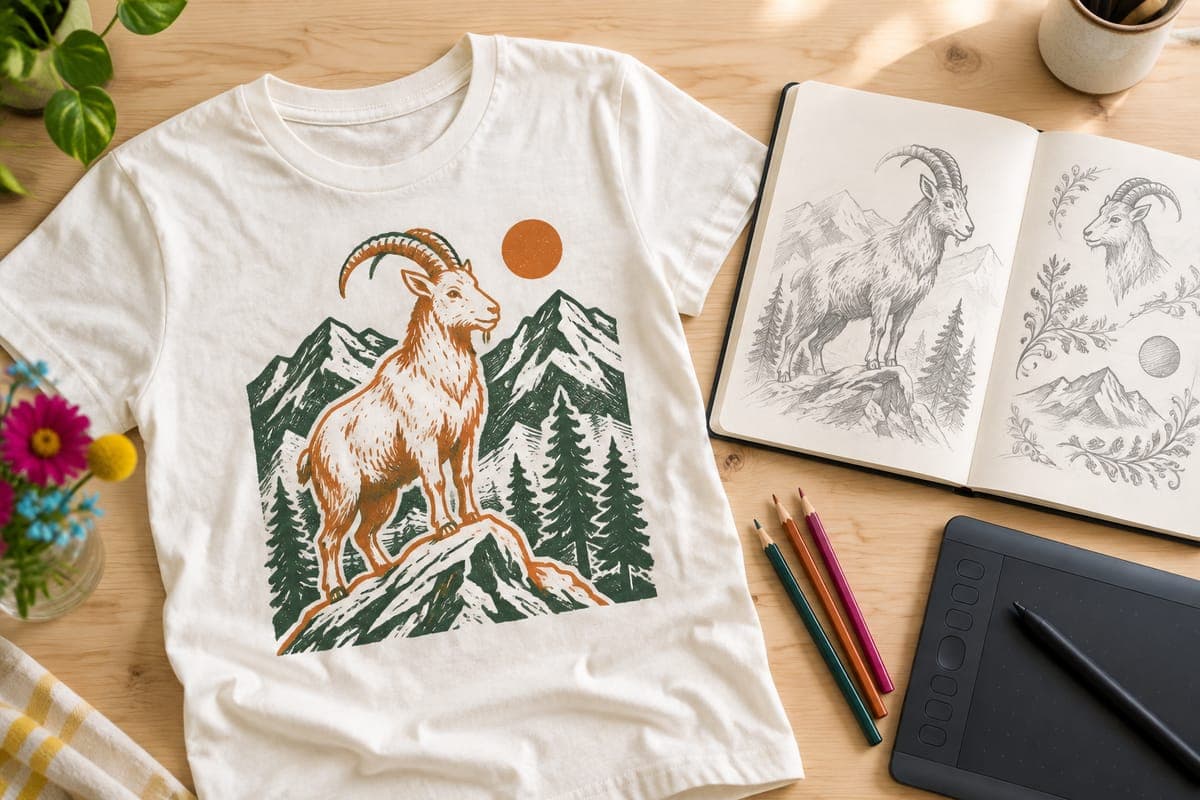
Here’s what a prompt built this way looks like: specific about the subject, style and palette, with no names in it.
Try this idea in POD Made Easy
“Linocut-style mountain goat on a rocky ridge at sunrise, three-color screen print look in cream, rust and pine green, transparent background”
The other legal basics for a POD shop
Rights are one part of running a shop that lasts. The others are the ones most sellers put off: paying tax on your profit (see our guides for US print-on-demand taxes and paying tax on Etsy sales in the UK) and, if you sell to Europe, the EU’s product safety rules, covered in GPSR for Etsy and POD sellers.
None of this should stop you using AI. It’s a drafting tool that lets a non-designer with five spare hours a week compete, as long as the final design is original, checked and honestly listed.
Frequently asked questions
- Can I sell images from free AI image generators?
- Sometimes. Terms can differ by plan: Recraft’s free tier, for example, is for personal use only and Recraft keeps ownership of those images, while OpenAI’s and Google’s standard terms don’t split ownership by plan. Check the terms for the exact plan you were on when you made the image.
- Do I have to say a design was made with AI?
- On Etsy, yes: you disclose AI use in the listing description. Some model terms also forbid passing output off as human-made; Black Forest Labs’ terms, for example, bar presenting output as entirely human-generated. You don’t usually need to name the specific tool.
- Can someone else sell the same AI image I made?
- If they generate a similar image themselves, the tools’ terms generally allow it, because outputs aren’t exclusive. If they copy yours, a purely AI-generated design may have no US copyright for you to enforce, although parts you created yourself can be protected.
- Is it legal to put AI-generated celebrities on products?
- It’s very risky. Many places protect a person’s name and likeness through publicity or personality rights, whether a person or a model made the image, and some AI terms require the person’s consent. Leave real people out of POD designs.
- Do I still own my Midjourney images if I cancel?
- Yes. Under Midjourney’s current terms, your ownership of the images you created continues if you downgrade or cancel. The exceptions: images you upscaled from other users stay theirs, and companies with more than $1 million a year in revenue need a Pro or Mega plan to own their images.
Keep reading
More legal & policy guides
Legal & policy
Public Domain Images for Print-on-Demand: Sources and Rules
Public domain images for print-on-demand in 2026: the 1930 cutoff, trusted free sources, license traps and how to turn vintage art into your own design.
Sep 24, 2026 · 12 min read
Legal & policy
GPSR for Etsy and POD Sellers: What the EU Rules Require
GPSR for Etsy print-on-demand sellers: who it covers, EU responsible person options, what each listing must show, and how Printify, Printful and Gelato help.
Sep 24, 2026 · 13 min read
Legal & policy
Print-on-Demand Taxes for US Etsy Sellers (2026 Guide)
Print-on-demand taxes for US Etsy sellers: the $20,000 1099-K rule, Schedule C and self-employment tax, sales tax on provider bills, deductions and 2026 dates.
Sep 24, 2026 · 13 min read