Can You Sell Fan Art on Etsy? The Honest Answer for POD
Can you sell fan art on Etsy? Usually not without a license. Why fan art gets removed, the myths behind it, the legal routes and original designs that sell.
By the POD Made Easy team · September 24, 2026 · 12 min read
Can you sell fan art on Etsy? You can list it, and plenty of shops do, but in most cases you don’t have the legal right to sell it. Characters, logos, names and catchphrases from films, shows, games, books and bands almost always belong to someone, and selling merchandise built on them without permission can infringe their copyright, their trademark or both.
Etsy doesn’t ask for proof of permission before a listing goes live. It mainly acts when rights owners report listings, and repeated reports can cost you your shop. This guide covers why fan art is riskier than it looks for print-on-demand (POD) sellers, the myths behind it, the legal ways to sell licensed or public-domain characters, and original designs that reach the same fans.
Key takeaways
- Most fan art is a derivative work: selling it without permission can infringe copyright, and character names and logos are often trademarks too.
- Drawing it yourself, crediting the creator, changing details or adding a disclaimer doesn’t make it legal to sell.
- Etsy doesn’t pre-approve listings. Rights owners report them, Etsy removes them, and repeat reports can cost you your shop.
- Legal routes exist: a license from the rights owner, written permission from an indie creator, or characters that are genuinely in the public domain (in their earliest form only).
- Original genre designs reach the same fans, and nobody can take them down for being yours.
Is fan art legal to sell?
Fan art usually touches three separate rights at once, and a design only has to break one of them to be taken down:
| Element of the design | Right it can infringe | Why it matters on merch |
|---|---|---|
| A character you drew yourself | Copyright, often trademark too | Well-known characters are protected as part of the works they appear in, especially when they have a distinctive look and personality |
| A character, show, game or band name | Trademark | Names are often registered for clothing, mugs and stickers, so using them on those products is exactly what the registration covers |
| A logo, emblem or title lettering | Trademark and copyright | On a product, it signals official merchandise |
| A catchphrase or quote | Trademark, sometimes copyright | Famous lines are often registered for apparel, and longer passages are copyrighted text |
| An actor’s, musician’s or athlete’s face | Right of publicity | Many US states let people control commercial use of their name and likeness |
| Screenshots, official art or traced images | Copyright | This is straightforward copying |
Simplified. Details vary by country and by case.
Copyright gives the owner the exclusive right to make derivative works, meaning new works based on the original. A new drawing of an existing character usually counts as one, however much skill went into it. The US Copyright Office makes the related point in its fair use guidance: you can’t claim copyright in someone else’s work, no matter how much you change it, without the owner’s consent.
Making fan art for yourself, or sharing it for free, is a different situation from selling it, and many rights owners tolerate non-commercial fan work. Putting it on products for sale is where the risk sits, because merchandise is exactly what rights owners license to other companies for money.
Why is there so much fan art on Etsy?
If fan art is risky, why do searches for popular characters return pages of it? Because of how enforcement works, not because it’s allowed.
- Etsy doesn’t pre-approve listings. It runs a notice-and-takedown system: rights owners report listings they believe infringe, and Etsy removes them. Etsy says it doesn’t decide which listings infringe.
- Rights owners choose what to chase. Some report aggressively, some focus on the biggest sellers and some rarely act. A listing that’s been live for a year hasn’t been approved. It just hasn’t been reported yet.
- You only see the survivors. Removed listings and closed shops disappear from search, so what’s left looks safer than it is.
- Success raises the risk. A listing that sells well ranks higher and is easier for brand-protection teams to find. The design you most want to scale is the one most likely to be reported.
What Etsy’s rules say about fan art
Etsy’s Intellectual Property Policy has no exception for fan art. When a rights owner files a report that meets Etsy’s requirements, Etsy removes the listing and emails you the reporter’s contact details. Etsy tells sellers not to create new listings for the reported content unless they’ve resolved it with the other party, and warns that repeat reports can cost you your selling privileges.
Etsy’s Seller Handbook even has an article on the subject, Fan Art and Fair Use: One Truth and Five Myths. Its message: fair use is one possible defense in the US, but the four-factor test is complex and unpredictable, and some rights owners see fan art as free advertising while others see lost licensing income. Etsy won’t referee that for you, and you can’t know in advance which kind of owner you’re dealing with.
There’s a second rule to keep in mind. Etsy’s Creativity Standards treat POD items as “designed by” you, which means the design should be your own original work. A character someone else created doesn’t become your design because you redrew it. (For how the Creativity Standards apply to AI-assisted art, see our guide to selling AI designs on Etsy.)
Fan art myths that get POD shops in trouble
Most fan art trouble starts with a belief that sounds reasonable. Here are the common ones:
| The myth | The reality |
|---|---|
| “I drew it myself, so it’s mine.” | The drawing is yours, but the character isn’t. A new drawing of a protected character is still a derivative work. |
| “I credited the creator.” | Credit isn’t permission. It can even show you knew exactly whose work you were using. |
| “My listing says it’s unofficial.” | A disclaimer doesn’t license anything, and it won’t stop a report. |
| “I changed it enough.” | There’s no percentage rule. What matters is whether the character is still recognizable, and fan art only works if it is. |
| “It’s fair use.” | Fair use is a defense that only a court can confirm, case by case. A shirt that sells because of a famous character is a weak candidate. |
| “It’s parody.” | Legal parody comments on the original work. Using a character to sell a joke about something else usually isn’t parody in that sense. |
| “The studio loves fan art.” | Many owners tolerate non-commercial fan work, and published fan content policies typically exclude selling merchandise. Read the actual policy. |
| “I only sell a few.” | Infringement doesn’t depend on volume. Low sales may keep you under the radar, not in the clear. |
| “Other shops sell the same thing.” | Their listings not being reported yet doesn’t protect yours. |
The US Copyright Office notes there’s no set number of words, notes or percentage of a work that makes copying safe.
Fan art, “inspired by” and genre designs: a risk ladder
Not every design that appeals to fans is fan art. The closer you get to someone else’s specific characters, names and imagery, the higher the risk. The closer you stay to broad genres and your own creations, the lower it gets.
| What you make | Example | Risk |
|---|---|---|
| Official art, screenshots or logos | Traced artwork or a cropped still from a show | Very high |
| A recognizable character, drawn by you | Your own version of a famous cartoon hero | High |
| Franchise or character names in the design, title or tags | “Inspired by [show]” in a listing title | High (trademark) |
| A famous quote or catchphrase from the property | A line every fan would recognize | High |
| A signature costume, emblem or color scheme, with no name | An unnamed figure in a character’s iconic outfit | Medium to high: recognizability is what counts |
| Genre tropes and archetypes | A wizard’s tower, a haunted house, a lone space pilot | Low |
| Original characters and worlds | Your own creature with its own name and story | Low |
A screening guide, not legal clearance. If a design sits in the middle rows, change it or skip it.
Titles and tags count too. A design can be completely original and still draw a trademark report if the listing uses a franchise name to catch fan searches. Keep brand, character and creator names out of your titles, tags and descriptions, and check any phrase you print with the steps in our guide to avoiding trademark infringement. Lyrics and film lines follow the same logic, covered in our guide to putting song lyrics and movie quotes on shirts.
If you design with AI, keep franchise and character names out of your prompts, and look closely at what comes back. Image models have seen famous characters and can produce lookalikes without being asked.
Original ideas, with a safety net
POD Made Easy builds every design from your own idea and flags famous brand, character, team and artist names in your prompt, design text, title and tags before you publish. It’s a safety net, not legal clearance, so keep running your own trademark checks too.
Start your free trialHow to sell fan art legally
There are legitimate routes. None of them is quick, but they exist.
1. License it from the rights owner
Big franchises license their characters through consumer products or licensing teams. Expect an application, product approvals, royalties on every sale and often a minimum guarantee paid up front. These programs are built for established manufacturers, so for a one-person POD shop, a major franchise license is a long shot.
2. Get written permission from an independent creator
Webcomic artists, indie game studios, authors and small bands are far easier to reach, and some welcome a fan who’ll make merch for a fee or a share of sales. Get it in writing, and cover:
- Which characters, artwork or names you can use
- Which products, and where you can sell them
- How long the permission lasts, and how either side can end it
- What the creator gets: a flat fee, a percentage of sales or both
- Whether they approve each design before it goes live
An email thread is better than nothing. A short signed agreement is better still, and having a lawyer draft one costs far less than a dispute.
3. Use a marketplace’s licensed program
Some print-on-demand marketplaces have run programs in which specific rights holders approve fan designs and take a share of each sale. They cover a limited list of properties and apply only on that marketplace, so they don’t make the same design legal in your Etsy shop.
4. Read official fan content policies
Some game companies and creators publish rules for fan works. Most cover non-commercial projects only. If a policy explicitly allows merchandise, follow its conditions exactly and save a dated copy of the version you relied on.
Public domain characters: the version trap
In the US, works published in 1930 or earlier are in the public domain as of January 1, 2026, and another year’s works join every January. That includes the earliest versions of some famous cartoon characters and many characters from classic novels, which you can use without a license. The fine print matters, though:
- Only the original version is free. Traits added later, such as a redesigned look, new colors, a voice, a sidekick or a catchphrase, can still be protected by the later works that introduced them.
- Trademarks don’t expire with copyright. Character names and designs can still work as trademarks on merchandise, where they signal official products.
- Other countries use different clocks. The UK and EU generally protect works until 70 years after the creator’s death, so a character that’s free in the US can still be protected there.
- Adaptations are separate works. A later film or TV version has its own copyright, even when the book it’s based on is public domain.
If you go this route, work from the original published source rather than a later adaptation, don’t style the name like a logo, and never imply the product is official. Our guide to public domain images for print-on-demand covers how to confirm dates and where to find genuinely free sources.
Original designs that sell to the same fans
Fans don’t only buy logos. They buy identity: the genre they love, the hobby that goes with it and the in-jokes of being a fan. You can sell to all of that without touching anyone’s characters.
- Genres, not franchises. Cozy fantasy, cosmic horror, retro sci-fi, cottage witchcraft and noir detective styles belong to no one.
- The fan lifestyle. Designs about rewatching a favorite series, reading past midnight, tabletop game night or waiting for the next season speak to fans of everything at once. Write your own wording, then search it before you publish.
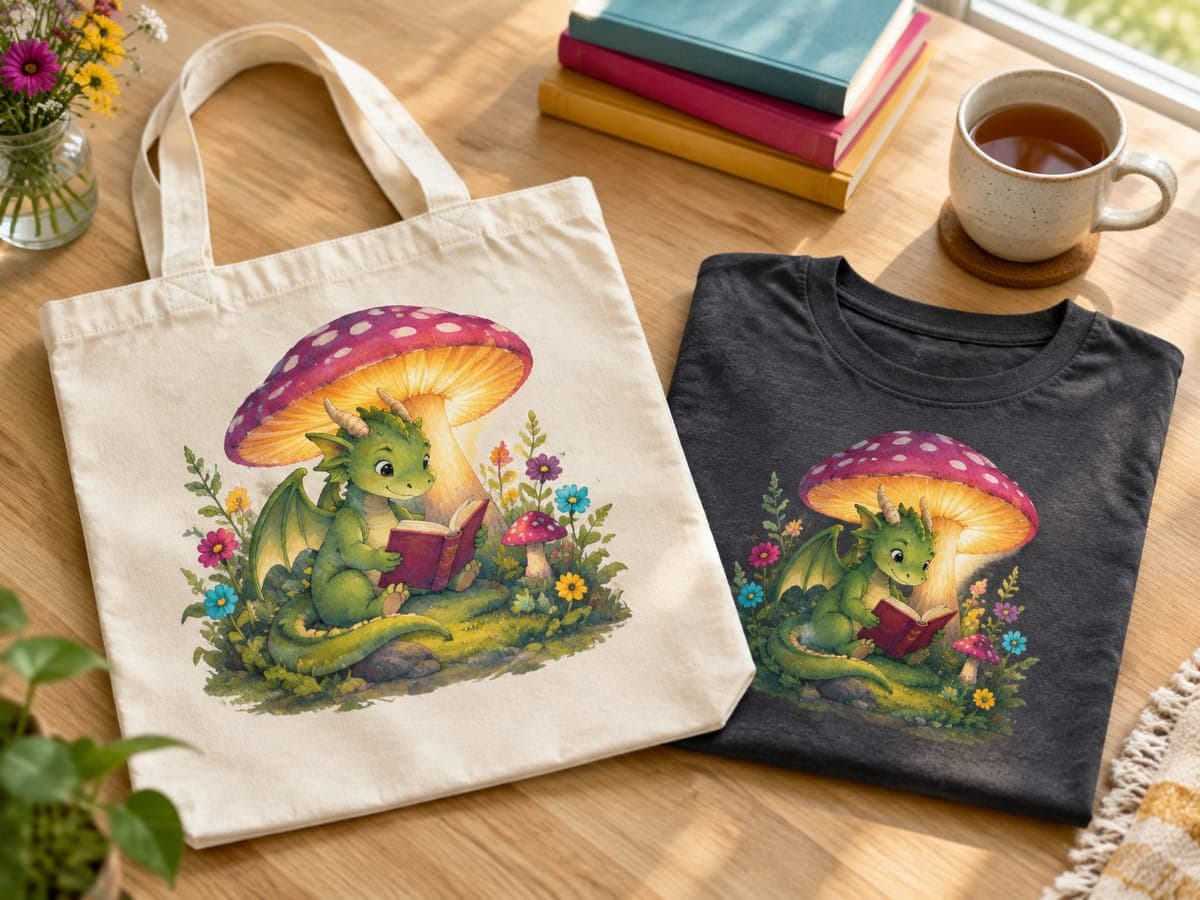
- Your own characters. A recurring original mascot, such as a grumpy owl librarian or a tiny dragon who hoards teacups, can carry a whole collection that belongs entirely to you.
- Adjacent niches. Readers, gamers and collectors overlap with niches you can target directly. Bookish merch ideas and our print-on-demand niches guide are good places to start.
Try this idea in POD Made Easy
“Original cozy fantasy illustration of a small friendly dragon reading a book under a glowing mushroom lamp, storybook style, warm autumn palette, transparent background”
Try this idea in POD Made Easy
“Retro 1980s sci-fi paperback cover style design of an original lone astronaut on a purple alien plain under two moons, grainy halftone, bold outlines, for a dark tee”
If a fan art listing gets reported
Don’t relist it, and don’t file a counter notice just because you disagree with the rules. Check your whole shop for the same character or name on every product type, remove the matches (in your POD provider too, so they aren’t republished) and note the reporter’s contact details from Etsy’s email. Our step-by-step guide to an Etsy intellectual property infringement notice covers retraction requests, counter notices and the risk of repeat reports.
Then use the moment to reset. One report is a warning; a pattern of them is what closes shops. Shift your collection toward original designs before the next report arrives, not after.
Frequently asked questions
- Is fan art protected by fair use?
- Rarely, when it’s sold on merchandise. Fair use is a legal defense that courts decide case by case, weighing four factors, including whether the use is commercial and whether it competes with the owner’s own products. A t-shirt that sells because of a famous character is a weak candidate.
- Can I sell fan art commissions on Etsy?
- The same rules apply. A commission is still a sale of a derivative work, and Etsy’s IP policy has no exception for one-off custom pieces. Commissions of a buyer’s own pet, family or original character are the safe version.
- Will Etsy warn me before it removes a fan art listing?
- Usually not. When a rights owner files a report that meets Etsy’s requirements, Etsy removes the listing and then emails you the reporter’s contact details. It doesn’t ask for your side first or decide who’s right.
- Can I use a character’s name in my tags if the design is original?
- Avoid it. Character and franchise names are often registered trademarks, and using them in titles or tags to catch fan searches can get a listing reported even when every line of the artwork is yours.
- Is fan art safer on Redbubble or other print-on-demand sites?
- Not legally. Copyright and trademark law are the same wherever you sell. Marketplaces differ in how they handle reports, and some have run licensed programs with specific rights holders, but those deals only cover that marketplace.
- What about fan art of bands, actors or athletes?
- It adds another layer. Band and team names and logos are usually trademarks, and a real person’s face or name can be protected by publicity rights in many places, even when you drew the portrait yourself.
Keep reading
More legal & policy guides
Legal & policy
Public Domain Images for Print-on-Demand: Sources and Rules
Public domain images for print-on-demand in 2026: the 1930 cutoff, trusted free sources, license traps and how to turn vintage art into your own design.
Sep 24, 2026 · 12 min read
Legal & policy
Etsy Intellectual Property Infringement: What to Do Next
Got an Etsy intellectual property infringement notice? What it means, your options (retraction or counter notice), a template and how to protect your shop.
Sep 24, 2026 · 12 min read
Legal & policy
How to Add an Etsy Production Partner (Printify, Printful)
Add an Etsy production partner for Printify, Printful or Gelato: the exact steps and fields, what to write, how to bulk-assign listings and what if you skip it.
Sep 24, 2026 · 9 min read