Bookish Merch Ideas: 50 Book Lover Designs That Sell
50 bookish merch ideas for romance, fantasy, mystery and library lovers, plus what you can and can’t quote, the products readers buy and the dates that sell.
By the POD Made Easy team · September 24, 2026 · 11 min read
Readers are a tribe of tribes. A romance fan who rates books by spice level, a fantasy reader who studies the map before chapter one and an annotator with a rainbow of sticky tabs all “love books,” but they’d rarely buy the same shirt. Good bookish merch ideas pick one of those readers and speak their language on the things they use: totes, sweatshirts, mugs and stickers.
This guide covers the reader tribes worth designing for, the copyright line that matters more in this niche than almost any other, 50 original design ideas, the products readers buy and the dates that drive sales.
Key takeaways
- Design for a reader tribe (romance, fantasy, mystery, horror, classics, library lovers, book clubs), not for “books” in general.
- Quotes from books still in copyright, characters, fictional places and author names are off-limits without a license.
- Tropes, genres and reading habits are fair game, and they’re what readers identify with most.
- Public-domain classics are usable in the US (most works published in 1930 or earlier, as of 2026), with edition and country caveats.
- Totes, crewneck sweatshirts, mugs and stickers are the core products, and personalized ex libris designs make strong gifts.
Who buys bookish merch? Reader tribes
Readers sort themselves by what they read and how they read it. Each tribe has its own vocabulary, visual language and favorite products, so a design that uses the right slang feels made for them.
| Tribe | What they love | Visual language |
|---|---|---|
| Romance readers | Tropes, happy endings, spice ratings | Hearts, chili peppers, bold retro type |
| Fantasy and romantasy readers | Maps, magic systems, dragons, fae | Hand-drawn maps, moons, swords, forests |
| Mystery and thriller readers | Clues, twists, unreliable narrators | Evidence boards, magnifying glasses, noir palettes |
| Horror readers | Dread and cozy spookiness | Cabins, candles, dark woods |
| Classics and dark academia fans | Old libraries, public-domain authors | Inkwells, candles, engraved etching styles |
| Library lovers and librarians | Libraries themselves | Due-date cards, card catalogs, library stamps |
| Annotators and trackers | Tabs, highlighters, reading logs | Rainbow palettes, grids, stationery |
| Book clubs | The group, the snacks, the arguments | Crests, badges, matching sets |
Tribes overlap, but each listing should speak to one of them in the title, tags and first photo.
Book clubs deserve a special mention: they’re one of the few bookish buyers who order in groups. A club crest with the club’s name and founding year can sell six or ten items in one order.
What you can and can’t put on bookish merch
This niche has more intellectual property traps than most, because the things readers love most (quotes, characters, covers) belong to authors and publishers. This isn’t legal advice, but here’s how the lines usually fall:
| Element | Why it’s risky or safe | What to do |
|---|---|---|
| Quotes from books still in copyright | The text is protected, and publishers do file takedowns | Write your own lines |
| Titles and short phrases | Not protected by copyright, but series titles and phrases can be trademarks | Don’t build a design around a real title |
| Author names | Some are registered trademarks, and using one implies endorsement | Leave them out |
| Characters, fictional places, houses and factions | Protected by copyright and often trademarked for merchandise | Invent your own or use genre archetypes |
| Cover art and cover typography | Protected artwork and distinctive design | Don’t imitate a real cover’s look |
| Tropes, genres and reading slang (TBR, DNF) | Ideas and common terms generally aren’t protected | Fair game; still search exact slogans |
| Public-domain classics | In the US, most works published in 1930 or earlier (as of 2026) | Check the edition, translation and your markets |
General information, not legal advice. Search slogans in the USPTO database before you publish.
The US Copyright Office’s Circular 33 confirms that titles, names and short phrases aren’t protected by copyright, but that doesn’t make them free to use: trademarks work differently, and many series, fictional places and some author names are registered for clothing and gifts. Search any phrase in the USPTO trademark database before you print it.
Public-domain classics are the big exception. On January 1, 2026, works published in 1930 entered the US public domain, according to Duke’s Center for the Study of the Public Domain, and 1931 works follow on January 1, 2027. Three caveats: a modern translation or annotated edition has its own copyright, film adaptations and their imagery are separate works, and the UK and EU generally protect a work until 70 years after the author’s death, so a book that’s free in the US may not be free there. Our guides to public-domain images and selling fan art on Etsy go deeper, and our guide to quotes and lyrics on shirts explains why attribution isn’t permission.
50 bookish merch ideas by reader tribe
All of these are original concepts built on genres, tropes and reading habits rather than anyone’s books. Adapt the style, the wording and the product to your shop.
Romance readers (1–7)
- Trope bingo. A bingo card of romance tropes: fake dating, grumpy and sunshine, only one bed, second chances.
- Spice scale. A row of chili peppers rating a book’s heat, cheeky rather than explicit.
- Grumpy and sunshine. A storm cloud and a smiling sun sharing an umbrella.
- Enemies to lovers. Two crossed swords whose blades curve into a heart.
- Romance readers’ club. A vintage members-club badge with your own motto.
- Happy ending required. A contract-style design stating the reader’s one non-negotiable.
- Fictional crush sign-up sheet. A clipboard waiting list for fictional crushes, in your own words.
Fantasy and romantasy readers (8–14)
- An invented map. A hand-drawn map of a realm you make up, with your own place names.
- Dragon hoard. A dragon asleep on a pile of books instead of gold.
- Fae forest. Mushrooms, moths and a crescent moon in a dark wood.
- Sword and quill crest. A crest of a crossed sword and quill with an invented motto.
- Spell book. An ornate grimoire with glowing runes of your own design.
- Prophecy checklist. A scroll listing everything a chosen one must do, ticked off with sarcasm.
- Side-character fan. A design for readers who love the side characters more than the hero.
Mystery, thriller and horror readers (15–20)
- Evidence board. Red string connecting clues pinned to a corkboard.
- Cozy mystery. A teacup, a sleeping cat and a magnifying glass.
- Unreliable narrator. A mirror reflecting a slightly different face.
- Plot twist ahead. An original road sign with a hairpin bend.
- One lit window. A lone cabin with one lit window in a dark forest, for horror readers.
- Reading with the lights on. A reader in bed surrounded by every lamp in the house.
Classics and public-domain lines (21–26)
- Dark academia desk. A candle, an inkwell and a leather-bound book in an engraved style.
- Classic line series. Short lines from public-domain novels in typewriter type, checked against an original edition.
- Victorian botanicals. Pressed-flower illustrations framing a public-domain line.
- Library ladder. A tall bookcase with a rolling ladder.
- Typewriter page. A vintage typewriter with a sheet caught mid-sentence, for readers who write.
- Penny-dreadful cover. A Victorian illustrated cover for an invented story.
Try this idea in POD Made Easy
“Dark academia design, a lit candle beside an inkwell and an old leather-bound book on a wooden desk, deep forest green and antique gold, engraved etching style, transparent background” · text: “Chapter by Candlelight”
Library lovers and librarians (27–32)
- Due-date card. A vintage library pocket card with a column of stamped dates.
- Personal library card. An old-fashioned card personalized with the reader’s name, not copying any real library’s design.
- Card catalog. Drawers labeled with the buyer’s favorite genres.
- Librarian owl. An owl in half-moon glasses with a wing raised for quiet.
- Book return portal. A book drop slot glowing like a door to another world.
- Library haul. A tote bag drawn overflowing with books, printed on a tote bag.
Try this idea in POD Made Easy
“Vintage library due-date card tucked in a book pocket with a column of hand-stamped dates, retro typewriter style, faded blue and red ink on cream, transparent background” · text: “Returned Late, Loved Deeply”
TBR piles, annotators and reading habits (33–40)
- TBR tower. A wobbly stack of to-be-read books taller than the reader.
- Cat supervisor. A cat asleep on top of the stack, guarding it.
- Annotation kit. Sticky tabs, highlighters and pencils fanned out in a rainbow.
- DNF permission slip. An official-looking certificate granting permission not to finish a book.
- Reading tracker. A grid of 52 book spines to color in, great as a print or poster.
- Bookmark collection. A flat lay of illustrated bookmarks in a pattern.
- 2 a.m. reader. A clock pointing to 2 a.m. and a book open in bed.
- Rain and reading. Raindrops on a window, a mug and an open book.
Try this idea in POD Made Easy
“Tall wobbly stack of colorful books with a tabby cat asleep on top, cozy hand-drawn illustration, muted sage, mustard and cream, transparent background” · text: “Supervised by a Cat, Buried in Books”
Book clubs (41–44)
- Club crest. A personalized crest with the club’s name and founding year, sold as a group order.
- Snack board. A snack board with a book tucked beside the cheese, about the real reason people come.
- Club roles. A matching set with roles such as the host, the one who didn’t finish and the one who cried.
- Meeting calendar. A year of club dates with a small icon for each month’s book, left generic.
Check your wording before readers do
Readers notice typos faster than anyone. POD Made Easy spell-checks AI-rendered text with a vision model before a design can be published, flags famous brands and characters, and writes the Etsy title, 13 tags and AI disclosure, so a tote or sweatshirt goes live clean.
Start your free trialE-readers and audiobooks (45–47)
- E-reader case stickers. Small, bold stickers sized for e-reader cases, with brand-free wording.
- Audiobook listener. Headphones wrapped around a book, for commuters and dog walkers.
- Every format counts. A paperback, an e-reader and headphones as a friendly trio.
Young readers and reading families (48–50)
- Blanket-fort story time. A parent and child reading by flashlight under a blanket fort.
- Ex libris bookplate. A “from the library of” bookplate design personalized with a name, for tees, totes and stickers.
- Little reader. A toddler tee with a board book and a tiny crown.
Librarians and reading teachers are a natural crossover. Our teacher shirt ideas include designs for school librarians and reading specialists.
Products readers actually buy
- Tote bags: the signature bookish product, for library hauls and bookstore trips. Bold, simple art reads best on canvas.
- Crewneck sweatshirts: “reading sweatshirt” is a gift in itself. A small chest design or a large front print both work.
- Mugs: tea and coffee are part of the reading ritual. Keep words short and type large.
- Stickers: for e-reader cases, laptops and water bottles, and an easy add-on. Small print areas need simplified art; see our sticker design size guide and sticker selling guide for the margins.
- Blankets and pillows: for the reading nook, especially in the Christmas season.
- Prints and posters: library-style wall art and reading trackers.
- Bookmarks: only if your provider offers them; check its catalog.
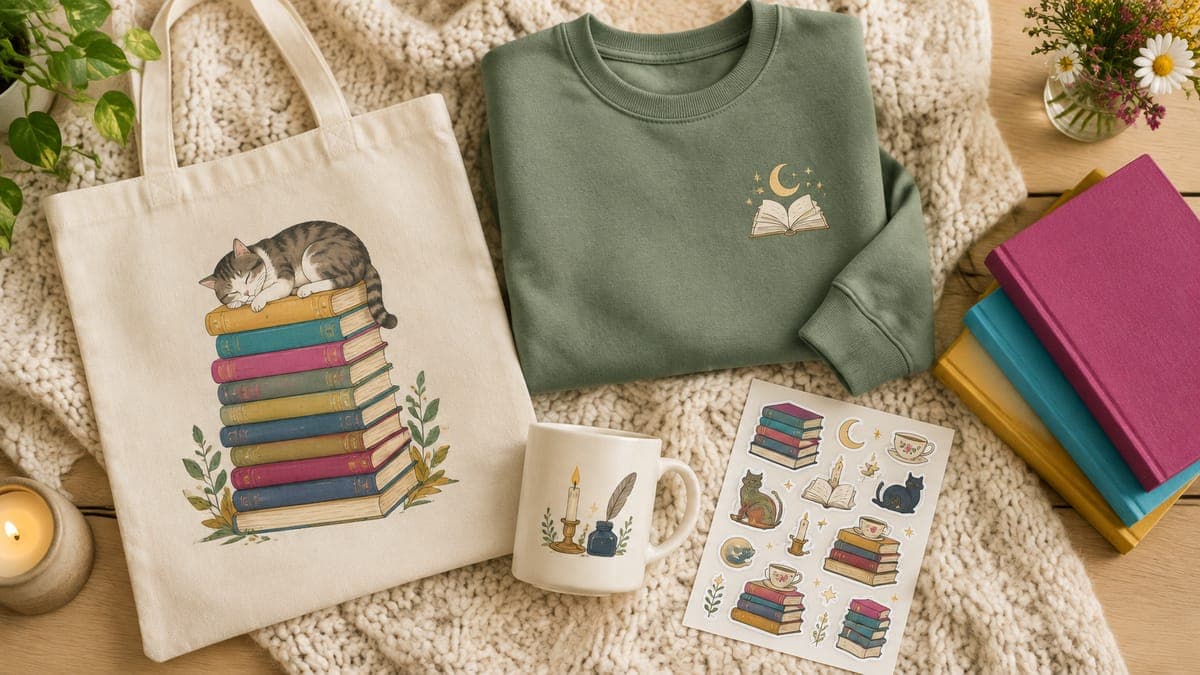
Style your mockups with plain or blank-spined books. A recognizable real cover in your product photo puts someone else’s artwork and trademark in your listing.
Dates that drive bookish sales
| Date | Moment | Design angle | Have listings live by |
|---|---|---|---|
| Oct 31, 2026 | Halloween | Horror readers, spooky reading nooks | Now |
| Nov–Dec 2026 | Christmas gifts for readers | Totes, sweatshirts, ex libris gifts | Late October |
| Jan 1, 2027 | Works published in 1931 enter the US public domain | New classic-line designs | January |
| Feb 14, 2027 | Valentine’s Day | Romance readers, trope designs | Early January |
| March 2027 | Reading month in many US schools; World Book Day in the UK and Ireland (Mar 4) | Reading families, teachers | Mid-February |
| April 2027 | National Library Week (Apr 11–17) and World Book and Copyright Day (Apr 23) | Library lovers, librarians | Mid-March |
| Summer 2027 | Summer reading and beach reads | Beach, travel and TBR designs | May |
Christmas is the biggest gift window. Check each work’s publication date and later editions before using new public-domain material.
For the rest of the year’s selling seasons, see our print-on-demand seasonal calendar.
How to list bookish merch so readers find it
Put the tribe and the product first in your title (“romance reader sweatshirt,” “library tote bag,” “cozy mystery mug”), and use your 13 tags for the tribe, the trope or habit, the product and the recipient (“gift for book lover,” “book club gift”). Avoid author, series and device brand names in titles and tags, even when buyers search for them.
Etsy title & tag checkerCheck title length, the 20-character tag limit and repeated words before you publish a bookish series.Pick one reader tribe you belong to, publish five to ten designs across a tote, a sweatshirt and a sticker, and let views and favorites show you which tropes and habits your readers respond to. For more ways to find and validate niches like this one, see our print-on-demand niches guide.
Frequently asked questions
- Can I use an author’s name on bookish merch?
- It’s best not to. Some authors register their names as trademarks, and using a living author’s name on a product can suggest they endorse it. Design around the reading experience, genres and tropes instead of a specific author or series.
- Can I sell “spicy book” merch on Etsy?
- Cheeky, suggestive humor for romance readers is common, but Etsy restricts adult and sexually explicit content. Keep designs playful rather than explicit, keep the first photo and title tame, and read the mature content rules in Etsy’s Prohibited Items Policy before you list.
- When do books enter the public domain in the US?
- On January 1 each year. As of 2026, most works published in 1930 or earlier are public domain in the US, and works from 1931 join them on January 1, 2027. Other countries usually count from the author’s death instead.
- What do book lovers want as gifts?
- Things they use while reading: a tote for library hauls, a mug, a cozy sweatshirt or a blanket. Personalized ex libris designs with the reader’s name make a book-lover gift feel made for them.
- Is bookish merch too competitive for a new shop?
- Generic “I love books” designs are crowded. Reader tribes such as cozy mystery fans, romance trope lovers, annotators or book clubs are much narrower, and a design that uses their exact slang stands out.
Keep reading
More niches & trends guides
Niches & trends
The Best Print-on-Demand Products to Sell in 2026 (Ranked)
The best print-on-demand products to sell in 2026, scored on margin, shipping cost, gift demand and production risk, with example profits and a starter plan.
Sep 24, 2026 · 10 min read
Niches & trends
Print-on-Demand Niches: 50 Ideas and How to Validate Them
How to find profitable print-on-demand niches in 2026: a simple niche formula, a free 30-minute validation check, 50 niche ideas and when to list seasonal ones.
Sep 24, 2026 · 12 min read
Niches & trends
Print-on-Demand Pet Products: What to Sell (and Personalize)
Print-on-demand pet products worth selling on Etsy: bandanas, bowls, owner apparel and portraits, plus margins, breed targeting and personalization workflows.
Sep 24, 2026 · 10 min read