Can You Put Song Lyrics or Movie Quotes on Shirts You Sell?
Can you put song lyrics on shirts you sell? Usually only with a license. What’s protected, how much you can quote, public-domain songs and safer ideas.
By the POD Made Easy team · September 24, 2026 · 10 min read
Can you put song lyrics on shirts you sell? In most cases, not without permission. Lyrics are protected by copyright as part of the song, so printing a verse, a chorus or a line fans instantly recognize on merchandise generally needs a license from the song’s music publisher. Memorable lines from films, TV shows and books work the same way.
There are real exceptions, though. Very short, common phrases aren’t protected by copyright on their own, songs published in 1930 or earlier are in the US public domain, and lines you write yourself are yours. Below you’ll find where the lines fall, how licensing actually works, and how to make lyric-style designs you can sell with confidence.
Key takeaways
- Song lyrics are copyrighted as part of the musical work, usually for 70 years after the last songwriter dies (or 95 years from publication for older songs).
- There’s no safe word count. A distinctive line can draw a report, while a short, everyday phrase generally isn’t copyrightable (but may be trademarked).
- Crediting the artist, adding a disclaimer or calling it fan merch doesn’t give you permission.
- Licenses come from the music publisher, not the performer, and big publishers often don’t take small one-off requests.
- Songs published in 1930 or earlier are public domain in the US as of 2026, but check the exact version and where you sell.
- Original lyric-style lines, written by you and searched on the USPTO, are the dependable route.
Are song lyrics copyrighted?
Yes. Every song carries two separate copyrights:
- The musical work: the melody and the lyrics, owned by the songwriters and usually managed by music publishers.
- The sound recording: one specific recorded performance, usually owned by a record label or the artist.
Printing words on a shirt uses the musical work, so the people who can say yes are the songwriters and their publishers, not the singer who made the song famous (unless they wrote it). Copyright exists without a © notice or a registration, so assume any modern song is protected. How long it lasts depends on when the song was published and where you sell:
| When the song was published | US status (September 2026) | UK and EU |
|---|---|---|
| 1930 or earlier | Public domain, in its original published form | Generally protected until 70 years after the last surviving lyricist or composer died |
| 1931 to 1977 | Usually protected for 95 years from publication (a few are free because a copyright wasn’t renewed or notice was missing, which takes research to prove) | The same 70-years-after-death rule |
| 1978 or later | Protected for the life of the last surviving songwriter plus 70 years | The same 70-years-after-death rule |
Simplified. Company-owned and anonymous works follow different terms, and each country has its own rules for foreign songs. In the US, songs published in 1931 join the public domain on January 1, 2027.
How many words of a song can you use?
There’s no safe number. The US Copyright Office says plainly that no legal rule permits the use of a specific number of words, musical notes or percentage of a work. What matters is what you take and how recognizable it is.
The one real carve-out is for very short phrases. The Copyright Office won’t register words and short phrases such as titles, slogans and catchphrases, even when they’re clever or distinctive (see its Circular 33, Works Not Protected by Copyright). So a two- or three-word everyday expression that happens to appear in a song generally isn’t protected by copyright on its own.
That still leaves three ways a short line can cause trouble:
- Distinctive lines. The more original and recognizable a line is, the more it looks like a piece of the song rather than a common phrase, and the more likely a publisher is to report it.
- Trademarks. Circular 33 itself notes that names, titles and short phrases may be protected under trademark law. Famous lines, song titles and artist names are often registered for clothing.
- Takedowns don’t wait for a verdict. Etsy removes a listing when a rights owner files a valid report. Even if you might win in court, the listing is gone in the meantime.
| What you print | Copyright risk | Other risks | What to do |
|---|---|---|---|
| A full verse, a chorus or several lines | High | Artist names and art often get added too | License it or skip it |
| One distinctive line fans recognize instantly | Medium to high | Publisher reports; the line may be a trademark | Treat it as needing a license |
| A song title on its own | Low: titles aren’t copyrightable | Titles can be trademarks, and a title with the artist’s imagery reads as fan merch | Search the USPTO and leave out artist names and art |
| An everyday phrase that also appears in songs | Low | It may be registered for apparel | Search the USPTO, then decide |
| A line you wrote yourself | None: it’s yours | Someone may have registered similar wording | Search the USPTO, then publish |
A screening guide, not legal clearance.
For any phrase you plan to print, run it through the USPTO’s free Trademark Search and check the class for your product (class 25 for apparel). Our guide to avoiding trademark infringement walks through the search step by step.
What about movie quotes, TV lines and book quotes?
The same logic applies. Screenplays, scripts and books are copyrighted, so longer passages need permission. Short famous lines often aren’t copyrightable on their own, but studios, publishers and estates often register the best-known lines, character names and titles as trademarks for clothing and other merchandise. The Copyright Office lists character names and catchphrases among the things copyright doesn’t cover and points to trademark law for exactly that reason.
Quotes from real people add two more checks:
- Who owns the words. Speeches, interviews and books by modern figures can be copyrighted by the speaker or their estate. Text published in 1930 or earlier is public domain in the US, but a modern translation of an older text can have its own copyright.
- The name and the face. Putting a famous person’s name or portrait on a product can raise right-of-publicity issues in many US states, in some cases for decades after death.
Also check that the quote is real. Misattributed quotes circulate widely, and a shirt that credits the wrong person invites complaints even when it’s legal.
Why credit, disclaimers and “fair use” won’t save the listing
Three beliefs keep lyric shirts coming back to Etsy search:
- “I credited the artist.” Credit isn’t permission. Adding the performer’s name can make it worse, because artist names are often registered trademarks and are covered by publicity rights.
- “It says unofficial.” A disclaimer doesn’t license the words, and it doesn’t stop a report.
- “It’s fair use.” Courts weigh four factors, including whether the use is commercial and whether it harms the market for the original. A shirt that sells because of the lyric is commercial, uses the part fans care about and competes with merchandise the publisher could license. Only a court can decide fair use, and the Copyright Office’s advice when in doubt is to get permission.
Fan art runs on the same myths. Our guide to selling fan art on Etsy goes through the rest of them.
How to license lyrics for merchandise
Licensing is possible, but it’s built for businesses that can pay advances and handle approvals. Here’s how it works:
- Find every songwriter and publisher. Songs often have several writers, each with a publisher controlling a share. The searchable databases of the US performing rights organizations (ASCAP, BMI and SESAC) and The MLC’s public work search show who publishes most commercially released songs. Those organizations license performances and streaming, not t-shirts, but they tell you whom to ask.
- Ask each publisher for a merchandise license. Name the song and its writers, the exact lines, the products, where you’ll sell, your expected quantity and price, and the dates.
- Expect terms, or a no. A yes usually comes with a fee or royalty, often an advance and approval of the design. Many publishers don’t take small one-off requests at all.
- Clear the extras separately. The lyric license covers the words. The artist’s name, photo, logo and album art belong to the artist, their label or their merch company, and each needs its own permission.
- Get it in writing and keep it. If a report comes in later, a signed license from every publisher is your answer.
Honestly, for a side-hustle shop, licensing a hit song rarely makes financial sense. Independent musicians are the exception: many control their own publishing, answer their own email and may welcome a fair deal, which also gives you a partner who’ll share the product with their fans.
Your own words, print-ready
POD Made Easy turns lines you write into print-ready designs at the exact print size, spell-checks the lettering with a vision model and flags famous brand, character and artist names in your prompt, title and tags. It can’t recognize a lyric, so what you write is still your call.
Start your free trialPublic domain songs: what’s actually free
In the US, songs published in 1930 or earlier are in the public domain as of January 1, 2026, and each New Year’s Day adds another year. That opens up many traditional folk songs, hymns, spirituals, nursery rhymes and early popular songs. Before you print one, check four things:
- The exact wording. Old songs often picked up new verses, rewrites or translations decades later, and those newer versions can be protected. Print the words as originally published.
- The publication date, not the recording date. A 1925 song recorded in 1975 is free to print, but the 1975 recording isn’t free to use. Recordings follow separate rules: in 2026, US recordings from 1925 entered the public domain.
- Where you sell. In the UK and EU, a song with words is generally protected until 70 years after the last surviving lyricist or composer dies, with country-specific rules for foreign songs, so a song can be free in the US and still protected in Europe.
- Trademarks. A public-domain title or phrase can still be registered for clothing today. Search it anyway.
Faith-based designs have their own wrinkle: modern Bible translations are copyrighted, each with its own permission rules. See Christian shirt ideas for wording tips, and our guide to public domain sources for how to confirm dates.
Write your own: lyric-style designs you can sell
Most people who buy lyric shirts want a feeling: a genre, a memory, a mood. You can sell that feeling with words you write yourself. Some formulas that work:
- The invented tracklist. A back print styled as the “album” of a buyer’s life, such as a dog mom’s greatest hits or a teacher’s Friday playlist, with every track title written by you.
- Genre voice, original words. A country-heartbreak line about a lost TV remote, or a power-ballad ode to morning coffee. Writing in a genre’s style isn’t copying a song.
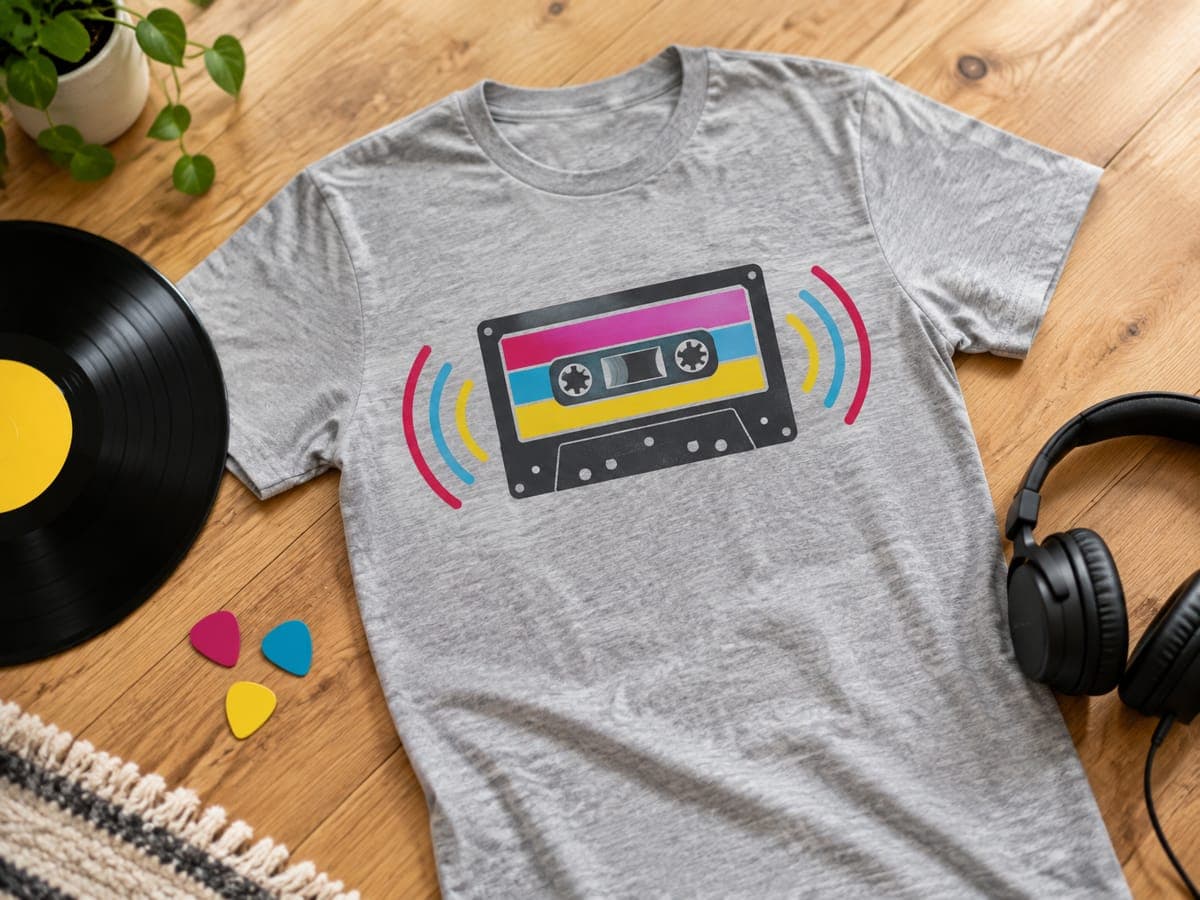
- Music imagery without names. Cassettes, vinyl, sound waves, mixtape labels and equalizer bars are free to use. Invented festival lineups work too, once you’ve searched the invented band names.
- The buyer’s own words. Personalized designs with a family saying, a couple’s inside joke or a kid’s funniest quote sidestep the question entirely.
- Musician identity. Drummers, choir members, band parents, piano teachers and karaoke regulars all buy shirts about who they are.
Try this idea in POD Made Easy
“Retro mixtape cassette with a hand-drawn sound wave coming out of it, sunset orange and teal palette, distressed screen-print texture, transparent background” · text: “Kitchen Dance Party Headliner”
Lettering carries these designs, so choose type that’s legible and licensed for merchandise. Our guide to the best fonts for t-shirts covers both, and t-shirt design ideas by niche has more starting points.
If a lyric shirt gets reported
Etsy will remove the listing and email you the reporter’s contact details. Take the same line off every product in your shop (mugs and stickers too) and out of your POD provider so it isn’t republished, and keep artist names out of your tags from now on (our Etsy tags guide shows how to fill all 13 without them). If you truly believe the report is a mistake, our guide to handling an Etsy IP infringement notice explains retractions and counter notices.
Frequently asked questions
- Can I sell a shirt with just a song title on it?
- Song titles aren’t protected by copyright, but they can be registered trademarks, and a title paired with the artist’s name, photo or album art reads as unofficial merch. Search the title in the USPTO database and keep artist names and imagery out.
- Do I need permission to use one line from a song?
- Often, in practice. US copyright law has no safe word count, and a distinctive line that fans recognize can be reported by the publisher. Very short, everyday phrases generally aren’t copyrightable on their own, but check them for trademarks.
- Is it legal to sell lyrics if I hand-letter them myself?
- No. Writing the lyrics out yourself, in any font or style, still reproduces the words. The lettering may be your work, but the lyrics still belong to the songwriters and their publishers.
- Can I sell lyric shirts if I only make a few?
- Quantity doesn’t change the law. A small shop may attract less attention, but a single report can still remove the listing, and repeat reports can put your whole shop at risk.
- Are Christmas carols and old hymns public domain?
- Many traditional ones are, in their original published form, because they were published long before 1931. Newer verses, modern arrangements and recent carols are protected, so check the exact wording and when it was first published.
Keep reading
More legal & policy guides
Legal & policy
Public Domain Images for Print-on-Demand: Sources and Rules
Public domain images for print-on-demand in 2026: the 1930 cutoff, trusted free sources, license traps and how to turn vintage art into your own design.
Sep 24, 2026 · 12 min read
Legal & policy
Can You Sell Fan Art on Etsy? The Honest Answer for POD
Can you sell fan art on Etsy? Usually not without a license. Why fan art gets removed, the myths behind it, the legal routes and original designs that sell.
Sep 24, 2026 · 12 min read

Legal & policy
Etsy Intellectual Property Infringement: What to Do Next
Got an Etsy intellectual property infringement notice? What it means, your options (retraction or counter notice), a template and how to protect your shop.
Sep 24, 2026 · 12 min read