What Sells on Etsy in 2026? POD Categories and Demand Checks
What sells on Etsy for print-on-demand in 2026: the product categories that suit POD sellers, why they sell, and free ways to check demand before you design.
By the POD Made Easy team · September 24, 2026 · 10 min read

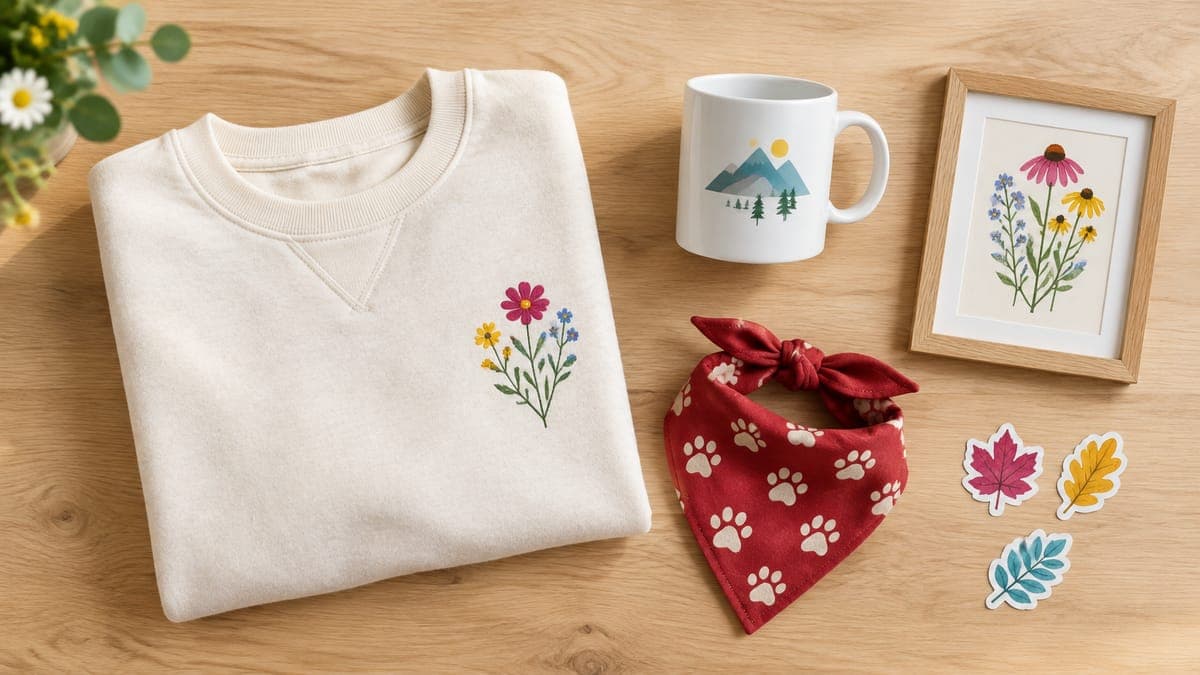
For print-on-demand (POD) sellers, what sells on Etsy is rarely a product type on its own. It’s a product made for someone specific: personalized gifts, apparel for a hobby, job or identity, wall art for a particular room or style, mugs and stickers with a niche joke, pet items and seasonal designs. Etsy shoppers look for things that feel chosen for a person or an occasion, and those searches are where POD designs win.
Etsy doesn’t publish a list of its best-selling products, so be wary of “top 10” lists that quote sales figures. This guide covers the categories that suit POD sellers, why each one works, what to watch for, and a free 20-minute demand check you can run on any idea before you design it.
Key takeaways
- Specific beats generic: Etsy has more than 100 million listings, and shoppers find you through precise, gift-shaped searches.
- The POD categories that fit Etsy best are personalized gifts, identity and hobby apparel, wall art, mugs, stickers, pet products and seasonal designs.
- Check demand with Etsy’s own data: Marketplace Insights shows 30-day searches and listing counts for 15 keywords a week, free.
- Recent reviews on page-one listings are a better demand signal than favorites or viral videos.
- Research the need, never copy the design: copying breaks Etsy’s rules and can be infringement.
Why specific designs sell on Etsy
Etsy’s own disclosures mention more than 100 million listings. A generic “funny shirt” competes with a big slice of them. A “retro pickleball shirt for grandpa” competes with far fewer, and the shopper typing it already knows what they want. Three things push Etsy demand toward specific items:
- Gifting. Gift shopping is central to Etsy: it even runs a Gift Mode that recommends listings by recipient type, and its own tagging advice includes recipient and occasion phrases because gift shoppers search that way.
- Identity. People buy things that say something about them or someone they love: a job, a hobby, a pet, a family role.
- Search behavior. Etsy’s own seller guidance notes that shoppers who know what they want use more specific searches, and that those long-tail searches tend to convert better.
So the useful question isn’t “what sells on Etsy?” but “who on Etsy is looking for something I can make well?” Our guide to print-on-demand niches has a formula for answering it.
The POD categories that sell on Etsy, and why
| Category | Why it works on Etsy | Watch out for |
|---|---|---|
| Personalized gifts (names, dates, photos) | Made for one person, easy to justify as a gift, hard to find in stores | Every order needs a check before production |
| Identity and hobby apparel | Bought for yourself and as gifts for the nurse, angler or reader in your life | Broad niches are crowded; you need a specific angle |
| Wall art (posters, framed prints, canvas) | Shoppers browse by room, style and color; one design sells in several sizes | Aspect ratios, damage in transit, heavier framed shipping |
| Mugs and drinkware | An affordable gift that suits almost any niche | Shipping is high relative to the price; breakage |
| Stickers | Cheap add-ons and impulse buys | Low prices leave little room after fees and postage |
| Pet products and pet-owner gifts | Owners love breed-specific and pet-name items | Breed accuracy; custom portraits take time |
| Seasonal and event designs | Predictable search spikes every year | Short windows and production cut-offs |
Our assessment for POD sellers, not Etsy sales data. Margins depend on your provider’s prices and your own.
Personalized gifts
Names of grandkids on a sweatshirt, a pet’s name on a mug, a family name and year on reunion shirts. Etsy’s Creativity Standards explicitly allow buyer-personalized items made by a production partner, and Etsy’s personalization fields now support up to five questions per listing. The catch is time per order. Our guide to personalized print-on-demand on Etsy covers the setup and the order review.
Identity and hobby apparel
Tees, sweatshirts and hoodies for jobs (nurses, teachers, electricians), hobbies (fishing, sewing, birding), life stages (new grandma, retiree) and places. It’s where most POD shops start, so broad niches are crowded and the angle matters: “labor and delivery nurse” rather than “nurse”, “fly fishing grandpa” rather than “fishing”. Browse 120 t-shirt design ideas by niche for starting points.
Try this idea in POD Made Easy
“Retro badge of a vintage sewing machine with a spool of thread and crossed pins, distressed screen-print texture, mustard, teal and cream, transparent background” · text: “Fabric Stash Keeper”
Wall art
Posters and framed prints sell by style (mid-century, botanical, minimalist) and by room. One design can be listed in several sizes if you design in the right aspect ratio. Gelato and Prodigi are strong here; see our guide to print-on-demand wall art.
Try this idea in POD Made Easy
“Mid-century style poster of layered desert mesas at dusk, flat shapes in terracotta, dusty pink and sand, subtle paper grain”
Mugs and stickers
Mugs are an easy gift in almost any niche, but shipping is heavy relative to the price, so check your margin before you list. Stickers are the opposite: light and cheap, which is exactly the problem. On an illustrative $4.50 sticker, Etsy’s standard fees alone come to about $0.88 (the $0.20 listing fee, the 6.5% transaction fee and 3% + $0.25 processing), roughly a fifth of the price, before you pay for the sticker and postage. They work best as add-ons to bigger orders. See POD mugs and selling stickers on Etsy.
Pet products
Bandanas, bowls, beds, owner apparel and pet-name mugs. Breed-specific designs do the work that “dog lover” can’t, and personalization with the pet’s name adds gift appeal. More in our guide to print-on-demand pet products.
Seasonal designs
Christmas, Halloween, Valentine’s Day, Mother’s and Father’s Day, graduation and back to school bring reliable search spikes, but the listing has to be live before shoppers start searching, and production and shipping cut-offs come early. Our POD seasonal calendar shows when to list for each date.
For a product-by-product ranking using a transparent scoring rubric, see the best print-on-demand products to sell.
How to check demand yourself in 20 minutes
Run this on any idea before you spend an evening designing it:
- Write the idea as a search. Who it’s for plus the product: “sewing lover sweatshirt”, not “sewing”.
- Look it up in Marketplace Insights (Shop Manager → Stats). Note the searches and the number of listings for the last 30 days, then check the related terms for sharper angles. You get 15 free lookups a week at the time of writing; Etsy’s help article explains the tool.
- Search it on Etsy and read page one. Is it full of close matches, or of loosely related items? A page of near misses is an opening.
- Check recent reviews on five top listings. Reviews with dates in the last few weeks mean those items are selling now. Not every buyer leaves a review, so treat reviews as a floor, not a count.
- Check the season. Marketplace Insights shows 30-day trends; Google Trends shows whether a phrase peaks at one time of year.
- Check the price. Note what the top listings charge, including shipping, and make sure you’d still profit at that price with your provider’s costs and Etsy’s fees.
If you want to go deeper on the keyword side of this check, our Etsy keyword research guide has a worked example.
A demand scorecard you can reuse
| Signal | 0 points | 1 point | 2 points |
|---|---|---|---|
| Searches in the last 30 days | Barely any | Steady | Strong for a specific phrase |
| Listings competing | Far more listings than searches | About as many listings as searches | Few listings for the searches |
| Recent reviews on the top 5 listings | None in months | Some in the last 3 months | Several in the last month |
| Page one | Near-identical designs from big shops | Mixed | Few listings match the phrase closely |
| Profit at the going price | A loss or under $3 | $3–6 | Over $6 after fees and shipping |
| Trademark risk | Tied to a brand, show or celebrity | Unclear: needs a search | Generic and original |
A rough filter, not a formula. 8 or more points out of 12 is worth testing with a few listings; 5–7, sharpen the angle first; under 5, move on. Profit bands are illustrative for a t-shirt.
The scorecard’s job is to stop you designing for ideas that fail on one fatal point, like a trademark or a price you can’t profit at. A 0 on trademark risk should end the idea however well it scores elsewhere.
Signals that look like demand but aren’t
- Favorites without reviews. Shoppers favorite things they like and never buy. Recent reviews are the stronger signal.
- A viral trend tied to a brand, show, song or celebrity. The demand is real, but it belongs to someone else, and those listings get removed.
- One shop with thousands of reviews owning page one. There’s demand, but it’s taken. Look for a sub-niche that shop doesn’t serve.
- Big Google numbers for information searches. People searching “how to make sourdough” want a recipe, not a sweatshirt.
- Friends saying they’d buy it. Kind, but not data.
Test more ideas in the same few hours
Found a niche that scores well? POD Made Easy turns your idea and the words to print into four drafts (about a cent each at Low effort), then a print-ready file at your product’s exact print size, with the title, 13 tags and description written.
Start your free trialResearch vs copying: where the line is
Looking at what sells is research. Recreating it is copying, and a quick way to lose listings. Etsy’s rules are built around sellers’ original designs, and rights holders can have infringing listings removed; repeat reports put the whole shop at risk.
| Research (fine) | Copying (not fine) |
|---|---|
| Noticing that retro hobby sweatshirts sell | Recreating a best seller’s layout, colors or wording |
| Using buyer phrases from reviews as tags | Pasting a competitor’s title and 13 tags |
| Making an original design for a buyer group you found | Running someone’s design through an AI tool to get a lookalike |
| Checking that a phrase is generic before using it | Using brand, team, character or celebrity names |
Before you use any phrase on a design, search it in the USPTO trademark search (and the UK IPO or EUIPO databases if you sell there). Our trademark guide for POD sellers shows how.
What usually struggles for new POD shops
- Generic slogans. Phrases that could be printed for anyone compete with everyone.
- Designs for “everyone”. “Funny shirt” has no buyer in mind, so it matches no search well.
- Cheap items on their own. A shop of stickers alone has to sell a lot to cover its fees.
- Heavy items priced like light ones. Blankets and framed art can sell, but only priced for their shipping.
- Late seasonal listings. A Christmas design published in mid-December has almost no time to be found, made and delivered.
- Fan art and brand-adjacent designs. They may sell until they’re removed, and repeated reports can put your whole shop at risk.
From demand check to your first 10 listings
If you have a few hours a week, this plan turns one good score into a real test:
- Pick one buyer group that scored 8 or more, such as people who sew.
- Choose two or three products that suit them, for example a sweatshirt, a mug and a tote.
- Make three or four original designs, each aimed at a specific phrase from your research.
- List each design on each product: four designs on three products is 12 listings.
- Give them four to six weeks, watch your Stats, then make more of what earns visits and orders.
That’s a test, not a verdict. If nothing gets views after a month, the keywords or the niche need work; if views come without sales, the photos, price or shipping do. When you’re ready for the next niche, our list of low-competition Etsy niches is a good place to start, and our complete Etsy SEO guide covers making each new listing easy to find.
Frequently asked questions
- What is the best-selling item on Etsy?
- Etsy doesn’t publish a single best-selling product, and lists that claim exact sales figures are usually third-party estimates. For POD sellers, personalized gifts, niche apparel, wall art, mugs, stickers, pet items and seasonal designs are the categories that fit Etsy shoppers best.
- Do t-shirts still sell on Etsy in 2026?
- Yes, but broad t-shirt niches are crowded. Tees and sweatshirts sell when the design is made for a specific person, hobby or occasion, and when the first photo, price and shipping hold up against the listings around them.
- Is Etsy too saturated for print-on-demand?
- Generic designs are saturated; specific ones often aren’t. Compare searches with listing counts in Marketplace Insights and check how recently the top listings got reviews. Steady searches with few close matches still mean there’s room.
- How do I find trending items on Etsy?
- Etsy’s Marketplace Insights shows trending searches in your categories over the last 30 days. Combine that with a seasonal calendar and Google Trends, and treat viral trends tied to brands, shows or celebrities as off-limits.
- How many products should a new POD shop start with?
- Two or three product types in one niche is enough to learn from. Putting three or four designs on each gives you about a dozen listings, which is plenty to see what gets views before you expand.
Keep reading
More niches & trends guides
Niches & trends
The Best Print-on-Demand Products to Sell in 2026 (Ranked)
The best print-on-demand products to sell in 2026, scored on margin, shipping cost, gift demand and production risk, with example profits and a starter plan.
Sep 24, 2026 · 10 min read

Niches & trends
Print-on-Demand Niches: 50 Ideas and How to Validate Them
How to find profitable print-on-demand niches in 2026: a simple niche formula, a free 30-minute validation check, 50 niche ideas and when to list seasonal ones.
Sep 24, 2026 · 12 min read
Niches & trends
Print-on-Demand Pet Products: What to Sell (and Personalize)
Print-on-demand pet products worth selling on Etsy: bandanas, bowls, owner apparel and portraits, plus margins, breed targeting and personalization workflows.
Sep 24, 2026 · 10 min read