How Much Can You Make With Print-on-Demand? Honest Math
How much can you make with print-on-demand? Per-sale profit for tees, hoodies, mugs and stickers after Etsy fees and ads, and what $500 a month really takes.
By the POD Made Easy team · September 24, 2026 · 11 min read
“How much can you make with print-on-demand?” has no single honest answer. Results range from nothing at all to a full-time income, depending on niche, designs, pricing and how consistently you publish. What we can do is show you the math, so you can see what a sale is really worth and how many sales a goal like $500 a month takes.
The short version: on our illustrative numbers, a typical Etsy POD sale earns roughly $5 to $11 before ads, so a $500 month takes dozens of orders. If you’re building this around a day job and weighing whether it’s worth your evenings, that’s the math to start from. Every cost and profit figure below is an illustrative example based on typical US pricing at the time of writing, so swap in your own numbers to see your real margins.
Key takeaways
- In our illustrative examples, a $24.99 tee keeps about $8.62 after product, shipping and Etsy fees, and a $44.99 hoodie about $11.27.
- Fixed costs per order hit cheap items hardest: a single $6.99 sticker can lose money once shipping and fees are paid.
- Ads change the math. A 15% Offsite Ads fee cuts the example tee’s profit to about $4.87.
- At an illustrative $8 profit per order, $500 a month takes about 63 orders, roughly two a day, before tools and samples.
- Margin comes from niche, pricing, order value and provider choice, not from racing to the lowest price.
Profit per sale: four products worked through
Here’s the math for four common POD products sold on Etsy to a US buyer, with free shipping built into the price. Product and shipping costs are illustrative round numbers of the kind you’ll see from typical Printify partners; yours will differ by partner, product and destination.
| Line | Tee | Hoodie | Mug (11 oz) | Sticker |
|---|---|---|---|---|
| Sale price (free shipping) | $24.99 | $44.99 | $19.99 | $6.99 |
| Product cost (illustrative) | −$8.80 | −$20.50 | −$5.50 | −$2.20 |
| Shipping, first item (illustrative) | −$4.75 | −$8.50 | −$7.00 | −$4.00 |
| Etsy listing fee (renews on sale) | −$0.20 | −$0.20 | −$0.20 | −$0.20 |
| Etsy transaction fee (6.5%) | −$1.62 | −$2.92 | −$1.30 | −$0.45 |
| Payment processing (3% + $0.25) | −$1.00 | −$1.60 | −$0.85 | −$0.46 |
| Profit per sale | ≈ $8.62 | ≈ $11.27 | ≈ $5.14 | ≈ −$0.32 |
| Share of the price you keep | 34% | 25% | 26% | −5% |
Illustrative example only. Costs vary by product, print partner, destination and plan. Fees are Etsy’s standard US rates at the time of writing, before ads, refunds and taxes.
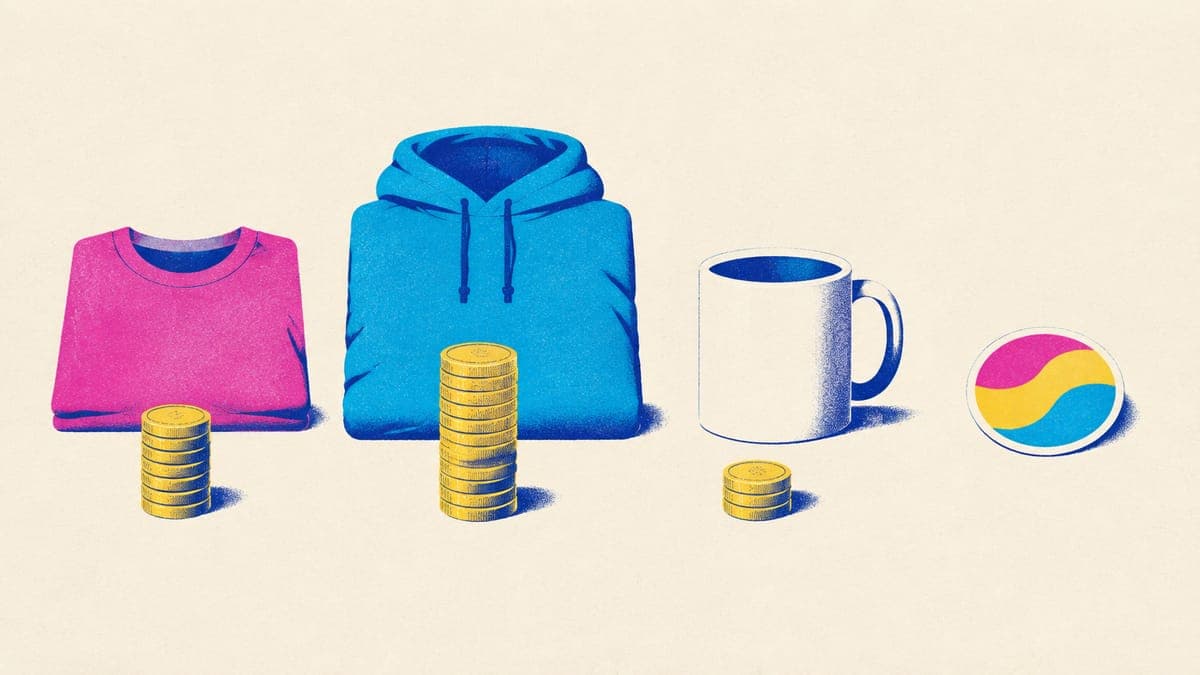
Three patterns stand out:
- Higher prices earn more dollars, not always a better percentage. The hoodie earns the most per sale, but the tee keeps a bigger share of its price. Both are worth listing, and hoodies and sweatshirts matter most in the colder months.
- Shipping weighs on mugs. Mugs are heavy and fragile, so shipping takes a big bite. They work better at a slightly higher price or as a second item in a bigger order (more in our guide to print-on-demand mugs).
- A single sticker loses money. Fixed costs (the $0.20 renewal, the $0.25 processing fee and first-item shipping) swallow a low-priced item. Stickers make sense as bundles, sticker sheets or add-ons; see selling stickers on Etsy with POD for the pricing math.
The Etsy fees behind those numbers
On Etsy in the US, a POD sale typically carries these fees at the time of writing:
- Listing fee: $0.20. Charged when you publish, and again each time an item sells and the listing renews. Unsold listings renew every four months if auto-renew is on.
- Transaction fee: 6.5% of the item price plus shipping.
- Payment processing: about 3% + $0.25 per order in the US, on the order total including shipping and any sales tax. Rates vary by country.
- Offsite Ads: 12–15% of the order, only when a sale comes from an Etsy ad shown on another site (more on this below).
- Currency conversion: 2.5% if you list in a different currency from your payment account.
$0.20
Listing fee, charged again each time an item sells and renews
Source: Etsy fee policy
6.5%
Transaction fee on the item price plus shipping
Source: Etsy fee policy
12–15%
Offsite Ads fee, only on sales that come from those ads
Source: Etsy fee policy
Depending on where you’re based, you may also pay VAT on your Etsy fees or other local fees, so check Etsy’s fee page for your country before you set prices. Our breakdown of every Etsy fee on a POD sale covers each one in detail.
A simple formula for pricing with free shipping
If you know the profit you want, you can work backward to a price. With Etsy’s standard US fees (6.5% transaction, 3% + $0.25 processing and the $0.20 listing renewal), the formula is:
Price = (product cost + shipping + target profit + $0.45) ÷ 0.905
The $0.45 is the two flat fees ($0.25 + $0.20), and 0.905 is what’s left after the two percentage fees (100% minus 6.5% minus 3%). For the example tee, with $13.55 of product and shipping and a $9 profit target, that’s $23.00 ÷ 0.905 = $25.41, so a price of $25.99 clears your target with a little to spare.
To keep that profit even on Offsite Ads sales, include the ad fee: at 15%, divide by 0.755 instead of 0.905. The same tee would need about $30.46 to keep $9 on an ad-driven sale. That’s why it usually makes more sense to accept a smaller profit on those orders than to price every listing for the worst case. Once you have a number, round it to a price point that fits your niche and compare it with the first page of Etsy results. Our guide to pricing print-on-demand products has ready-made price tables for tees, hoodies, mugs and posters.
What ads do to your margin
There are two kinds of Etsy advertising, and they affect your margin in very different ways.
Offsite Ads are ads Etsy places on other sites, such as search engines and social media. You don’t pay per click; you pay a fee only when a sale comes from one. The fee is 15% of the order for shops that have never made $10,000 in a 12-month period (these shops can opt out), or 12% once a shop has passed $10,000 in any 12-month period, after which participation is required. Either way, it’s capped at $100 per order. On the example tee, a 15% fee is $3.75, which cuts profit from $8.62 to $4.87. At 12%, profit is about $5.62.
Etsy Ads are on-site ads you pay for per click, with a daily budget you set. The number that matters is your ad cost per sale: cost per click divided by the share of clicks that turn into orders. With hypothetical numbers, at $0.25 per click and 2% of clicks buying, each ad-driven sale costs $12.50, more than the entire profit on the example tee. At $0.15 per click and 4% buying, it’s $3.75, which the tee can absorb.
The lesson isn’t “never advertise.” It’s to advertise listings that already sell, on products with enough margin to absorb the cost, and to check the numbers every week rather than letting a budget run on autopilot. For a small, structured test, see are Etsy Ads worth it for POD.
How many sales does $500 a month take?
Divide your monthly goal by your average profit per order. Because profit per order varies so much by product and ad spend, here are three illustrative levels:
| Monthly profit goal | At $5 per order | At $8 per order | At $12 per order |
|---|---|---|---|
| $250 | 50 orders | 32 orders | 21 orders |
| $500 | 100 orders | 63 orders | 42 orders |
| $1,000 | 200 orders | 125 orders | 84 orders |
Profit per order after product, shipping, Etsy fees and ad costs, before tool subscriptions, samples and taxes. Illustrative figures, rounded up.
At $8 per order, a $500 month is about two orders a day. Then add your fixed monthly costs, such as a design tool, a Printify Premium plan if you use one, and a few samples. With $50 a month in fixed costs, a $500 profit goal becomes $550, or about 69 orders at $8 each.
How many listings does that take? There’s no reliable ratio; it depends on niche, design quality and search demand. In many shops a small share of listings brings in most of the sales, which is why the goal is to find your winners and build variations around them, not to publish endlessly.
There’s one cost no table shows: your hours. If each new listing takes you an hour or more by hand (research, design, file prep, mockups and copy), five hours a week means only a handful of new listings. On a side-hustle schedule, speeding up design and listing often matters more than shaving cents off product costs. Our 5-hour-a-week side hustle plan shows how to split the time.
What a $500 month could look like
Here’s one hypothetical month for a small Etsy shop selling a mix of tees, hoodies and mugs, using the per-sale profits from the table above:
| Hypothetical month | Amount |
|---|---|
| 40 tees at $8.62 profit each | $344.80 |
| 15 hoodies at $11.27 profit each | $169.05 |
| 15 mugs at $5.14 profit each | $77.10 |
| Offsite Ads fees on 5 tee sales (15%) | −$18.75 |
| Etsy Ads budget ($1 a day) | −$30.00 |
| Design tools and samples | −$50.00 |
| Profit for the month (70 orders) | ≈ $492.20 |
A hypothetical example to show the math, not a forecast. Taxes are not included.
Notice how the hoodies pull their weight: 15 of them earn almost half as much as 40 tees. Product mix matters as much as order count.
What actually drives your margin
- Niche. Buyers pay for designs that feel made for them. A design for a specific job, breed or hobby can often carry a higher price than a generic one, because there are fewer close substitutes.
- Pricing. Price from your costs up, charge more for 2XL and larger sizes (they cost more to produce), and test small increases of $1–$2 on your best sellers.
- Average order value. The $0.25 processing fee is charged once per order, and additional items from the same print partner usually ship at a lower rate than the first. With an illustrative $2.00 additional-item rate, a two-tee order earns about $20.23, or roughly $10.12 per tee, compared with $8.62 for a single tee. Items made by different partners ship separately, each at its own first-item rate.
- Bundles and sets. Sticker sheets instead of single stickers, matching family designs and “complete the set” suggestions in your descriptions all nudge order value up.
- Provider and plan. Compare print partners for each product, and consider Printify Premium (up to 20% off products, at $24.99 a month billed yearly or $39 monthly) once your volume justifies it. As an illustrative example, if it saves about $1.50 per tee, it pays for itself at around 17 tees a month (see is Printify Premium worth it).
- Fewer refunds. A blurry print or a typo turns a sale into a refund plus a bad review. Print partners usually cover their own production errors, but wrong sizes and change-of-mind returns are typically your cost. Who pays for what is covered in POD returns and misprints.
Try this idea in POD Made Easy
“Cozy retro sweatshirt design for book lovers, a stack of books with a steaming mug, muted fall palette” · text: “Book Club Regular”
Realistic timelines
Print-on-demand rewards consistency more than speed. This is a reasonable way to plan your first year, not a prediction of what will happen:
| Phase | What you’re doing | What to expect |
|---|---|---|
| Months 1–3 | Pick a niche, publish your first 30–100 listings, order samples | Early sales are possible but not certain; you’re mostly learning what gets views |
| Months 4–6 | Double down on listings that get views and sales; build variations | More consistent sales if you’ve found a niche that works |
| Months 7–12 | Expand winners to new products and related niches; test ads on proven listings | A clear picture of your profit per order and a realistic monthly goal |
| Q4 (October–December) | Holiday designs live by late October or early November | Seasonal demand can be much higher than the rest of the year |
A planning guide, not a forecast. Results vary widely by niche, design quality, pricing and time invested.
Keep simple records from day one: sales, fees, product costs and subscriptions. Profit is taxable income in most countries, and good records also show you which products actually make money. (US sellers, see our guide to print-on-demand taxes.)
Spend your few hours on designs, not busywork
POD Made Easy handles the slow parts: print-ready files with spell-checked text, 13 tags and SEO copy, and products created in your own Printify or Gelato account at your prices. No fulfillment markup and no per-sale fees, so your margin stays yours.
Start your free trialSo, how much can you make?
On our illustrative numbers, each sale earns roughly $5 to $11 before ads, so a $500 month means dozens of orders, not a handful. It’s a reachable goal for a focused shop, but not a quick or certain one: it takes time, consistent publishing and prices that leave room for fees and ads.
Start by knowing your profit per sale for every product you list. Price from your costs up, favor products and bundles that raise your order value, and put ad money only behind listings that already sell. More views also means more sales at the same margin, so check every title and tag with our free Etsy title and tag checker before you publish. The shops that last are the ones that treat margin as a design decision, not an afterthought.
Frequently asked questions
- What is a good profit margin for print-on-demand?
- There’s no official benchmark. In our illustrative examples, a $24.99 tee keeps about 34% of its price after product, shipping and Etsy fees, and a $44.99 hoodie about 25%. A practical rule is to set a minimum profit in dollars per sale, because fixed fees hit low-priced items hardest.
- How many sales do I need to make $500 a month with print-on-demand?
- At an illustrative $8 profit per order, about 63 orders a month, or roughly two a day, before tool subscriptions, samples and taxes. At $5 per order you’d need 100; at $12 per order, about 42.
- Is print-on-demand still profitable in 2026?
- It can be, but margins are thinner than with bulk-printed stock, so profit depends on pricing, niche and keeping costs like ads under control. There’s no guaranteed income, so treat your first few months as research.
- How much do Etsy fees take from a print-on-demand sale?
- In the US at the time of writing: a $0.20 listing fee each time an item sells and renews, a 6.5% transaction fee on the item price plus shipping, and about 3% + $0.25 for payment processing. On a $24.99 tee that’s about $2.82. Offsite Ads add 12–15% when a sale comes from one.
- Should I pay for Printify Premium?
- Only when the discount beats the fee. As an illustrative example, if Premium saves you about $1.50 per tee, the $24.99-a-month yearly plan pays for itself at around 17 tee sales a month.
Keep reading
More business guides
Business
Best Print-on-Demand Tools in 2026: Design, SEO, Mockups
The best print-on-demand tools in 2026, sorted by job: design, keyword research, mockups, trademark checks and publishing, plus $0, $25 and $75 tool stacks.
Sep 24, 2026 · 10 min read
Business
How to Price Print-on-Demand Products (Formula + Tables)
How to price print-on-demand products on Etsy: a formula with every fee, price tables for tees, hoodies, mugs and posters, size upcharges and discount math.
Sep 24, 2026 · 11 min read

Business
Etsy Fees Explained (2026): What You Really Pay per Sale
Every Etsy fee a print-on-demand seller pays in 2026, from the $0.20 listing fee to Offsite Ads, with a worked t-shirt example that shows your real profit.
Sep 24, 2026 · 12 min read