Etsy vs Shopify for Print-on-Demand: Fees, Traffic, Control
Etsy vs Shopify for print-on-demand: fees on a $24.99 sale, traffic, control and weekly effort compared, plus seven signs it’s time to add Shopify to Etsy.
By the POD Made Easy team · September 24, 2026 · 8 min read

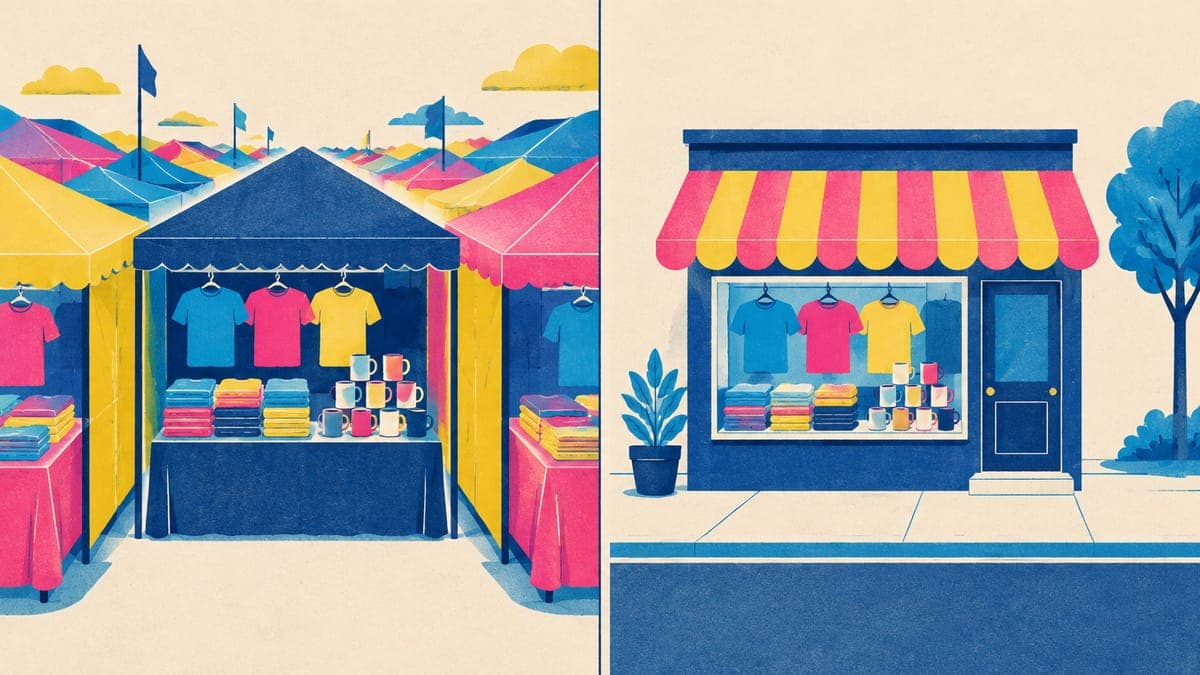
For most new print-on-demand sellers, Etsy is the better place to start, because buyers are already there searching. Shopify is better once you have an audience and repeat customers, because it charges less per sale and gives you full control. On a $24.99 tee, Etsy’s standard fees are about $2.82 and Shopify’s payment fee about $1.02, but Shopify also costs $29–$39 a month and brings you no traffic.
So the real Etsy vs Shopify question isn’t “which is better,” it’s “which is better for you right now.” Below: fee math on the same sale, the traffic cost that doesn’t show in fee tables, control and branding, the weekly effort each asks for, and seven signals that it’s time to add Shopify.
Key takeaways
- Etsy: no monthly fee, about $2.82 in standard fees on a $24.99 order, and buyers who search for you.
- Shopify: $29/mo billed yearly (Basic) plus 2.9% + 30¢ per card payment, and every visitor is yours to find.
- Shopify’s plan pays for itself at roughly 16–22 orders a month, but only if the traffic doesn’t cost more.
- Etsy’s Offsite Ads (15%, or a mandatory 12% after $10K a year) are the fee that most often tips growing shops toward Shopify.
- The common path: start on Etsy, prove your designs, then add Shopify when repeat buyers and an audience show up.
Etsy vs Shopify at a glance
| Etsy | Shopify | |
|---|---|---|
| What it is | A marketplace with millions of shoppers | Software to run your own store |
| Traffic | Built in: buyers search Etsy | None: you bring every visitor |
| Monthly cost | $0 (Etsy Plus is optional, $10/mo) | Basic $39/mo, or $29/mo billed yearly |
| Fees on a $24.99 order | About $2.82 (more with Offsite Ads) | About $1.02 with Shopify Payments |
| Branding | Shop banner, logo and listings on Etsy’s pages | Your domain, design, checkout and emails |
| Customer relationship | Etsy’s messages and rules | Your own customer list |
| US sales tax | Etsy collects and remits it | Your responsibility (Shopify can calculate) |
| Main weekly work | Listings and Etsy SEO | Marketing and content |
US sellers, at the time of writing (September 2026).
Fees on a $24.99 sale: Etsy vs Shopify
Here’s one US order for a POD tee with free shipping, using illustrative Printify costs ($8.80 product, $4.75 shipping). Etsy figures come from our Etsy fees guide and Etsy’s fee policy; Shopify figures from Shopify’s pricing page.
| Etsy | Etsy, sale from a 15% Offsite Ad | Shopify Basic | |
|---|---|---|---|
| Buyer pays | $24.99 | $24.99 | $24.99 |
| Listing fee | −$0.20 | −$0.20 | $0 |
| Transaction fee (6.5%) | −$1.62 | −$1.62 | $0 |
| Payment processing | −$1.00 | −$1.00 | −$1.02 |
| Offsite Ads | $0 | −$3.75 | $0 |
| Total fees on this order | $2.82 | $6.57 | $1.02 |
| Profit after product and shipping | $8.62 | $4.87 | $10.42 before the plan fee and marketing |
Illustrative example, no sales tax. Shopify’s card rate is 2.9% + 30¢ on Basic; Etsy’s processing is 3% + $0.25 in the US.
Per order, Shopify wins by $1.80. Per month, it has to earn back its plan fee first. The break-even is simple: $29 ÷ $1.80 ≈ 16 orders a month on yearly billing, or about 22 on monthly billing. If some of your Etsy sales come through Offsite Ads, the gap per order grows and the break-even arrives sooner: if one Etsy order in five came from an ad, the average saving would be about $2.55 an order and Shopify would break even at about 12 orders a month.
Offsite Ads matter more as you grow. Once your Etsy shop makes $10,000 in a 365-day period, they become mandatory at 12% of attributed orders (capped at $100 per order). That’s often the moment sellers start taking a second channel seriously.
For UK sellers
The per-order gap is wider. At the time of writing, Shopify Basic in the UK costs £25 a month, or £19 billed yearly, with online card rates from 2% + 25p. Etsy charges UK sellers 4% + £0.20 for processing, plus a regulatory operating fee and VAT on its fees, on top of the 6.5% transaction fee. The traffic question doesn’t change, though: a cheaper order only helps if someone places it. Our guide to print-on-demand in the UK covers providers and tax.
Etsy fee & profit calculatorRun your own prices and POD costs, with and without Offsite Ads, and see what each Etsy sale really leaves you.Traffic: the cost that doesn’t show in the fee table
Etsy’s fees buy you something Shopify can’t: shoppers who type “fishing shirt for grandpa” into a search box. Your job on Etsy is to be the best match for those searches, which is what our Etsy SEO guide covers.
On Shopify, nobody arrives unless you send them. Free sources (Pinterest, short videos, an email list, Google’s free product listings, niche communities) take weeks to build. Paid sources work faster but cost real money: at an illustrative $0.50 per click and a 2% conversion rate, each sale costs $25 in ads, which erases the whole order. That’s why the fee comparison above only favors Shopify when your traffic is free or cheap.
If you’d rather build that traffic before paying for a store, start with our Pinterest plan for Etsy sellers, or with short videos (our TikTok Shop print-on-demand guide covers formats that sell POD). The same audience can follow you to Shopify later.
Control, branding and customer relationships
On Etsy, you rent space in a busy market. You follow Etsy’s rules on what you can sell and how: print-on-demand items need a production partner, and AI-assisted designs need a disclosure in the description. Messages are for order communication, not unsolicited promotions, and your listings appear next to competitors’. In return, Etsy handles checkout, payments, sales tax and a lot of buyer trust.
On Shopify, you own the store: domain, design, checkout experience, discount rules, bundles and, most valuably, a customer list you can email with consent. You still follow Shopify’s terms and your payment provider’s rules, but nobody ranks your products below a competitor’s on your own homepage.
Not sold on Shopify itself? Other store builders work the same way for POD. Printify, for example, also connects to WooCommerce, Wix, Squarespace and BigCommerce, with the same trade-offs: lower per-order fees, full control and no built-in shoppers.
Effort: what each one asks of you each week
For a seller with about six hours a week, the time splits very differently:
| Task | Etsy shop | Shopify store |
|---|---|---|
| New designs and products | 2–3 hours | 2–3 hours |
| Titles, tags, attributes and listing SEO | 1–2 hours | Under 1 hour |
| Marketing and content | 0–1 hour (optional) | 2–3 hours (the engine) |
| Orders and customer messages | Under 1 hour | Under 1 hour |
| Store upkeep (theme, apps, email flows) | None | About 1 hour |
Illustrative split for a small shop. Your numbers will vary with volume and niche.
If you only have Sunday afternoons, that difference decides it: Etsy lets most of your time go into products, while Shopify asks you to become a marketer too.
Taxes, payments and policies
- Sales tax (US): Etsy collects and remits it on your orders. On Shopify, you may need to register and collect it in states where you have an obligation; Shopify can calculate it. See our print-on-demand taxes guide for the basics (general information, not tax advice).
- Payments: Etsy Payments deposits your earnings on the schedule you choose in your Payment account. Shopify Payments pays out to your bank on its own schedule; using another payment provider adds a 2% fee on Basic.
- Policies: Etsy gives you set fields for returns and processing times. On Shopify you write your own refund, shipping and privacy policies, including how you handle misprints.
When to add Shopify: 7 signals
Add a Shopify store when three or more of these are true:
- You get repeat buyers or groups (teams, families, clubs) who order again.
- You have an audience outside Etsy: a few hundred people who’d open an email or watch your videos.
- You sell consistently, for example 20+ Etsy orders a month, so the plan fee is covered.
- You’re near or past $10,000 a year on Etsy, where Offsite Ads become mandatory at 12%.
- People search for your shop or brand name, not just your product type.
- You want bundles, group orders or custom collections that Etsy listings handle awkwardly.
- You want a customer list you own and can email.
And signs to wait: no sales yet, fewer than about 30 listings, or no time for weekly content. In that case, put the hours into your Etsy shop first; our plan for your first Etsy sale is a better use of the next month.
Running Etsy and Shopify together
You don’t have to choose one. A provider like Printify connects to both (each as its own store in your account), creates the product for each and routes orders from both to production. A few habits keep it manageable:
- Launch new designs on Etsy first. Etsy search tells you what sells; move proven designs to Shopify.
- Keep prices close. Shopify’s lower fees let you offer a small discount or free shipping to your own customers without undercutting Etsy heavily.
- Write different copy. Etsy titles are built for search; Shopify pages are built for people who already found you.
- Sync only what you need. Shopify can import orders from marketplaces into your admin (50 synced orders a month free, then 1% up to $99 a month at the time of writing), but if your POD provider already handles both stores, you don’t need it.
Two channels without twice the work
POD Made Easy makes each design print-ready at the exact product size, writes search-first Etsy copy and creates the product in your own Printify shop, which publishes to the Etsy and Shopify stores you’ve connected there. No fulfillment markup and no per-sale fees.
Start your free trialThe verdict
Start on Etsy unless you already have an audience: it’s cheaper to begin, and buyers find you while you learn. Our guide to starting print-on-demand on Etsy walks through setup. Add Shopify when the signals above show up, using our Shopify print-on-demand launch guide. And if you’re curious about other channels, compare them in our guide to the best print-on-demand sites.
Frequently asked questions
- Can I sell the same designs on Etsy and Shopify?
- Yes. Your designs are yours to sell wherever you like. With a provider like Printify, connect both stores to one account (each as its own store) and create the product in each, so orders from both route to production automatically.
- Which is better for beginners, Etsy or Shopify?
- For most beginners, Etsy, because buyers are already searching there and you can start for $0.20 a listing. Shopify suits beginners who already have an audience they can send to a store.
- Does Etsy or Shopify handle US sales tax?
- Etsy collects and remits US sales tax on your orders as a marketplace. On your own Shopify store, you’re responsible for collecting and filing it where you have an obligation, though Shopify can calculate it. This is general information, not tax advice.
- Do I need a custom domain for a Shopify store?
- Not strictly: every store gets a free myshopify.com address. A custom domain, typically $10–$20 a year, looks more trustworthy and is easier to share, so most sellers add one before launch.
- What happens to my Etsy shop if I add Shopify?
- Nothing changes unless you change it. Shopify is a separate store with its own products and settings, so treat it as an extra channel rather than a move.
Keep reading
More platforms & providers guides
Platforms & providers
Best Print-on-Demand Sites (2026): Providers vs Marketplaces
The best print-on-demand sites in 2026: providers for your own shop (Printify, Printful, Gelato, Prodigi) vs royalty marketplaces, with margins and picks.
Sep 24, 2026 · 11 min read

Platforms & providers
Shopify Print-on-Demand: How to Launch Beyond Etsy (2026)
Shopify print-on-demand in 2026: real costs ($29–$39/mo plus 2.9% + 30¢ per sale), the best POD apps, setup steps and where your first visitors come from.
Sep 24, 2026 · 9 min read

Platforms & providers
Print-on-Demand on Amazon (2026): Merch vs Printify
The two ways to sell print-on-demand on Amazon in 2026: Merch on Demand royalties or your own seller account with Printify. Fees, rules and profit per sale.
Sep 24, 2026 · 12 min read