Print-on-Demand vs Dropshipping: Which Is Better for You?
Print on demand vs dropshipping compared: worked margin examples, shipping times, platform rules (Etsy bans dropshipping), IP risks and who should pick which.
By the POD Made Easy team · September 24, 2026 · 8 min read
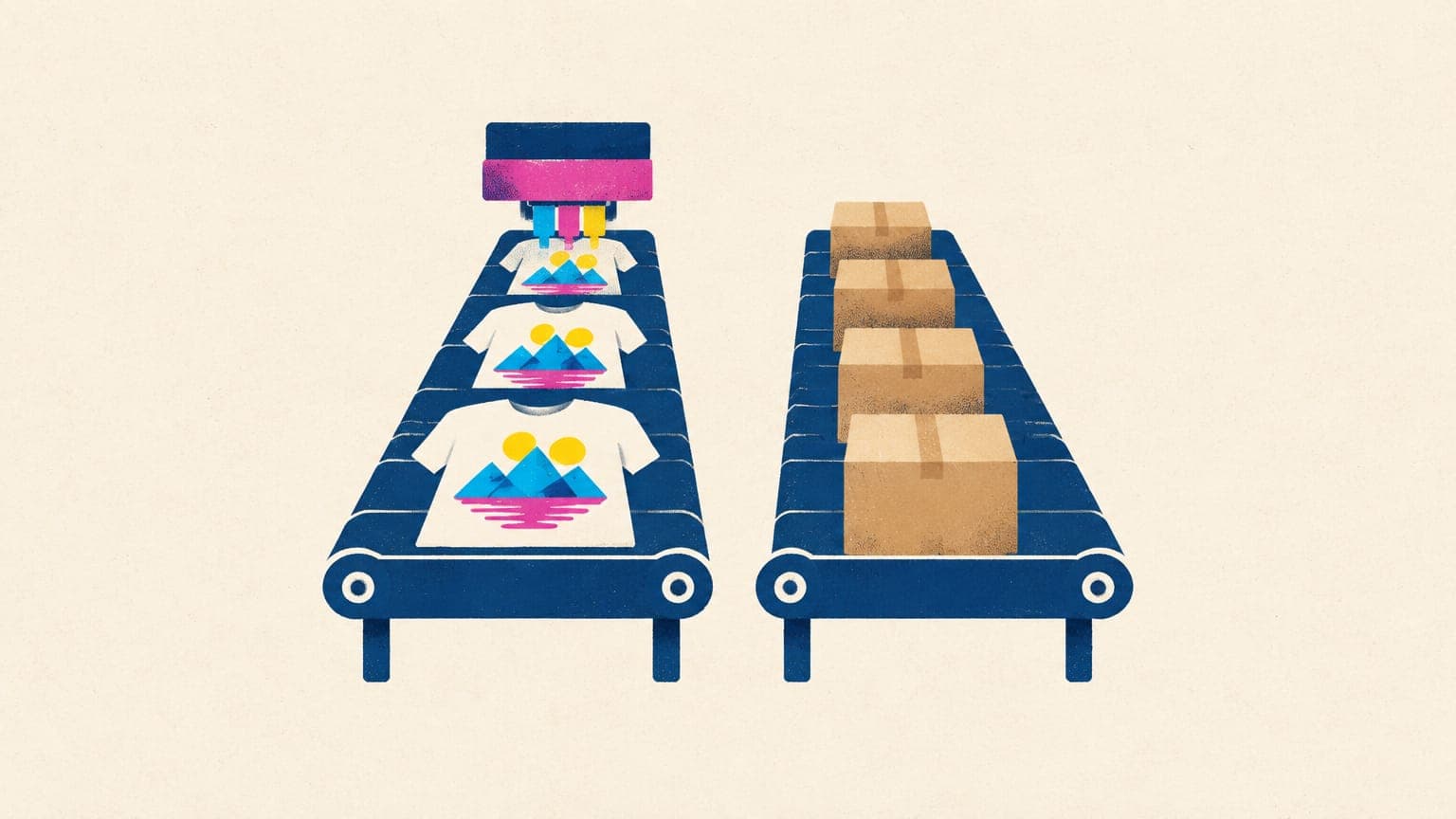
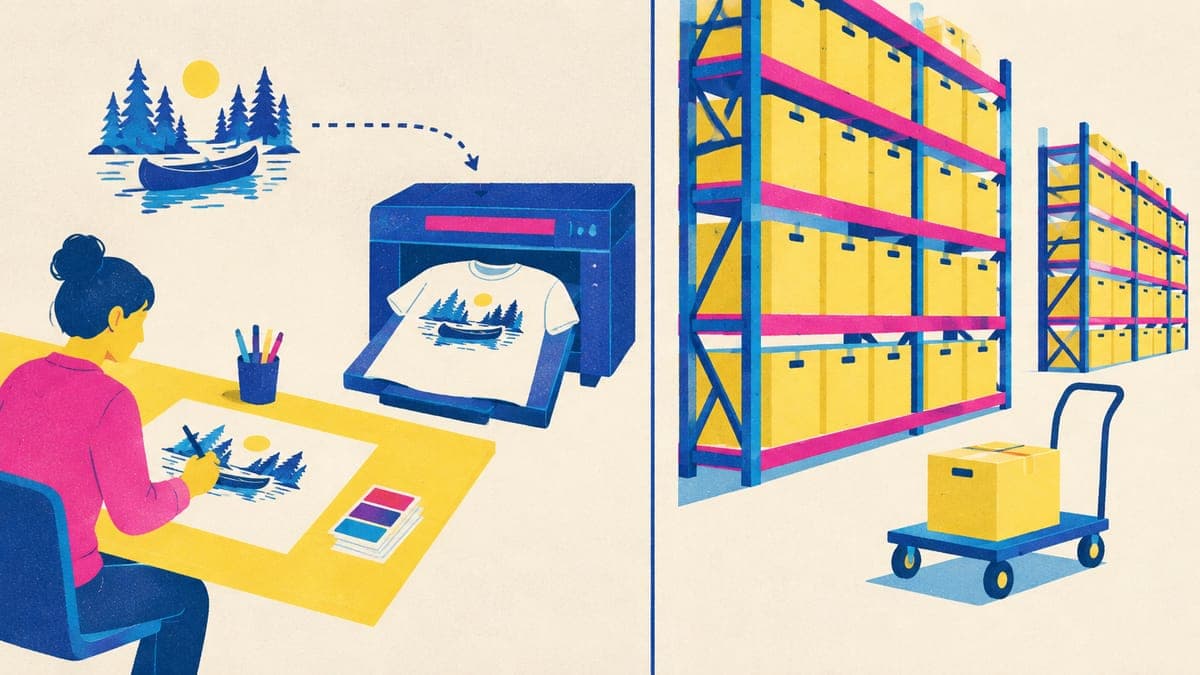
Print-on-demand and dropshipping both let you sell without holding stock, because a supplier ships each order straight to your customer. The difference is what you sell. With print-on-demand (POD) you sell your own designs, printed after each order. With dropshipping you resell existing products that someone else makes and stocks.
For most beginners, and for anyone selling on Etsy, print-on-demand is the better place to start. Etsy allows POD as items “designed by” you but doesn’t allow dropshipping, and a design is harder to copy than a product anyone can source. Below is the full comparison: margins with worked numbers, shipping, platform rules, risks and who should pick which.
Key takeaways
- Both models skip inventory: POD sells your designs; dropshipping resells someone else’s products.
- Etsy allows POD with a production partner but doesn’t allow dropshipping, apart from narrow cases such as craft supplies.
- Dropshipping often shows a bigger margin on paper, but paid traffic can eat it. POD on Etsy comes with marketplace search.
- POD delivery includes production time (most Printify orders ship within 2–7 business days); overseas dropshipping can take much longer.
- Pick POD if you have ideas and a niche; pick dropshipping if you enjoy product sourcing and running paid ads.
What’s the difference between print-on-demand and dropshipping?
Dropshipping: you list products from a supplier’s catalog, such as phone accessories, kitchen gadgets or pet toys, usually on your own store. When someone buys, you pay the supplier, who ships the product. You never see it. Your edge is choosing products and marketing them well.
Print-on-demand: you create a design, choose blank products (tees, mugs, posters) from a provider such as Printify, and the provider prints your design on each item after it’s ordered. Your edge is the design and knowing exactly who it’s for.
Is print-on-demand a type of dropshipping?
Technically, yes. A third party makes and ships the order, which is why you’ll see the phrase “print-on-demand dropshipping”. The practical difference is who owns the idea. With POD, the product doesn’t exist until your design goes on it, and that’s why marketplaces like Etsy treat the two models so differently. If you’re new to the model, what print-on-demand is and how it works covers the basics.
Print-on-demand vs dropshipping: side by side
| Print-on-demand | Dropshipping | |
|---|---|---|
| What you sell | Your designs on blank products | Existing products from a supplier |
| How different you can be | Very: the design is yours | Barely: others can sell the same item |
| Typical sales channels | Etsy, plus Shopify, TikTok Shop and Amazon | Your own store; sometimes Amazon or eBay |
| Where buyers come from | Marketplace search (on Etsy) plus your own marketing | Mostly paid ads and social media |
| Profit per sale | Moderate: about $8.62 on an illustrative $24.99 tee on Etsy | Can look higher, until you count ad cost per sale |
| Delivery time | Production (a few business days) plus shipping | Depends on the supplier’s location; overseas can take weeks |
| Supplier risk | Print quality varies by print partner | Stock-outs, quality swings, suppliers disappearing |
| IP risk | Designs that use trademarks or copyrighted material | Knockoffs, counterfeits and copied product photos |
| Allowed on Etsy? | Yes, as “designed by” you, with a production partner | No, apart from narrow cases such as craft supplies |
| Startup cost | Very low | Low to moderate: store plan, apps, ad tests |
| Core skills | Niche research, design sense, SEO | Product research, ads, customer service |
A general comparison. Margins are illustrative and vary by product, supplier and sales channel.
Where each model is allowed
- Etsy: POD is allowed when the design is yours (or the buyer’s customization) and you name the production partner. Reselling or dropshipping items you didn’t make or design isn’t, apart from narrow categories such as vintage and craft supplies. Etsy spells this out in its help article on dropshipping and reselling.
- Amazon: dropshipping is only allowed if you’re the seller of record: your name on packing slips and invoices, you handle returns, and you don’t buy from another retailer that ships to your customer. POD sellers can use Merch on Demand or connect Printify to Amazon US.
- eBay: dropshipping from wholesale suppliers is allowed; buying from another retailer or marketplace to ship to your buyer isn’t.
- Shopify or your own site: both models are allowed. The difference is traffic: there’s no marketplace search, so you bring every visitor yourself.
- TikTok Shop: Printify and Gelato both connect to it for POD. If you plan to dropship there, read TikTok Shop’s current seller policies first.
Margins: three worked examples
Here’s where the “dropshipping has better margins” idea comes from, and where it breaks. All three examples are illustrative, and they’re built to show the effect of traffic costs, not to predict your results.
| Line | POD tee on Etsy | POD tee on your own store, paid ads | Dropshipped gadget on your own store, paid ads |
|---|---|---|---|
| Sale price | $24.99 | $24.99 | $29.99 |
| Product cost | −$8.80 | −$8.80 | −$9.00 |
| Shipping | −$4.75 | −$4.75 | −$4.00 |
| Marketplace and payment fees | −$2.82 (Etsy) | −$1.05 (3% + $0.30) | −$1.20 (3% + $0.30) |
| Store plan, per order | $0 | −$1.30 | −$1.30 |
| Ad cost per sale | $0 (organic Etsy search) | −$10.00 | −$10.00 |
| Profit per sale | $8.62 | −$0.91 | $4.49 |
Illustrative: a $39-a-month store plan spread over 30 orders, card processing of 3% + $0.30, and $10 of ad spend per sale. Your numbers will differ.
Three lessons from that table:
- The channel matters more than the model. POD on Etsy wins here because Etsy’s search brings buyers without a per-click cost. The exception is Etsy’s Offsite Ads: when a sale comes from one, a 15% fee ($3.75 here) cuts the tee’s profit to $4.87.
- Dropshipping’s “bigger margin” is real before ads. Without the $10 of ad spend, the gadget would make $14.49. With it, less than the Etsy tee.
- Cheap traffic changes everything. If you already have an audience, rank in search or post content that travels, both models improve dramatically on your own store.
For the full fee picture on the Etsy side, see Etsy fees explained, and for setting prices that survive fees and ads, read how to price print-on-demand products.
Shipping times and supplier risk
Print-on-demand: every order is made after purchase, so production comes first. Most Printify orders ship within 2–7 business days, and Printful’s average fulfillment time is 2–5 business days, then transit time on top. You can choose print partners close to your buyers, and the big providers print in the US, Europe and elsewhere. Our Printify review covers how partner choice affects cost, speed and quality.
Dropshipping: delivery depends on where the supplier ships from. Domestic warehouses can be quick but usually cost more; overseas suppliers can take weeks. Stock-outs are a real risk too: a product that finally sells can vanish from a supplier’s catalog, taking your ads and reviews with it.
Import costs changed recently as well. The US suspended duty-free entry for low-value parcels in August 2025, and it remains suspended at the time of writing, so cheap items shipped one by one from overseas to US buyers now face duties. POD orders printed inside the US avoid that for US customers.
IP risk: the problem both models share
With print-on-demand, the risk is putting protected words or images on products: brand names, team names, characters, song lyrics, or an everyday phrase someone has registered as a trademark for clothing. Search before you publish, using our guide to avoiding trademark infringement in POD. And because purely AI-generated designs can’t be copyrighted in the US, you may not be able to stop copycats. More in selling AI designs on Etsy.
With dropshipping, the risk is selling knockoffs of branded products, or using a supplier’s product photos that belong to someone else. Both can get listings removed and accounts suspended.
Which should you choose?
| If you… | Choose | Because |
|---|---|---|
| Want to sell on Etsy | Print-on-demand | Etsy allows POD with a production partner; it doesn’t allow dropshipping |
| Know a hobby, job or community well | Print-on-demand | Your edge is designs for a specific buyer |
| Enjoy product research and running paid ads | Dropshipping | Your edge is finding products and cheap traffic |
| Have little money for ads | Print-on-demand on Etsy | Marketplace search brings buyers without a per-click cost |
| Already have an audience | Either, or both | Your own traffic makes both models more profitable |
| Care most about fast delivery | POD with local print partners, or domestic suppliers | Shorter distances mean faster, cheaper delivery |
A starting point, not a rule.
If you’re still deciding whether POD itself is right for you, our honest look at whether print-on-demand is worth it runs the numbers on your time.
Your designs are the moat. Make more of them.
POD Made Easy turns your ideas into print-ready designs with spell-checked text, flags famous brands and characters before you publish, writes Etsy-ready titles, 13 tags and descriptions, and creates products in your own Printify shop at your prices.
Start your free trialHybrid approaches that work
- Etsy for POD, your own store for both. Keep your designs on Etsy. On a Shopify store you can sell the same designs plus a few related products, such as outdoor gear alongside fishing-humor tees. Our guide to Shopify print-on-demand covers the setup.
- One design, many channels. Printify publishes the same product to 11 sales channels, including Etsy, Shopify, TikTok Shop US and Amazon US. That’s POD’s version of “adding more products”.
- Personalization. POD can print a name or a date on each order, something dropshipped stock rarely offers, and personalized gifts are a natural fit for Etsy buyers.
- POD first, stock later. When a design sells steadily, bulk printing can lower your cost per item. It also brings back inventory risk, so only do it for proven sellers.
Whichever mix you choose, the best print-on-demand sites roundup shows which providers and marketplaces fit each channel.
Try this idea in POD Made Easy
“Retro camping badge with a canoe on a lake, pine trees and a crescent moon, three-color screen-print style for a forest green tee”
Frequently asked questions
- Is print-on-demand more profitable than dropshipping?
- Not automatically. Dropshipped products can carry a bigger markup, but they usually rely on paid ads, which can cost more than the margin. POD on Etsy has smaller margins but gets marketplace search traffic. Compare profit after traffic costs, not before.
- Can you dropship on Etsy?
- Not in the usual sense. Etsy doesn’t allow reselling or dropshipping items you didn’t make or design, apart from narrow cases such as craft supplies. Print-on-demand is allowed because the design is yours and you name the production partner.
- Which is easier for beginners, print-on-demand or dropshipping?
- For most beginners, print-on-demand on Etsy. It costs less to start, doesn’t depend on paid ads, and Etsy brings its own buyers. Dropshipping suits people who already enjoy product research and testing ads.
- Can I do print-on-demand and dropshipping at the same time?
- Yes, if you keep them in the right places: POD on Etsy, and any dropshipped products on your own store or a marketplace that allows them. Always name your production partner on Etsy listings.
- Do print-on-demand products ship slower than dropshipped ones?
- It depends on the supplier. POD adds a few business days of production but can print close to the buyer. Dropshipping from a domestic warehouse can be faster, while overseas suppliers are often slower than domestic POD.
Keep reading
More getting started guides
Getting started
How to Start Print-on-Demand on Etsy (2026 Step-by-Step)
How to start print-on-demand on Etsy in 2026: pick a niche, choose a provider, make print-ready files, price for profit and write listings that get found.
Sep 24, 2026 · 9 min read

Getting started
Is Print-on-Demand Worth It in 2026? An Honest Answer
Is print on demand worth it in 2026? An honest verdict with real per-sale margins, what your hours are worth, the saturation question and a yes/no checklist.
Sep 24, 2026 · 9 min read
Getting started
17 Print-on-Demand Mistakes That Sink New Shops (and Fixes)
17 print on demand mistakes that sink new shops, grouped by stage: niche, design, print files, listings, pricing, operations and legal, each with a clear fix.
Sep 24, 2026 · 11 min read