What Is Print-on-Demand? How It Works (and Who It’s For)
What is print on demand? A plain-English guide to how POD works, who pays whom on a real $24.99 tee, providers vs marketplaces, pros, cons and first steps.
By the POD Made Easy team · September 24, 2026 · 9 min read
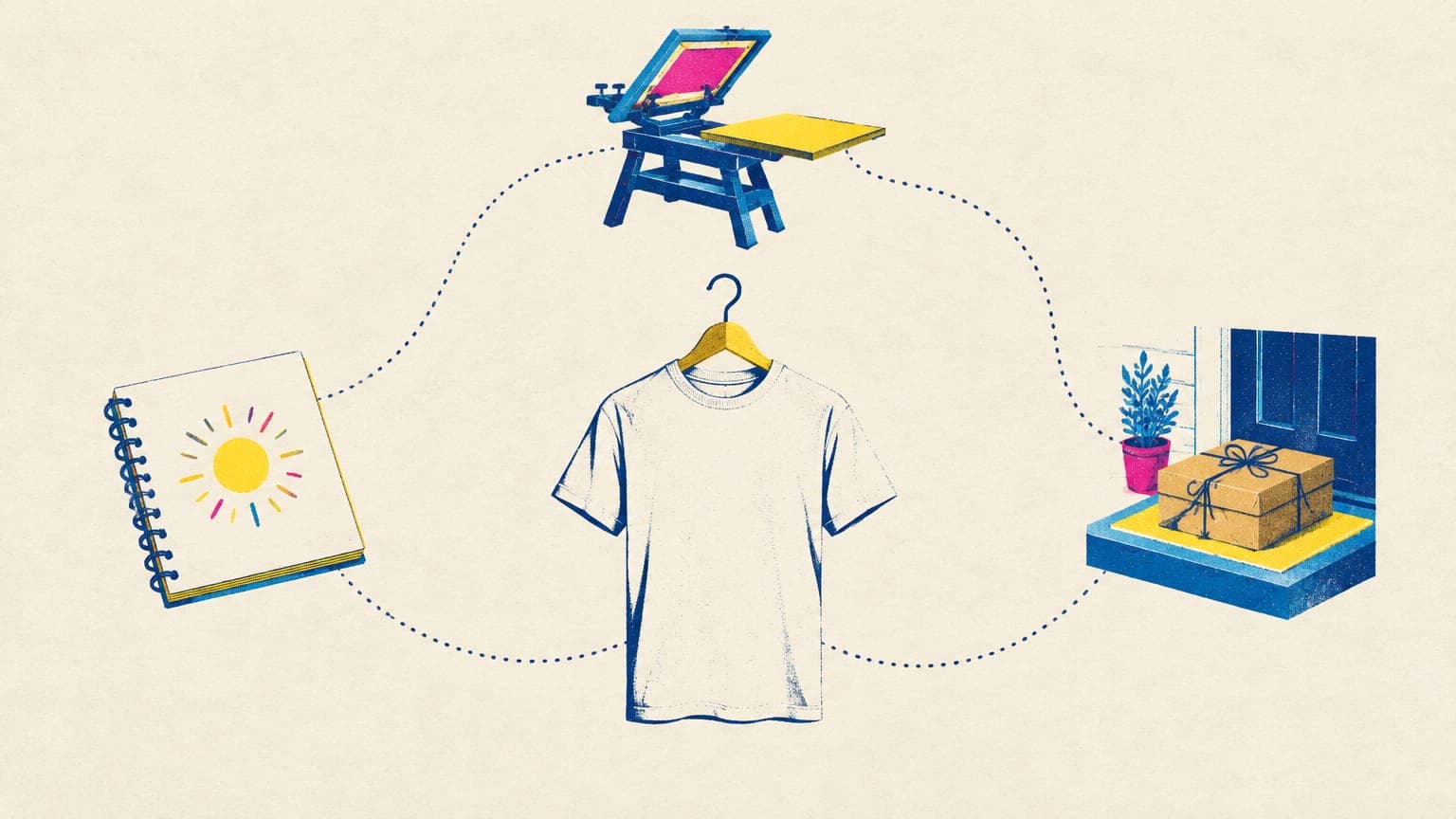
Print-on-demand (POD) is a way to sell custom products, such as t-shirts, mugs, posters and stickers, where each item is printed only after a customer orders it. You create the design and the listing; a print provider makes the product and ships it straight to your buyer. You never buy stock, and you keep the difference between your price and the provider’s cost, minus marketplace fees.
That’s the whole idea. The details are where beginners get surprised, so this guide follows one order from checkout to doorstep, shows who pays whom on a $24.99 t-shirt, explains the difference between print providers and print-on-demand marketplaces, and ends with honest pros and cons, who it suits and your first three steps.
Key takeaways
- Print-on-demand means nothing is made until someone buys it: you design and sell, a provider prints and ships.
- On an illustrative $24.99 Etsy tee, the buyer’s money splits into about $2.82 of Etsy fees, $13.55 for the provider and $8.62 for you.
- Print providers (Printify, Printful, Gelato, Prodigi) fulfill orders for your own shop; POD marketplaces (Redbubble, Merch on Demand) sell your designs for a royalty.
- Starting costs very little, but margins per sale are thin and generic designs face heavy competition.
- It suits people with 5–10 hours a week who enjoy ideas and research. You don’t need to be a trained designer.
How does print-on-demand work?
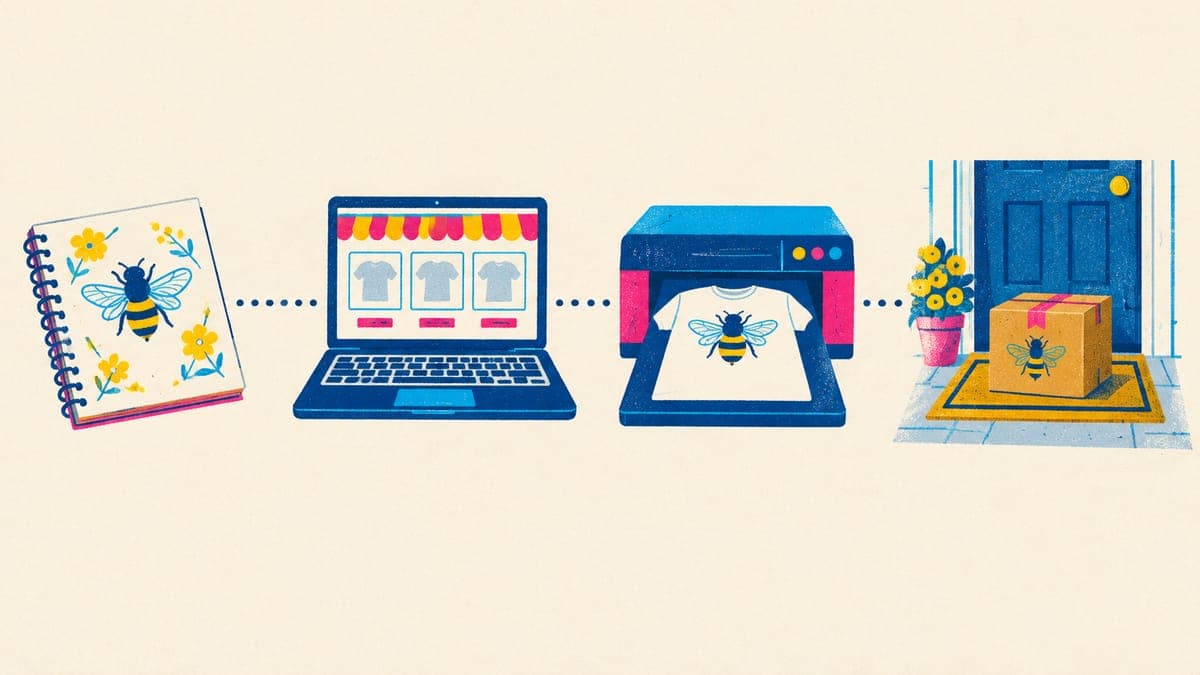
Here’s what happens with a typical Etsy shop connected to a provider such as Printify:
- You create a design and choose products. For example, a design for new beekeepers, set up on a tee, a mug and a sticker in your provider’s dashboard.
- The provider publishes the listing to your shop with mockup photos, sizes, colors and the price you set. On Etsy, you also name the provider as your production partner.
- A customer buys and pays the marketplace, not you directly.
- The order flows to your provider automatically, and the provider charges you for the product and shipping.
- The provider prints, packs and ships the item to your customer. Most Printify orders ship within 2–7 business days, and Printful’s average fulfillment time is 2–5 business days, before delivery time.
- The marketplace pays you the sale price minus its fees. What’s left after the provider’s charge is your profit.
Your job is everything that sells the product: the idea, the design, the listing and customer service. The provider’s job is everything physical. That split is why POD works as a side business. You never pack a parcel, but you’re still responsible for the customer’s experience from start to finish.
Who pays whom: one $24.99 t-shirt, followed through
Here’s the money on a single sale from an Etsy shop to a US buyer, with free shipping. The product and shipping costs are illustrative; yours depend on your provider and print partner.
| Step | What happens to the money | Left for you |
|---|---|---|
| The buyer checks out on Etsy | Pays $24.99, shipping included | $24.99 |
| Etsy takes its fees | $0.20 listing + $1.62 transaction (6.5%) + $1.00 processing (3% + $0.25) | $22.17 |
| Your provider charges you | $8.80 for the tee + $4.75 for US shipping | $8.62 |
| If the sale came from an Etsy Offsite Ad | An extra 15% fee of $3.75 | $4.87 |
Illustrative US example at the time of writing. Etsy’s fees apply to the item price plus shipping.
Two lessons hide in that table. First, your provider, not Etsy, is your biggest cost, so product choice and price matter more than fee tricks. Second, price moves profit fast: with the same costs, the tee earns about $4.09 at $19.99 and $13.14 at $29.99. For every fee in detail, see Etsy fees explained; for hoodies, mugs and stickers, see our print-on-demand profit margin breakdown.
The timing catch
Your provider charges your card when an order goes into production (Printify’s default is 24 hours after the order arrives). Etsy releases a new seller’s money later, often around two weeks after the sale. So even a “no inventory” business needs room on a card to cover a few orders while you wait for payouts.
Etsy fee & profit calculatorEnter a price and your provider’s costs to see every Etsy fee and what one sale really leaves you.What can you sell with print-on-demand?
Almost anything with a printable surface. Most beginner shops stick to a handful of products, and each one is made with a different print method, which affects how your design should look.
| Product | Usually printed with | Design tips | Good to know |
|---|---|---|---|
| T-shirts, sweatshirts, hoodies | DTG (ink printed straight onto fabric) or DTF (a printed film pressed on) | Transparent PNG at the full print-area size; bold shapes and readable text | The core of most POD shops; sweatshirts and hoodies peak in colder months |
| Mugs and tumblers | Usually sublimation | A wide wrap-around layout with key elements clear of the handle | Heavy and fragile, so shipping takes a big share of the price |
| Posters, framed prints, canvas | Inkjet or giclée on paper or canvas | Design in the right aspect ratio (such as 2:3 or 3:4) at high resolution | Strong for home decor and gift niches |
| Stickers | Digital print, kiss-cut or die-cut | A clear outline, thick lines, no tiny text | Low price, so they work best as add-ons or bundles |
| Totes, pillows, blankets, phone cases | Varies by product | Follow each provider’s template | Handy for expanding a design that already sells |
| Embroidered hats and sweatshirts | Embroidery | Simple shapes and only a few colors | Takes longer to produce than printed items |
Print methods vary by provider and product, so check each product’s details before you design for it.
Start with one core product for your niche, usually a tee or sweatshirt, and add others only for designs that already get attention. Our guide to the best print-on-demand products compares them in more detail.
Print providers vs print-on-demand marketplaces
“Print-on-demand site” can mean two different things, and they suit different people.
Print providers such as Printify, Printful, Gelato and Prodigi make products for your own shop: an Etsy shop, a Shopify store, TikTok Shop and more. You set the price, you keep the margin, and you handle marketing and customer service. Our Printify vs Printful vs Gelato comparison covers the big three.
POD marketplaces such as Redbubble, TeePublic, Spreadshirt and Amazon’s Merch on Demand sell your designs on their own sites. You upload artwork; they run the storefront, production, shipping and customer service, and pay you a royalty or a margin on each sale. Less work per sale, but less control over price and presentation.
| Print provider (your own shop) | POD marketplace | |
|---|---|---|
| Examples | Printify, Printful, Gelato, Prodigi | Redbubble, TeePublic, Spreadshirt, Amazon Merch on Demand |
| Who sets the price | You | The marketplace sets base prices; you earn a royalty or set a markup |
| Where buyers come from | Your sales channel (Etsy search, your own marketing) | The marketplace’s own traffic |
| Customer service | You | The marketplace |
| What you earn | Your price minus fees and product cost | A royalty or margin per sale |
| Uploading | Through your provider, including approved tools | Usually by hand; several ban automated uploads |
You can use both: a provider-connected shop as your main business, plus marketplaces for extra reach.
Our roundup of the best print-on-demand sites covers each option, including which ones suit beginners.
What does it cost to start?
Very little upfront. Printify, Printful and Gelato have free plans and charge only when an order comes in. Etsy charges $0.20 per listing and may charge a one-time setup fee when you open a shop. Everything else is optional: samples (a basic tee to your own door is about $13.55 at the example prices), design tools and ads. Add room on a card for the timing gap above, and most people can start for well under $100. For an itemized budget, see how to start print-on-demand with almost no money.
Is print-on-demand the same as dropshipping?
Close, but not the same. In both models a third party ships to your customer, so you never hold stock. The difference is the product. With dropshipping you resell items someone else designed and makes. With POD, the design is yours and each item is made for that order.
That difference matters on Etsy. Under Etsy’s Creativity Standards, POD items count as “designed by” you as long as you name your production partner, but reselling items you didn’t make or design isn’t allowed. The full comparison is in print-on-demand vs dropshipping.
The pros and cons of print-on-demand
The quick version is below. Our honest look at whether print-on-demand is worth it weighs them properly, with numbers.
Pros
- No inventory risk. A design that never sells costs you a $0.20 listing, not a box of unsold shirts.
- Cheap to test ideas. One design can go on a tee, a sweatshirt, a mug and a poster in minutes.
- Flexible hours. No packing, no post office runs, no fixed schedule.
- Room to grow. Printify alone publishes to 11 sales channels, including Etsy, Shopify, TikTok Shop US and Amazon US.
Cons
- Thin margins. In the example above, a tee earns about $4–$13 depending on price, before any ads.
- Quality you don’t fully control. Results depend on your provider or print partner, and you never inspect each item.
- Slower delivery. Production adds days before shipping even starts.
- Crowded generic niches. Anyone can sell a “funny cat shirt”, so generic designs struggle to get seen.
- Easy to copy. Purely AI-generated designs can’t be copyrighted in the US, so stopping copycats is hard.
Who print-on-demand suits (and who it doesn’t)
It tends to suit you if:
- you have 5–10 hours a week and can keep going for a few months;
- you know a hobby, job or community well enough to write phrases its members would happily wear;
- you enjoy research and ideas at least as much as drawing;
- you’re not a trained designer but you have taste. Templates, commercial-use fonts and AI tools do much of the drawing now; the judgment is still yours.
It probably isn’t for you if you need income within weeks, want to control every stitch and package (handmade or bulk printing gives you that), or don’t want to answer customer messages. If you’re fitting it around a job, our 5-hour-a-week side hustle plan shows what a realistic week looks like.
Not a designer? Start from an idea
Describe an idea and the exact words to print, and POD Made Easy returns four drafts, then a print-ready final at the exact pixel size for your product, with any AI-rendered text spell-checked. It also writes your Etsy title, 13 tags and description.
Start your free trialYour first three steps
You can set up a small print-on-demand business in a few evenings. Here’s the order that matters:
- Pick one niche with a clear buyer. “Funny shirts” is a category; “gifts for new beekeepers” is a niche. Type your idea into Etsy’s search bar and note the suggestions, which show what buyers actually search. Our guide to print-on-demand niches has a full method.
- Choose a provider and open your shop. Printify is the usual low-cost start, Printful trades higher prices for consistency, and Gelato suits international buyers. How to start print-on-demand on Etsy covers setup step by step. Selling from Britain? Read print-on-demand in the UK first.
- Make ten designs and listings, then order one sample. Ten listings for one kind of buyer teach you more than one perfect design, and a sample shows you exactly what your customers will receive.
Try this idea in POD Made Easy
“Vintage badge for new beekeepers, a honeybee over a honeycomb with wildflowers, warm retro palette, transparent background for a tee”
Frequently asked questions
- Is print-on-demand legit?
- Yes. Print-on-demand is an established way to sell custom products, and major marketplaces allow it. Etsy treats POD items as “designed by” the seller, as long as you name your production partner. The risks are business ones, like thin margins and competition, not legitimacy.
- Do I need design skills for print-on-demand?
- No formal training, but you need good judgment. Templates, commercial-use fonts and AI image tools handle much of the drawing. What sells is a clear idea for a specific buyer, readable text and a file that prints cleanly.
- How long does a print-on-demand order take to arrive?
- Production comes first: most Printify orders ship within 2–7 business days, and Printful’s average is 2–5 business days. Delivery time comes on top, so set your Etsy processing and delivery times to match your provider.
- Can I do print-on-demand without a website?
- Yes. Most beginners start on Etsy, which brings its own search traffic, or on marketplaces such as Redbubble. Your own Shopify store makes more sense later, once you can bring your own visitors.
- Who handles returns in print-on-demand?
- You do, as the seller. Providers generally reprint or refund their own production errors if you report them quickly with photos, but wrong-size orders and change-of-mind returns are usually your cost, so write a clear returns policy.
Keep reading
More getting started guides
Getting started
Is Print-on-Demand Worth It in 2026? An Honest Answer
Is print on demand worth it in 2026? An honest verdict with real per-sale margins, what your hours are worth, the saturation question and a yes/no checklist.
Sep 24, 2026 · 9 min read
Getting started
17 Print-on-Demand Mistakes That Sink New Shops (and Fixes)
17 print on demand mistakes that sink new shops, grouped by stage: niche, design, print files, listings, pricing, operations and legal, each with a clear fix.
Sep 24, 2026 · 11 min read

Getting started
How to Start Print-on-Demand on Etsy (2026 Step-by-Step)
How to start print-on-demand on Etsy in 2026: pick a niche, choose a provider, make print-ready files, price for profit and write listings that get found.
Sep 24, 2026 · 9 min read