Printify vs Printful (2026): Real Costs and Which to Use
Printify vs Printful in 2026: the same tee costs about $8.80 vs $12.25. See real Etsy profit per sale, plan break-evens, quality, branding and when to use both.
By the POD Made Easy team · September 24, 2026 · 11 min read
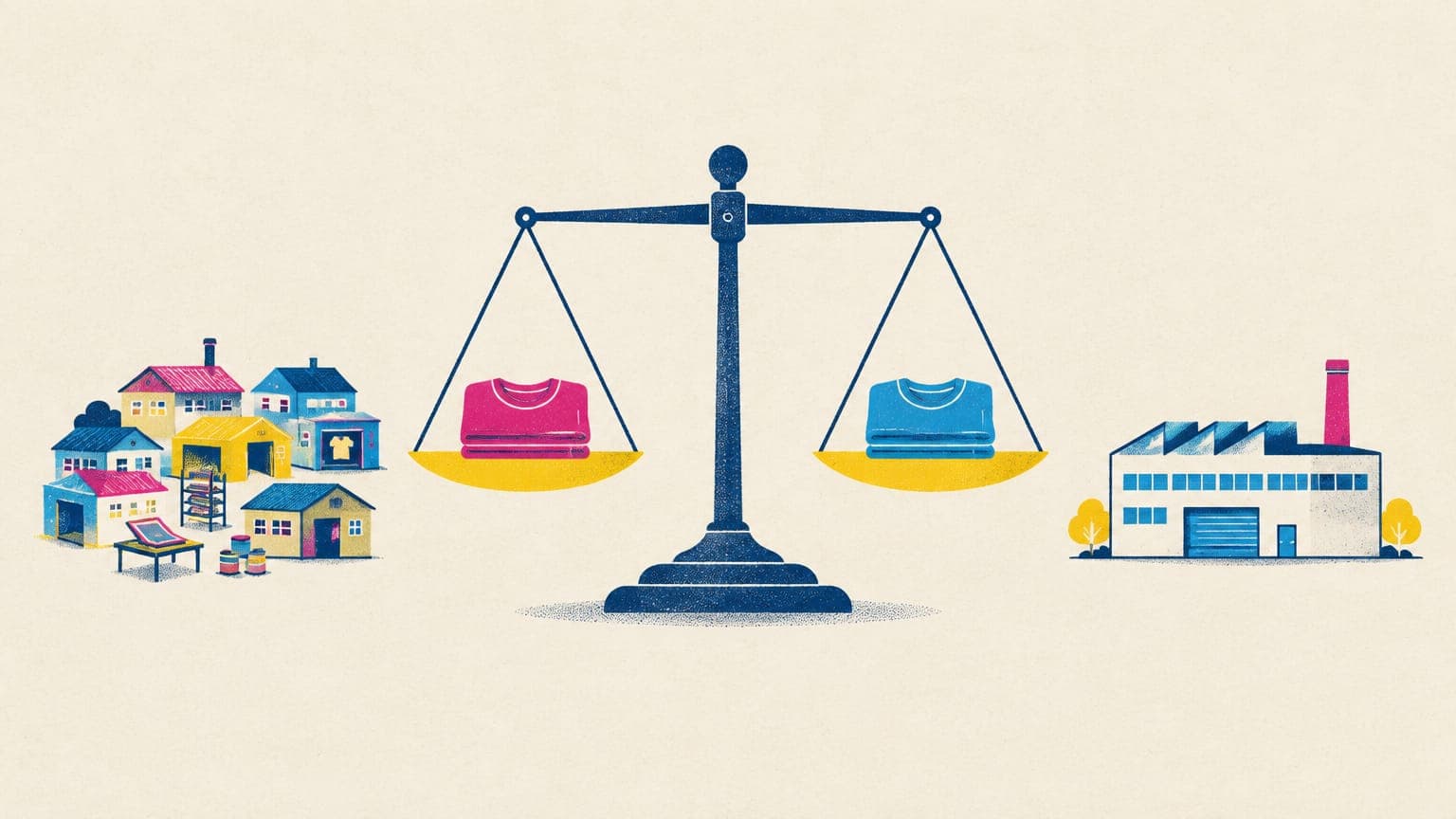
Printify is usually the cheaper choice and Printful the more consistent one. On the same Bella+Canvas 3001 t-shirt, a low-cost Printify partner charges about $8.80 plus shipping, while Printful charges about $12.25. In our Etsy example below, that’s the difference between roughly $8.60 and $5.00 of profit per shirt. What the extra cost buys at Printful is in-house production, one quality standard and simpler branding.
This head-to-head goes deeper than our Printify vs Printful vs Gelato overview: real per-sale math, which paid plan pays off first, how quality claims and branding work on each, a decision matrix and a setup for running both in one shop. Prices are a September 2026 snapshot, so check both pricing pages before you commit.
Key takeaways
- Printify is a marketplace of 90+ print partners, so base costs are lower and quality depends on the partner you pick. Printful makes everything in its own facilities.
- On a $24.99 Etsy tee with free shipping, our illustrative profit is $8.62 with a low-cost Printify partner and $4.97 with Printful. You’d need to charge about $29 on Printful to match.
- Printful Growth ($24.99/mo, free once you reach $12K a year in sales) offers up to 33% off. Printify Premium ($24.99/mo billed yearly, or $39 monthly) offers up to 20% off all products.
- Printful has the simpler branding story. Printify’s labels and inserts are cheaper but only available from selected partners.
- Many sellers use both: Printify for price-sensitive basics, Printful for premium or branded lines, with each Etsy listing linked to one provider.
Printify vs Printful at a glance
Both are free to join, connect to Etsy and charge you only when an order comes in. The differences sit underneath: who prints your order, what it costs and how much of the process you control.
| Printify | Printful | |
|---|---|---|
| How it works | Marketplace of 90+ independent print partners; you pick one per product | Makes orders in its own facilities |
| Catalog | 1,300+ customizable products | 562 products |
| Bella+Canvas 3001 tee (S–XL) | From about $8.80, depending on the partner | About $11.92–$12.25 |
| US shipping, first tee | About $4.75, depending on the partner | $4.95, then $2.20 per extra tee |
| Paid plan | Premium: $39/mo, or $24.99/mo billed yearly | Growth: $24.99/mo, free once you reach $12K a year in sales |
| Plan discount | Up to 20% off all products (up to 33% on new products) | Up to 33% off product pricing |
| Stores per account | 5 on Free, 10 on Premium | Unlimited |
| Branding | Neck labels from $0.55, inserts from $0.15 (selected partners) | Inside labels $0.99, outside labels $2.49, packaging extras |
| Manufacturing errors | Free reprint or refund within 30 days | Reprint or refund; claim within 30 days of delivery |
| Support | 24/7 | 24/7 |
US prices at the time of writing (September 2026), from each provider’s pricing page and catalog. Printify prices vary by print partner.
How much does the same t-shirt cost on Printify vs Printful?
Catalog-wide claims don’t help you price a listing, so here’s one popular blank on both. Printify’s own pricing page uses a Bella+Canvas 3001 tee with an $8.77 fulfillment cost as its example, and Printful’s catalog lists the same shirt at about $11.92–$12.25 for sizes S to XL. Below is a single US Etsy sale at $24.99 with free shipping, using the same fees as our Etsy fees breakdown.
| Line | Printify (low-cost partner) | Printful |
|---|---|---|
| Buyer pays (free shipping) | $24.99 | $24.99 |
| Etsy fees ($0.20 listing, 6.5% transaction, 3% + $0.25 processing) | −$2.82 | −$2.82 |
| Bella+Canvas 3001 tee, one print | −$8.80 | −$12.25 |
| Shipping to a US buyer, first item | −$4.75 | −$4.95 |
| Profit per sale | $8.62 | $4.97 |
| Price needed to keep about $8.62 | $24.99 | About $29.00 |
Illustrative example: US seller and buyer, no sales tax, September 2026 prices. Printify costs vary by print partner. Printful adds a $0.40 surcharge to US orders from Oct 15 to Jan 17.
A few things move that gap in real life:
- Plan discounts. Premium or Growth can cut product costs noticeably once you sell regularly (see the next section).
- Extra print areas. Both providers price the base product with one print; sleeves, backs and extra placements cost more.
- Bigger sizes. Printful lists this tee at about $13.75–$13.92 in 2XL and $15.25–$15.92 in 3XL. Price large sizes higher on either provider.
- Multi-item orders. Printful charges $2.20 for each extra tee shipped in the US, and Printify partners also charge less for additional items, so bundles and matching family shirts lift profit per order on both.
- Branding extras. A $0.99 Printful inside label comes straight out of that $4.97.
The honest takeaway: on everyday basics at typical Etsy prices, Printify leaves more room for ads, discounts and the occasional reprint. Printful earns its place when the product can carry a higher price (heavier blanks, embroidery, branded packaging) or when consistency saves you refunds and bad reviews.
Etsy fee & profit calculatorEnter each provider’s product and shipping cost to see your real profit per sale, including an Offsite Ads scenario.Printify Premium vs Printful Growth: which plan pays off?
Both plans trade a monthly fee for lower product costs. At the time of writing:
- Printify Premium costs $39 a month, or $24.99 a month billed yearly. It gives up to 20% off all products (up to 33% on new products), up to 33% off custom branding, AI mockups and 10 stores per account instead of 5.
- Printful Growth costs $24.99 a month, comes with a 14-day trial and becomes free once you reach $12,000 a year in sales. It gives up to 33% off product pricing, 9% off branding and 25% off sample orders (20% on the free plan).
“Up to” carries a lot of weight in both offers, so run the numbers on your own best sellers. As an illustration: if Premium took the full 20% off our $8.80 tee, you’d save $1.76 a shirt, and the yearly plan would pay for itself at about 15 tees a month (23 on monthly billing). If Growth saved a similar 20% on Printful’s $12.25 tee ($2.45), it would pay for itself at about 11 tees a month, and it costs nothing once you pass $12,000 a year.
Below those volumes, stay on the free plans and spend the money on samples. Our Printify Premium break-even guide has a table by product type.
Quality: vetted partners vs one in-house standard
Printify doesn’t print anything itself. It says every print partner is vetted and ranked on print quality, speed and shipping, and you choose the partner for each product. That’s why two sellers can have very different Printify experiences with the same blank. If you’d rather not choose, Printify Choice assigns a suitable partner to each order automatically (it’s built around US buyers), but you won’t see which partner made it.
Printful produces orders in its own facilities with a three-step quality check, and says 86% of orders are fulfilled in the same region as the customer. You give up choice and some margin. In return, a reorder six months later should look like the first one.
When something goes wrong, both cover their own mistakes:
- Printify: Merchant Protection covers a free reprint or refund within 30 days when an order arrives with a manufacturing error.
- Printful: manufacturing errors are reprinted or refunded. Claims for misprinted, damaged or defective items must be made within 30 days after delivery, and lost parcels within 30 days after the estimated delivery date (see Printful’s return policy).
- Both: wrong-size orders and change-of-mind returns are usually your cost, not the provider’s.
A practical rule for Printify: pick one well-rated partner per product, order a sample, and keep that product with that partner so repeat buyers get the same result. Our guide to choosing a Printify print provider has a comparison worksheet, and handling misprints and returns covers the claim process step by step.
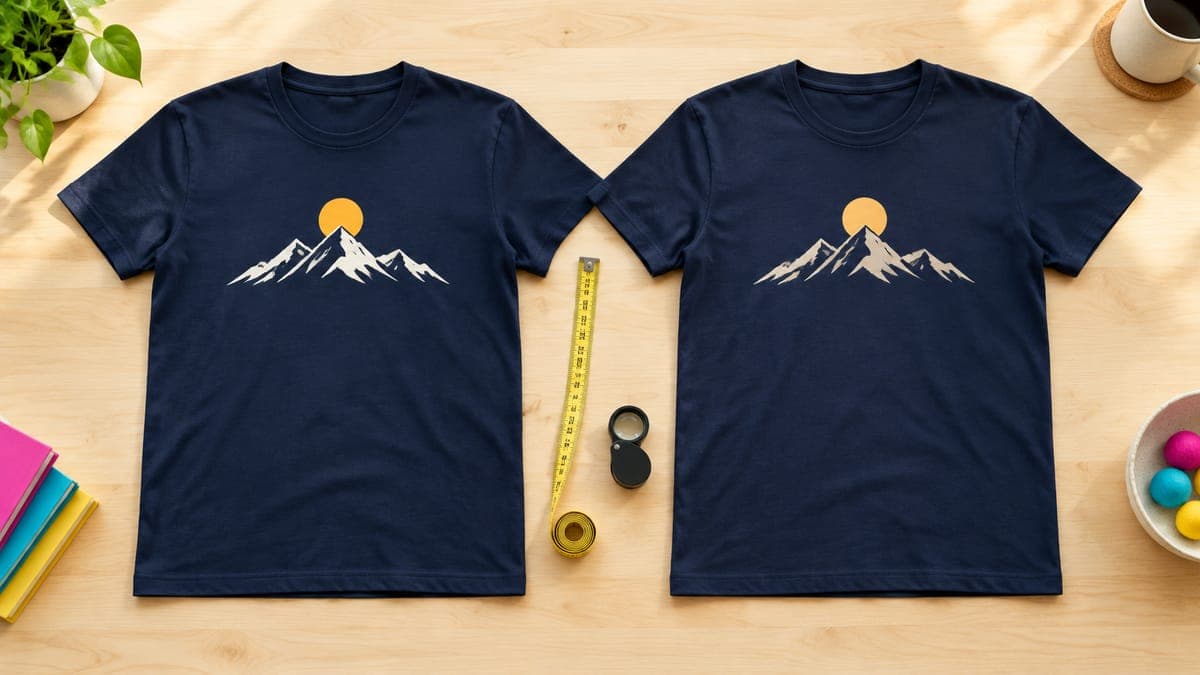
One more quality factor sits with you, not the printer. Upload artwork at the exact print-area size with a clean transparent background, or a great printer will faithfully print a blurry file. Printify lists each print area in pixels, and Printful’s print-file guidelines give both pixels and DPI, so export to those numbers exactly.
Branding: labels, inserts and packaging
Branding matters less on Etsy, where buyers remember “an Etsy shop,” than on your own website. But a small insert asking for a review, or a neck label with your shop name, can still pay for itself.
- Printful sells printed inside labels ($0.99 each) and outside labels ($2.49 each) on its apparel, plus branded packaging and inserts as paid extras. Growth takes 9% off branding.
- Printify is cheaper to start (neck labels from $0.55, inserts from $0.15) and supports gift messages. The catch: at the time of writing only a handful of partners support inserts (Dimona Tee, Monster Digital, SwiftPOD, Print Clever and Duplium), orders with inserts aren’t re-routed to other partners, and Express shipping doesn’t support inserts or neck labels.
If branded touches on every order are central to your plan, Printful is simpler. If you only want a thank-you card on your best-selling tee, check whether that product’s Printify partner supports inserts before you design one.
Etsy integration and other sales channels
Printify publishes the Etsy listing for you, with mockups, variants and prices, and imports each order. You choose when orders go to production: manually, after 1 hour, after 24 hours (the default) or once a day. Make edits in Printify rather than on Etsy, because changing synced fields on Etsy can break the link. Beyond Etsy, Printify publishes to 11 sales channels, including Shopify, WooCommerce, eBay US, TikTok Shop US and Amazon US. Our step-by-step guide to connecting Printify to Etsy covers the settings.
Printful can push new products to Etsy or link its products to listings you’ve already built on Etsy, which suits sellers who like to write listings on Etsy first. It connects to 20+ platforms and allows unlimited stores, which helps if you run several brands.
With either one, add the provider as a production partner in your Etsy settings, or listings can default to “made by” you. Our guide to adding an Etsy production partner shows the exact steps.
Support, samples and the time each one takes
Both advertise 24/7 support. The bigger day-to-day difference is how many decisions each asks of you, which matters when you only have a few evenings a week.
- Printify asks for research per product. For each new product type you compare partners on price, location and ratings once, then reuse that choice. Order samples from the same partner you’ll sell with, so the sample shows what buyers will receive.
- Printful asks for almost none. There’s no partner to choose, and samples are discounted: 20% off on the free plan and 25% on Growth, with one sample order a month of up to three items at the time of writing (more as your sales grow).
Decision matrix: which should you use?
| If this matters most… | Choose | Why |
|---|---|---|
| Lowest cost on tees, mugs and other basics | Printify | Partners compete on price, leaving more room for Etsy fees and ads |
| Consistent results without partner research | Printful | One in-house standard and a quality check on every order |
| Branded labels or inserts on every order | Printful | Branding extras across its own production; Printify’s depend on the partner |
| Several stores or brands | Printful | Unlimited stores, versus 5 (Free) or 10 (Premium) on Printify |
| Existing Etsy listings you want fulfilled | Printful | It can link its products to listings already on Etsy |
| Just starting, no sales yet | Printify | Free plan and lower costs while you learn what sells |
| Most buyers outside the US | Compare Gelato too | Local production can matter more than either of these |
A starting point, not a rule. Order samples before you commit a product line to either provider.
If international buyers are a big share of your orders, read our Printify vs Gelato comparison before deciding. And if you’re still weighing where to sell at all, our guide to the best print-on-demand sites puts providers and marketplaces side by side.
Using Printify and Printful in the same Etsy shop
You don’t have to choose forever. Each provider connects to your Etsy shop separately and manages the listings it created, so they run side by side. A setup that works for many small shops:
- Put price-sensitive basics (standard tees, mugs, stickers) on Printify, each with a partner you’ve tested.
- Put a premium line on Printful: heavier blanks, embroidery or anything with branded labels.
- Keep each listing linked to one provider, and add both as production partners on Etsy.
- Price each listing from that provider’s costs, not from a shop-wide price list.
- Export each design at the exact print-area size for each provider’s version of the product.
Step 5 is where the busywork piles up: two providers means two sets of print sizes, two product setups and two rounds of listing copy. Check what your design tool supports. POD Made Easy, for example, creates and publishes products in your own Printify shop, while for Printful it creates products in Printful’s “Manual order / API” stores and gives you exact-size print files, because Printful’s API doesn’t publish Etsy listings.
One design, sized right for every provider
POD Made Easy turns your idea into a print-ready file at the exact print-area size for the product you pick, spell-checks any text, writes your Etsy title, 13 tags and description, and creates the product in your own Printify shop at your prices. No fulfillment markup.
Start your free trialThe verdict
Start with Printify if you’re new, price-sensitive or selling mostly basics on Etsy: the lower base costs give you room to learn. Choose Printful when a product line needs consistency, branding or a premium feel that buyers will pay for. Once you sell steadily, compare Premium and Growth on your real best sellers, and re-check both catalogs every few months, because prices change.
Want the full picture on either platform? Read our Printify review and Printful review.
Frequently asked questions
- Is Printful better quality than Printify?
- Printful is usually more consistent, because it makes every order in its own facilities with a quality check. Printify’s quality depends on the print partner you choose, so a strong partner can match Printful and a weak one can’t. Order samples from both before you decide.
- Why is Printful more expensive than Printify?
- Printful prices one in-house service, while Printify lets independent partners compete on price. At the time of writing, a Bella+Canvas 3001 tee costs about $12.25 at Printful (S–XL) and about $8.80 from a low-cost Printify partner, before shipping.
- Do Printify or Printful take a cut of my Etsy sales?
- No. Both charge you for the product, printing and shipping when an order comes in, plus any optional plan you choose. Your profit is your price minus their costs and Etsy’s fees.
- Is Printful Growth free?
- It costs $24.99 a month at the time of writing, with a 14-day trial, and Printful makes it free once you reach $12,000 a year in sales. It offers up to 33% off product pricing plus discounts on branding and samples.
- Which is better for a beginner with no sales yet?
- Usually Printify. Its free plan and lower base costs leave more room for mistakes while you learn what sells. Add Printful for products where consistency or branding matters more than cost, and order samples before you promote anything.
Keep reading
More platforms & providers guides
Platforms & providers
Is Printify Premium Worth It? 2026 Break-Even Math
Is Printify Premium worth it? See the $39 or $299-a-year cost, what up to 20% off really saves per product, and a break-even table by monthly sales volume.
Sep 24, 2026 · 8 min read

Platforms & providers
How to Connect Printify to Etsy (and Fix Sync Problems)
How to connect Printify to Etsy step by step, the settings to change before you publish, what syncs and what doesn’t, and fixes for common sync problems.
Sep 24, 2026 · 11 min read
Platforms & providers
Printful Review 2026: Is the Higher Price Worth It?
Printful review for 2026: in-house quality, branding, Growth plan costs, the Etsy integration and the real price gap vs Printify, so you can decide if it pays.
Sep 24, 2026 · 9 min read